Back Economic Research

December FOMC – Hawkish-Optimistic Upgrades and Less Incentive to Cut

Published on December 18, 2024

Download the PDF Report

By

Peter Williams

December FOMC – Hawkish-Optimistic Upgrades and Less Incentive to Cut

  • To quote Chair Powell’s summary of the forecast revisions and why they see fewer cuts: “Growth is stronger… Unemployment is lower… Inflation is higher… We’re closer to the neutral rate which is another reason to be cautious… [and] uncertainty around inflation is higher.”
  • Given the forecast revisions, particularly the 30bps increase in 2025 core PCE expectations to 2.5% and the +20bps to 2.2% for 2026, the shift to only 2x cuts in 2025 and 2026 each is not obviously outright hawkish.
  • Clearly the market was unhappy with the new forecasts but just updating September’s forecasts but keeping the medium-term contours unchanged, as I and consensus largely expected, would have been exposed to greater and more likely upside risks which would have been gradually folded into the baseline anyway.
  • Not only did the baseline forecasts get revised less dovishly but the modal participant went from worrying about balanced PCE inflation and upside risks to the unemployment rate to now seeing upside risks to inflation and balanced unemployment rate risks.
  • It is worth noting that the Fed would have been aware of the solid consensus among market participants that 3x cuts in 2025 was the most likely outcome for the meeting and, a bit more speculatively on my part here, that few observers saw incorporation of hawkish tariff assumptions as likely given prior signaling from Powell and others. This suggests that there’s probably little likelihood of an immediate dovish course correction, if any doves / near-term bulls are hoping for that. Afterall, on a longer time horizon, the Fed will still see risk asset markets as supportive of growth and pricing in a fairly optimistic baseline, just a bit less so than they were at 1:59 ET.
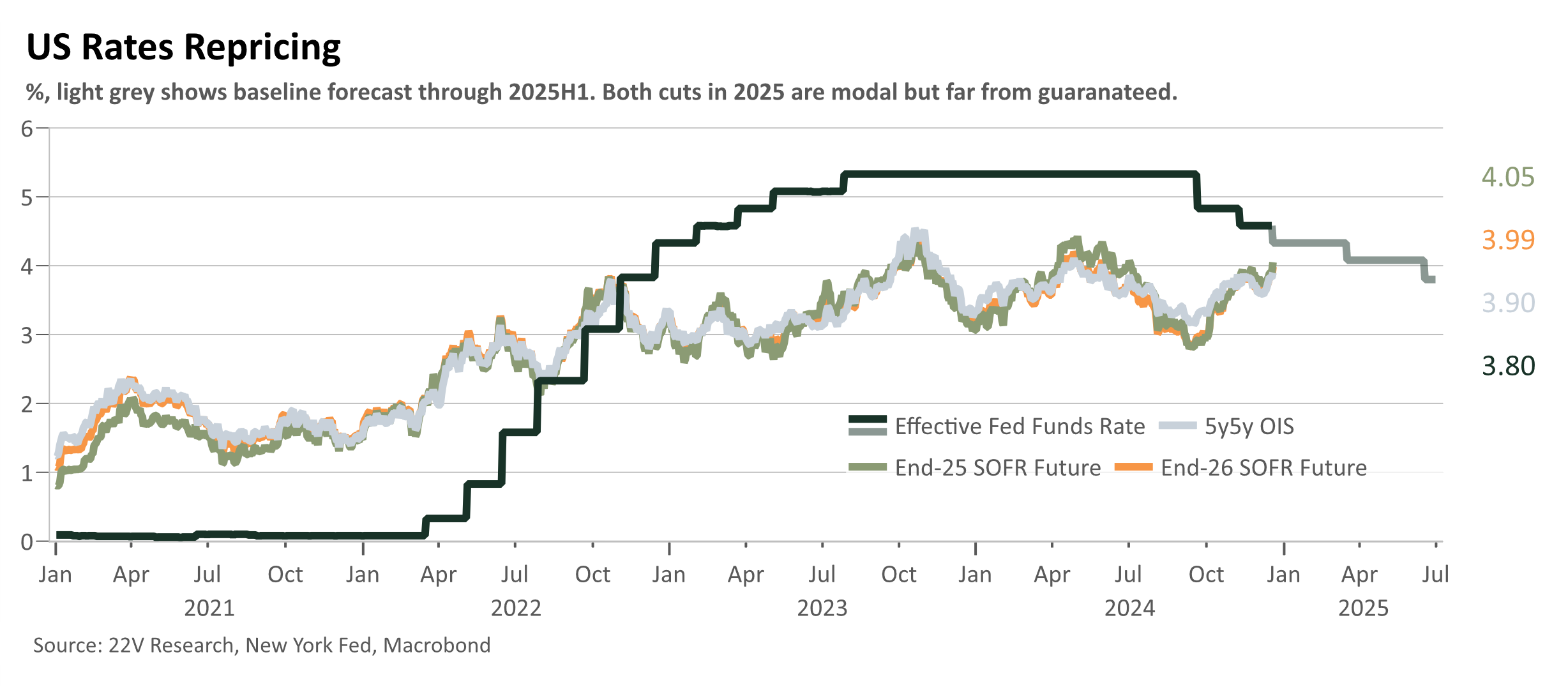
  • For now, my base case in 2025 remains that the FOMC cuts 2x more times before going on an extended pause.

The SEP and Dot Plot – Higher Rates, Inflation, and Less Concern About the Left Tail

  • The upward revisions to the inflation forecast medians and skews were the key shift inside the Summary of Economic Projections and the dot plot. In 2025 and 2026 core PCE was revised higher by 30 and 20bps, respectively, taking the forecasts to 2.5% and 2.2%.
  • In addition, the growth and unemployment rate forecasts were modestly upgraded in a truncation of left tails and a mild upgrade around the solid base case.
  • The median dots shifts’ higher were actually somewhat smaller than was most naïve Taylor rules would suggest as appropriate given the shifts in the macro forecasts. While the forecast paths naturally suggest a higher level of rates, the economist in me struggles somewhat pedantically to frame the meeting as outright hawkish given that there was minimal appreciable change in the reaction function to the forecasts and if anything it may have been a slightly dovish one.
  • Even without explicit knowledge of how widespread tariff and fiscal policy shifts were incorporated into the inflation forecasts, it is clear that the Fed’s underlying assumptions around inflation have shifted somewhat higher to show slightly more durable inflation which needs a policy offset.
  • Powell suggested that there was a wide range of choices on the part of participants with some folding in preliminary tentative policy assumptions, while others were in something closer to wait and see mode, and some didn’t say what they did. This pattern of assumptions is consistent with the upwards skew in the ‘most likely under appropriate [Fed] policy’ baseline around the 2.5% core PCE forecast for 2025. Both the overall range and the central tendency show notable upside skew around the median. That distribution of the medians is separate from the upwards skew in the risks to inflation, which were now seen as notably higher than in September (more below).
  • It is also clear that while some may make the argument that tariffs have a neutral overall inflation effect, the Fed will see them as inflationary if implemented in sufficient size and scope. There may ultimately be growth and FCI impacts which dent the medium-term inflation outlook, attenuating the first order inflation effect. For now though, while some at the Fed seem willing to incorporate hawkish tariff risks into their forecast baselines actual policy itself will only respond once
  • As the risk skew charts at the end of the SEP showed, the modal participant went from seeing balanced risks to PCE inflation and upside risks to the unemployment rate to upside risks to inflation and balanced unemployment rate risks. In my view, the labor market skew probably should have fallen by less and, given the old inflation forecast’s embedded assumption of a rapid return to roughly 2%, inflation risks should have been somewhat higher. While the base case is solid, as Powell went out of his way to emphasize many times, the upside risks to inflation and downside risks to employment suggest, correctly, that the Fed may face less palatable tensions between the two sides of its dual mandate going forward.
  • When considered as a whole, the inflation projections suggest that the FOMC had seen enough, still fairly modest in size, upside inflation surprises to be relatively less confident in the medium-term trend in inflation, barring a policy response.
  • The longer-run dot shifted higher yet again. Along with the median shift the broad distribution moved higher as well. I expect this trend will gradually continue until the large majority of them are in the much more currently plausible 3-4% range, rather than their pre-covid 2-3% range.

Powell Brings Hawkish Optimism Back to the Fore

  • One thread which seemed apparent in listening to Powell today is that there is little sense of underlying agreement on the reaction function and underlying inflationary base case.
  • The single most hawkish comment I heard today was not about 2025 or the revised inflation forecasts, which jointly seem reasonable enough, but rather Powells line that “today was a closer call but we decided it was the right decision” to cut rates. Perhaps that reads a bit more dramatically than he intended it to be, or is an implicit acknowledgement of Hammack’s dissent and the three others who’s dots showed no cut today, but it stuck out to me at the time given that neither he nor other members of the Fed’s core leadership had really suggested that December was up in the air.
  • The Fed’s habit of assuming that inflation is maybe noisy in the recent past and very near-term but quite well-behaved over the medium-term seems to have been largely jettisoned, or at least substantially attenuated. “Once again, we’ve had a year-end projection for inflation and it’s kind of fallen apart as we got to the end of the year.”
  • Powell noted that “we always try to be careful in throwing out the numbers we don’t like…. We have a long string now of inflation coming down.” (I would quibble some with the accuracy of the statement and the Fed’s frequent willingness to look through the upside skew in much of the monthly inflation data, even as the modal inflation print has been moving down) This tension between the recent upside surprises in the September and October data and the faith, which I guess ultimately the Fed will have to enforce, that inflation will return towards roughly 2% was apparent at a number of occasions during todays press conference.
  • His framing of 2025’s new 2.5% core PCE forecast was notably optimistic, saying it would represent “tremendous progress” relative to where inflation has been. While certainly true in some sense, this framing suggests that Powell and some others may be becoming more explicitly willing to non-hawkishly tolerate inflation in the bouncy mid-2s if the labor market isn’t reaccelerating.
  • It has been one of the notable themes for some time that the Fed no longer sees the labor market as a key contributor to inflation. Given that they assume that either inflation expectations are, or they can force them to be, well anchored this removes most inflationary problems from the medium-term.
  • On growth, Powell noted he’s “very optimistic about the economy all around… I expect another good year next year.”
  • Powell sounded notably less concerned about downside labor market tails than he did in September, and since then has seen slowly fading recessionary odds. “The downsides clearly appeared to have diminished… It is still cooling gradually and in an orderly way.”
  • He was quite clear though in acknowledging that the labor market “is still cooling gradually and in an orderly way” and payroll growth, while still notably positive, is running slow enough that it will impart an upward bias of a 1/10th or so every few months to the unemployment rate. Implicitly, slower labor supply growth or faster hiring will eventually stabilize labor slack but that will take some time to happen. Still, the Fed seems minimally concerned by gradual linear easing in labor slack so long as hiring remains positive and layoffs are low.
  • The expected slowdown in the pace of rate cuts, is appropriate given that “we’re 100bps closer to neutral,” whatever that current neutral rate might be.
  • When asked about the possibility that the Fed ultimately ends up hiking rates next year, Powell was quite dismissive. Saying, “you don’t rule things completely in or out in this world. [But] that doesn’t appear to be likely.”

DISCLOSURES AND DISCLAIMERS

Analyst Certification

The analyst, 22V Research Group, primarily responsible for the preparation of this research report attests to the following: (1) that the views and opinions rendered in this research report reflect his or her personal views about the subject companies or issuers; and (2) that no part of the research analyst’s compensation was, is, or will be directly related to the specific recommendations or views in this research report.

Analyst Certifications and Independence of Research.

Each of the 22V Research analysts whose names appear on the front page of this report hereby certify that all the views expressed in this Report accurately reflect our personal views about any and all of the subject securities or issuers and that no part of our compensation was, is, or will be, directly or indirectly, related to the specific recommendations or views of in this Report.

22V Research (the “Company”) is an independent research provider. The Company is not a member of the FINRA or the SIPC and is not a registered broker dealer or investment adviser. 22V Research has no other regulated or unregulated business activities which conflict with its provision of independent research.

22V Research, LLC is a professional services and independent publication organization. 22V Research, LLC is not a securities broker-dealer, not a member of the Financial Industry Regulatory Authority (FINRA), not a registered investment advisor (RIA) and not a member of SIPC.

Securities transactions, when offered, are offered by 22V Securities, LLC through LPS Capital, LLC. Certain employees of 22V Securities, LLC are dually registered as securities representatives of LPS Capital, LLC or Analyst Hub Securities, LLC. 22V Securities, LPS Capital and Analyst Hub Securities are members FINRA, SIPC.

https://brokercheck.finra.org/

Current Ratings Definition.

SECTOR OUTPERFORM: An “outperform” rating anticipates the company will outperform the S&P Regional Banking Index (peer group).

SECTOR PERFORM: A “market perform” rating anticipates the company will perform in line with the S&P Regional Banking Index (peer group).

SECTOR UNDERPERFORM: An “underperform” rating anticipates the company will underperform the S&P Regional Banking Index (peer group).

Limitation Of Research And Information.

This Report has been prepared for distribution to only qualified institutional or professional clients of 22V Research Group. The contents of this Report represent the views, opinions, and analyses of its authors. The information contained herein does not constitute financial, legal, tax or any other advice. All third-party data presented herein were obtained from publicly available sources which are believed to be reliable; however, the Company makes no warranty, express or implied, concerning the accuracy or completeness of such information. In no event shall the Company be responsible or liable for the correctness of, or update to, any such material or for any damage or lost opportunities resulting from use of this data. Nothing contained in this Report or any distribution by the Company should be construed as any offer to sell, or any solicitation of an offer to buy, any security or investment. Any research or other material received should not be construed as individualized investment advice. Investment decisions should be made as part of an overall portfolio strategy and you should consult with a professional financial advisor, legal and tax advisor prior to making any investment decision. 22V Research Group shall not be liable for any direct or indirect, incidental or consequential loss or damage (including loss of profits, revenue or goodwill) arising from any investment decisions based on information or research obtained from 22V Research Group.

Reproduction And Distribution Strictly Prohibited.

No user of this Report may reproduce, modify, copy, distribute, sell, resell, transmit, transfer, license, assign or publish the Report itself or any information contained therein. Notwithstanding the foregoing, clients with access to working models are permitted to alter or modify the information contained therein, provided that it is solely for such client’s own use. This Report is not intended to be available or distributed for any purpose that would be deemed unlawful or otherwise prohibited by any local, state, national or international laws or regulations or would otherwise subject the Company to registration or regulation of any kind within such jurisdiction.

Copyrights, Trademarks, Intellectual Property.

22V Research Group, and any logos or marks included in this Report are proprietary materials. The use of such terms and logos and marks without the express written consent of 22V Research Group is strictly prohibited. The copyright in the pages or in the screens of the Report, and in the information and material therein, is proprietary material owned by 22V Research Group unless otherwise indicated. The unauthorized use of any material on this Report may violate numerous statutes, regulations and laws, including, but not limited to, copyright, trademark, trade secret or patent laws.