Back Economics

Specter of scary arrow haunts the Fed

Published on December 16, 2024

Download the PDF Report

By

Gerard MacDonell

Clients have sent over a piece from a buy-side economist arguing that inflation is reaccelerating and that the Fed may have to reverse its rate cutting program in response.  With financial conditions seemingly quite accommodative and with the real-side data flow strong, I would not be inclined to fight the idea that medium-term rates risk is tilted to the upside, particularly given that the tariff issue has not gone away. 


However, the inflation news most recently has been more benign than my colleague characterizes, in part because he places far too much emphasis on CPI-based measures of underlying inflation, which are basically irrelevant.  The Fed will ease on Wednesday, probably hint that the timing and speed of future rate cuts is more data dependent, and yet probably also continue to imply that further rate cuts are in store.  The recent inflation news greenlights this approach.  The uncertainties here relate to the strength of the economy, financial conditions, and to the tariff issue. 

Fed must confront arrow in the data


Source: Bloomberg, Federal Reserve Bank of New York
NY Fed data are actual to November. University of Michigan data are actual to the December preliminary. 

In this note, though, I want to get into an admittedly secondary aspect of the hawkish argument, not because it is particularly important, but more because I have a differentiated take on it.  Note in the chart above two prominent measures of inflation expectations in the real economy, as opposed to financial markets, assessing things at both the short-term and medium- to longer-term horizon.  My colleague is concerned by the fact that the 5- to 10-year inflation expectation in the Michigan Survey looks to be about 10 basis points higher than it has tended to be during the most recent period of steep inflation.  He may have unnerved himself by putting a swoosh arrow under the time series to indicate that he already knows it will be higher in the future.  Just don’t do that. 


The value in telling the data what to do through chart annotation aside, I would just point out that the Fed cannot actually do anything about the 5- to 10-year inflation expectation, particularly if that is pushed higher by concerns that there may  be a politically-driven regime change in the conduct of monetary policy. Trump may or may not neuter the Fed, but raising interest rates now to deliver lower inflation in two years will have zero effect on where inflation might be 5 to 10 years from now. 


Closely related, you may recall from a paper that circulated a couple years ago senior-Fed staffer Jeremy Rudd arguing that even within the so-called “canonical” model, of which Rudd is skeptical in part because of the prominence it assigns to inflation expectations, it is the short-run inflation expectation that would presumably be relevant to policy.  I share his view on this, taking it as bloody obvious, at least within that standard model.  Here is the relevant passage from page 6:
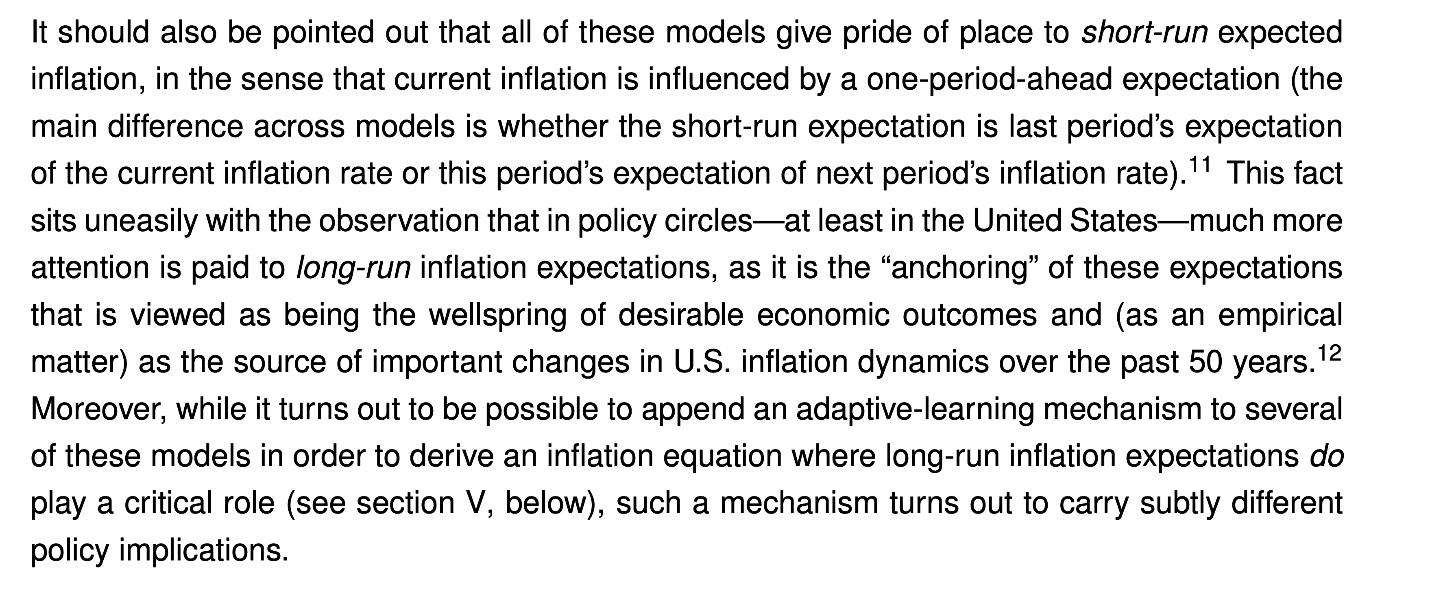

Source: Federal Reserve as linked above, page 6

So, then, why do Fed officials so frequently refer to the long-run inflation expectation? I confess that this is a bit of a mystery to me and that I must speculate in a way that involves reading motives, which I realize can be irksome.  It is possible that longer-term inflation expectations, as picked up possibly in, say, the Michigan survey, might be interpreted as an indication of how Americans assess the moral rectitude of even incumbent monetary policy makers.  The one-year inflation expectation might be dismissed as reflecting a bygone, possibly delivered by a shock. But the longer-term inflation expectation is clearly a comment on policy, perhaps interpreted as today’s policy makers. If we don’t trust them, then that number will go higher, which might hurt their feelings. That may sound like a stretch, but to me it is the least bad explanation.


Either way, though, there is little that a central banker can do about the risk of regime change.  Perhaps the only thing they can really do is deliver the right policy to make the economy turn out well enough. And that does not likely involve reacting to the University of Michigan’s 5- to 10-year inflation expectation, although I doubt the Fed would ever say this. It would sound defeatist, as if they were casting blame, even if fairly.  

Let me conclude with a caveat that actually reinforces the main point here.  The argument above takes it as given that the Michigan Survey being 10 bps above recent normal is actually picking up something real. Market based measures of forward inflation expectations strongly reject that assumption. But I thought it might be fun to argue in the subjunctive. Even if it were true…


DISCLOSURES AND DISCLAIMERS

Analyst Certification

The analyst, 22V Research Group, primarily responsible for the preparation of this research report attests to the following: (1) that the views and opinions rendered in this research report reflect his or her personal views about the subject companies or issuers; and (2) that no part of the research analyst’s compensation was, is, or will be directly related to the specific recommendations or views in this research report.

Analyst Certifications and Independence of Research.

Each of the 22V Research analysts whose names appear on the front page of this report hereby certify that all the views expressed in this Report accurately reflect our personal views about any and all of the subject securities or issuers and that no part of our compensation was, is, or will be, directly or indirectly, related to the specific recommendations or views of in this Report.

22V Research (the “Company”) is an independent research provider. The Company is not a member of the FINRA or the SIPC and is not a registered broker dealer or investment adviser. 22V Research has no other regulated or unregulated business activities which conflict with its provision of independent research.

22V Research, LLC is a professional services and independent publication organization. 22V Research, LLC is not a securities broker-dealer, not a member of the Financial Industry Regulatory Authority (FINRA), not a registered investment advisor (RIA) and not a member of SIPC.

Securities transactions, when offered, are offered by 22V Securities, LLC through LPS Capital, LLC. Certain employees of 22V Securities, LLC are dually registered as securities representatives of LPS Capital, LLC or Analyst Hub Securities, LLC. 22V Securities, LPS Capital and Analyst Hub Securities are members FINRA, SIPC.

https://brokercheck.finra.org/

Current Ratings Definition.

SECTOR OUTPERFORM: An “outperform” rating anticipates the company will outperform the S&P Regional Banking Index (peer group).

SECTOR PERFORM: A “market perform” rating anticipates the company will perform in line with the S&P Regional Banking Index (peer group).

SECTOR UNDERPERFORM: An “underperform” rating anticipates the company will underperform the S&P Regional Banking Index (peer group).

Limitation Of Research And Information.

This Report has been prepared for distribution to only qualified institutional or professional clients of 22V Research Group. The contents of this Report represent the views, opinions, and analyses of its authors. The information contained herein does not constitute financial, legal, tax or any other advice. All third-party data presented herein were obtained from publicly available sources which are believed to be reliable; however, the Company makes no warranty, express or implied, concerning the accuracy or completeness of such information. In no event shall the Company be responsible or liable for the correctness of, or update to, any such material or for any damage or lost opportunities resulting from use of this data. Nothing contained in this Report or any distribution by the Company should be construed as any offer to sell, or any solicitation of an offer to buy, any security or investment. Any research or other material received should not be construed as individualized investment advice. Investment decisions should be made as part of an overall portfolio strategy and you should consult with a professional financial advisor, legal and tax advisor prior to making any investment decision. 22V Research Group shall not be liable for any direct or indirect, incidental or consequential loss or damage (including loss of profits, revenue or goodwill) arising from any investment decisions based on information or research obtained from 22V Research Group.

Reproduction And Distribution Strictly Prohibited.

No user of this Report may reproduce, modify, copy, distribute, sell, resell, transmit, transfer, license, assign or publish the Report itself or any information contained therein. Notwithstanding the foregoing, clients with access to working models are permitted to alter or modify the information contained therein, provided that it is solely for such client’s own use. This Report is not intended to be available or distributed for any purpose that would be deemed unlawful or otherwise prohibited by any local, state, national or international laws or regulations or would otherwise subject the Company to registration or regulation of any kind within such jurisdiction.

Copyrights, Trademarks, Intellectual Property.

22V Research Group, and any logos or marks included in this Report are proprietary materials. The use of such terms and logos and marks without the express written consent of 22V Research Group is strictly prohibited. The copyright in the pages or in the screens of the Report, and in the information and material therein, is proprietary material owned by 22V Research Group unless otherwise indicated. The unauthorized use of any material on this Report may violate numerous statutes, regulations and laws, including, but not limited to, copyright, trademark, trade secret or patent laws.