Back Economic Research

November CPI Doesn’t Get in the Way of a December Cut

Published on December 11, 2024

Download the PDF Report

By

Peter Williams

November CPI Doesn’t Get in the Way of a December Cut

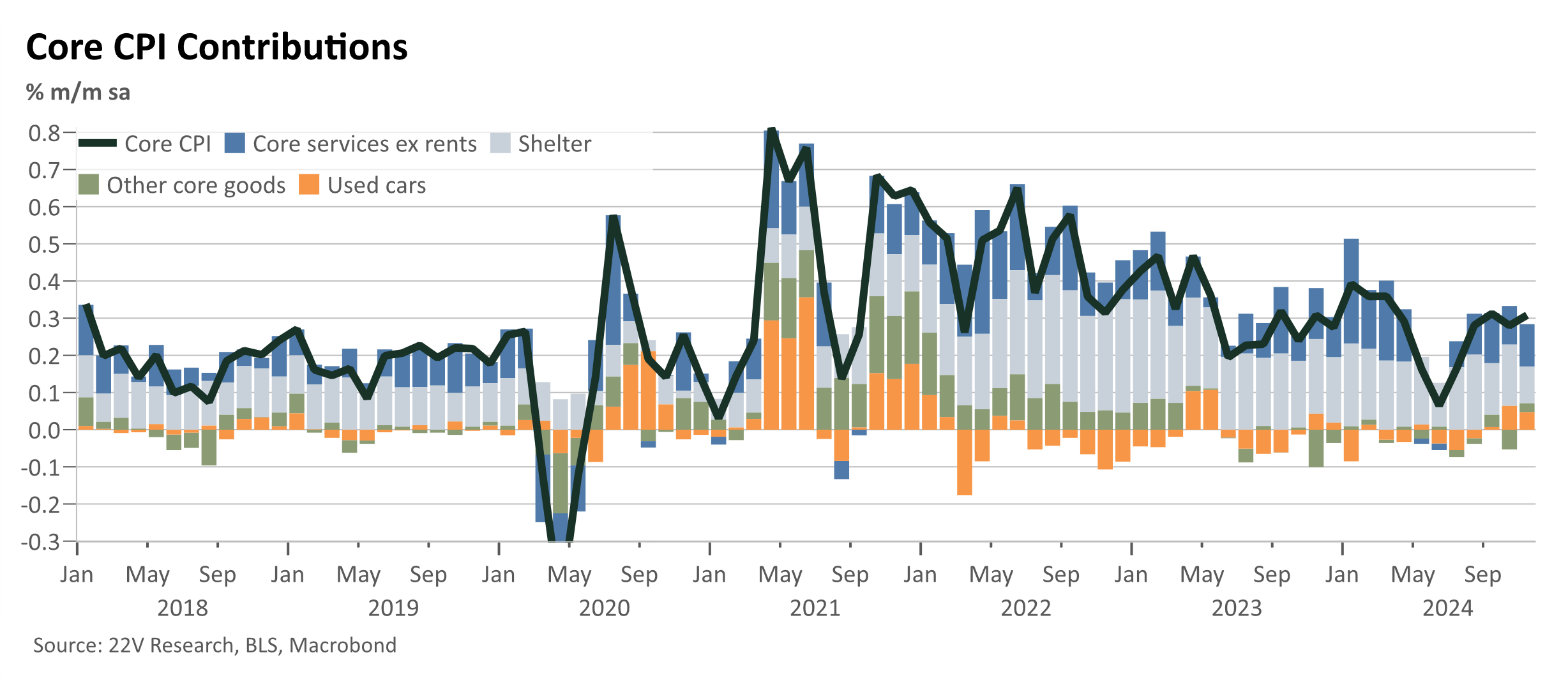
  • Core CPI came in just a bit above consensus (0.31% m/m sa vs 0.27% consensus) but this is far from hot enough to derail a December cut given pre-meeting messaging.
  • The Fed will be upgrading its 2024 inflation forecasts next week as a result of the string of moderately too hot inflation prints over the last 3-4 months. But these prints have not been hot enough to dissuade the Fed from its initial round of cuts, where it is paying back the hawkish insurance it took out in 2022-23 and getting to a “more neutral” stance.
  • The detailed message is a bit mixed. Rents and OER both took notable steps down to post-reopening m/m lows, autos pricing looks to be bouncing a bit, core goods ex autos were on the hot side this month and looking to be losing their deflationary pull, core services ex housing was steady but at a somewhat too hot level (34bps, hotels were an upside source of noise here). The careful slicing and dicing matters, but Fed still needs to see progress continuing in a fairly obvious, and not hyper-exclusionary, way.
  • This data seems consistent with my view that underlying inflation looks to be more like 2.5% than 2%. While some inflation expectations measures are fairly close to target-consistent levels that is not universal, nominal wage growth is running a bit hot, and the inflation data itself has shown an upside skew and slowing pace in its gradual descent.
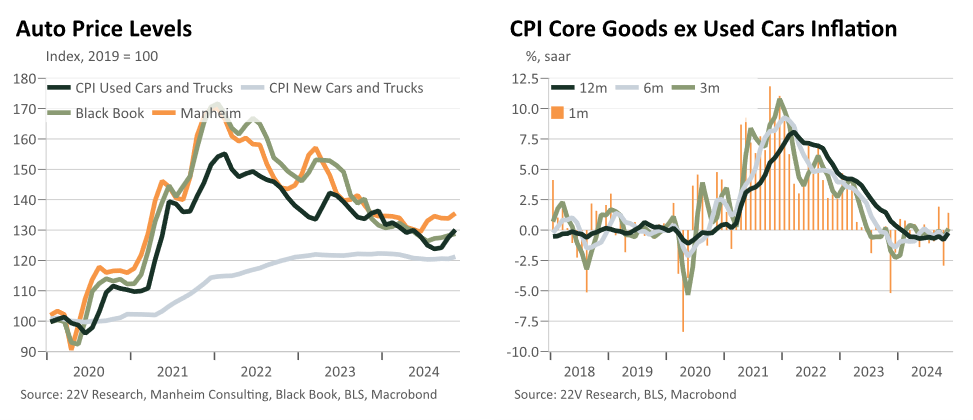
After a fairly steady decline, used auto prices have bounced some over the past few months. This may reflect robust demand conditions or simply a capitulation on the part of consumers at now much more reasonable seeming, if still well above pre-covid, price levels. New autos pricing has also been roughly flat for a year.

Core goods ex autos seems to be losing some of its disinflationary impulse. The prior two-months had seen quite odd m/m volatility, which continued into November, but the broader trend suggests that main deflationary move in this sector seems to be done. The question now is whether core goods ex autos would naturally stabilize with the sort of quite mild outright deflation seen pre-covid or if the trend might have shifted just a bit higher.

For all of core goods, potential tariffs could substantially directly alter the near-term inflation trajectory if implemented. The threat of possible tariffs could result in pull-forward demand and possible opportunistic price hikes which attenuate the one-off impact of tariffs and shift the timing of the inflationary impact but likely do little to shift the total magnitude of the price-level shock from tariffs, assuming the realized policy is fairly close to expectations.
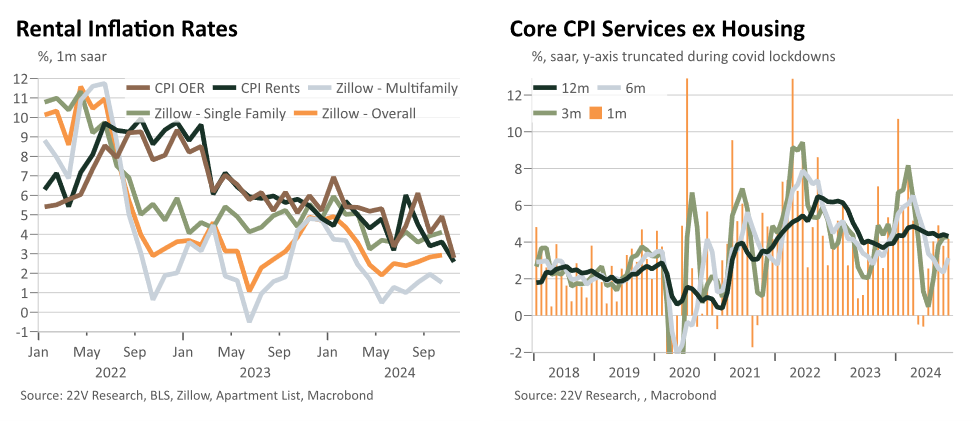
OER and rent of primary residence (CPI rents from here on out) both hit post-reopening lows in this month’s data, rounding to 0.2% m/m sa. The noisy, and much longer coming than widely expected, disinflationary push here seems to be resuming some of its largely inevitable downward trajectory. But this month’s print was actually soft enough that it takes CPI rents close to current marginal rent data and very simplistic models based off of lagged marginal rents suggest that there not be all that much room for CPI rents to fall from here. In single family, there remains some price level catchup for whole-economy rents as marginal rent growth there has seen greater total cumulative growth, and is still much more affordable than purchasing, and remains stronger in a spot sense. In multifamily, whole economy CPI rents appear to have caught up with marginal rents suggesting that, monthly noise aside, there should be relatively little remaining inflationary push there.

In the end, rent growth on the margin, and thus eventually in the CPI data, will be driven by the balance between supply-demand. Supply of MF is starting to roll off after its post-covid surge and in single family housing (usually not built for rental but the aggregate supply still matters) it remains around a pre-covid pace. There may be some supply-driven medium-term catch down in MF, but so long as the labor market remains robust and home purchases remain expensive, my imprecise medium-term baseline will be that rents will grow roughly inline with wages on the margin, as happened pre-covid.

Core services ex housing (specifically excluding CPI rents and OER but including hotels, which parts of housing are excluded can matter quite a lot) grew at a roughly 4% m/m saar pace again. The impact of one offs (hotels contributed 5bps to overall core this month) noted, the broader recent trend, since May and June’s anomalously low prints which were likely partial payback from the hot start to the year and so need to be taken together with them, suggests that while volatility remains elevated, the trend looks to be notably above pre-covid. How much more elevated is a more challenging question and, especially taking into account the better PCE tends than CPI recently, it may not be hot enough to make the Fed outright hawkish again even if sustained.
DISCLOSURES AND DISCLAIMERS

Analyst Certification

The analyst, 22V Research Group, primarily responsible for the preparation of this research report attests to the following: (1) that the views and opinions rendered in this research report reflect his or her personal views about the subject companies or issuers; and (2) that no part of the research analyst’s compensation was, is, or will be directly related to the specific recommendations or views in this research report.

Analyst Certifications and Independence of Research.

Each of the 22V Research analysts whose names appear on the front page of this report hereby certify that all the views expressed in this Report accurately reflect our personal views about any and all of the subject securities or issuers and that no part of our compensation was, is, or will be, directly or indirectly, related to the specific recommendations or views of in this Report.

22V Research (the “Company”) is an independent research provider. The Company is not a member of the FINRA or the SIPC and is not a registered broker dealer or investment adviser. 22V Research has no other regulated or unregulated business activities which conflict with its provision of independent research.

22V Research, LLC is a professional services and independent publication organization. 22V Research, LLC is not a securities broker-dealer, not a member of the Financial Industry Regulatory Authority (FINRA), not a registered investment advisor (RIA) and not a member of SIPC.

Securities transactions, when offered, are offered by 22V Securities, LLC through LPS Capital, LLC. Certain employees of 22V Securities, LLC are dually registered as securities representatives of LPS Capital, LLC or Analyst Hub Securities, LLC. 22V Securities, LPS Capital and Analyst Hub Securities are members FINRA, SIPC.

https://brokercheck.finra.org/

Current Ratings Definition.

SECTOR OUTPERFORM: An “outperform” rating anticipates the company will outperform the S&P Regional Banking Index (peer group).

SECTOR PERFORM: A “market perform” rating anticipates the company will perform in line with the S&P Regional Banking Index (peer group).

SECTOR UNDERPERFORM: An “underperform” rating anticipates the company will underperform the S&P Regional Banking Index (peer group).

Limitation Of Research And Information.

This Report has been prepared for distribution to only qualified institutional or professional clients of 22V Research Group. The contents of this Report represent the views, opinions, and analyses of its authors. The information contained herein does not constitute financial, legal, tax or any other advice. All third-party data presented herein were obtained from publicly available sources which are believed to be reliable; however, the Company makes no warranty, express or implied, concerning the accuracy or completeness of such information. In no event shall the Company be responsible or liable for the correctness of, or update to, any such material or for any damage or lost opportunities resulting from use of this data. Nothing contained in this Report or any distribution by the Company should be construed as any offer to sell, or any solicitation of an offer to buy, any security or investment. Any research or other material received should not be construed as individualized investment advice. Investment decisions should be made as part of an overall portfolio strategy and you should consult with a professional financial advisor, legal and tax advisor prior to making any investment decision. 22V Research Group shall not be liable for any direct or indirect, incidental or consequential loss or damage (including loss of profits, revenue or goodwill) arising from any investment decisions based on information or research obtained from 22V Research Group.

Reproduction And Distribution Strictly Prohibited.

No user of this Report may reproduce, modify, copy, distribute, sell, resell, transmit, transfer, license, assign or publish the Report itself or any information contained therein. Notwithstanding the foregoing, clients with access to working models are permitted to alter or modify the information contained therein, provided that it is solely for such client’s own use. This Report is not intended to be available or distributed for any purpose that would be deemed unlawful or otherwise prohibited by any local, state, national or international laws or regulations or would otherwise subject the Company to registration or regulation of any kind within such jurisdiction.

Copyrights, Trademarks, Intellectual Property.

22V Research Group, and any logos or marks included in this Report are proprietary materials. The use of such terms and logos and marks without the express written consent of 22V Research Group is strictly prohibited. The copyright in the pages or in the screens of the Report, and in the information and material therein, is proprietary material owned by 22V Research Group unless otherwise indicated. The unauthorized use of any material on this Report may violate numerous statutes, regulations and laws, including, but not limited to, copyright, trademark, trade secret or patent laws.
