November Employment Report Has an NFP Beat but the Gradual Easing in Slack Seems to Be Continuing
- The November employment report further raises odds of a December cut but does relatively little else to change the broader cyclical picture.
- The household survey lines up with other data suggesting that while relatively few workers are getting laid off, if you have been laid off or (re)entered the labor force it is a challenging time to find work.
- The move up in the unemployment rate almost took it back to the cycle highs of July (4.246 vs 4.253%) and, more concerningly, the prime-age employment-to-population ratio has fallen to 80.4% from its cycle high of 80.9% in July-Sep. We did see a similar decline in PAEPOP over the back half of last year, and this is what I’ll be watching most closely over the next few releases.
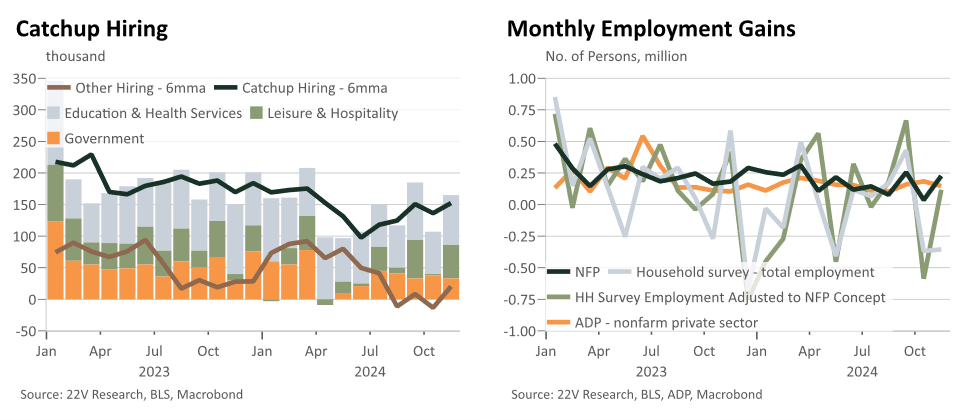
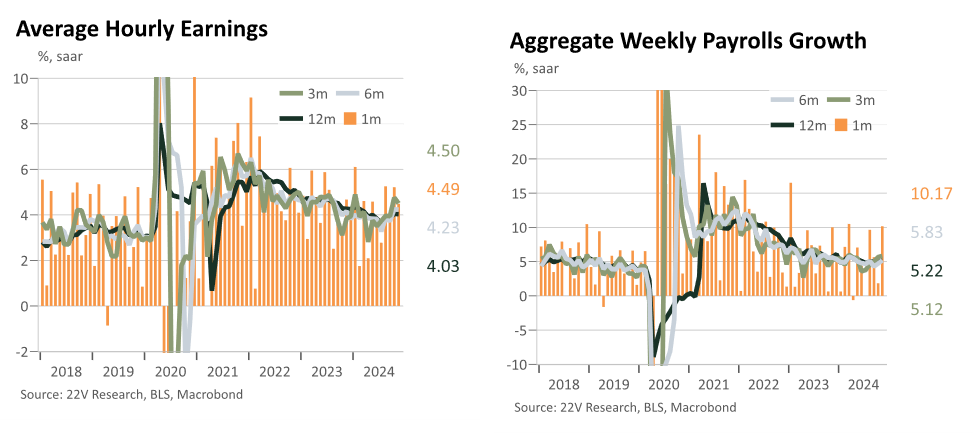
- Nonfarm payroll gains of +227k and +56k of revisions leave NFP telling a mildly positive story on the margin. Catchup hiring in government, education and healthcare, and leisure and hospitality continues to remain the dominant driver of net payroll growth.
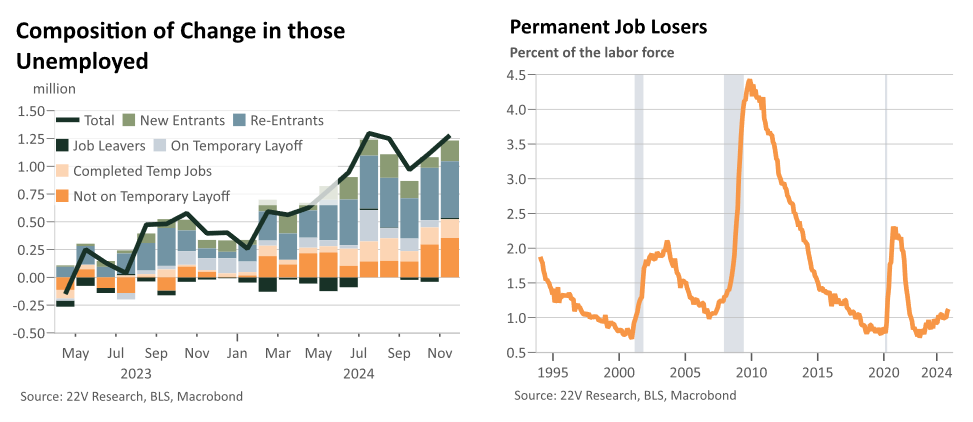
- The steadying of average hourly earnings growth at a 4-4.5% pace (1, 3, and 6m saars are all around 4.5% vs the 12m at 4.0%; production and non-supervisory trend is a bit closer to 4% across horizons) is probably slightly too hot for the Fed but is also a key support to forward demand. Given so many confounding factors, realized inflation data matters most here.
Household Survey Tells A Less Optimistic Story
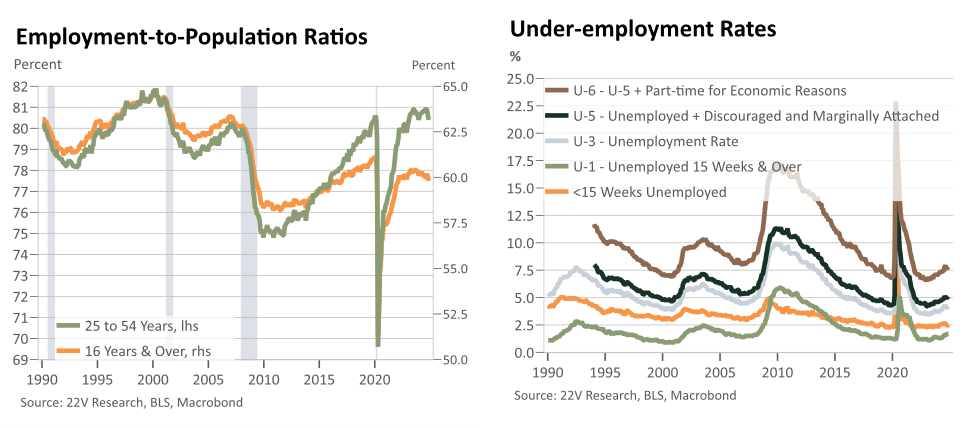
The household survey’s increased unemployment rate suggests that while the Fed’s forecasts from the September SEP are still unlikely to realized for 2024, and probably beyond that in the base case, the general trend of a still gradually easing labor market seems to be continuing apace. This is a function of a sluggish hiring in cyclical industries, which makes job searches more challenging, and the surge in immigration and domestic labor supply, both of which seem to be tapering off slightly. In Nov (re)entrants and the share of workers on permanent layoff both saw increases.
While the headline unemployment rate has almost tied its summer high, there are a few more concerning underlying trends worth highlighting now that weren’t present then. Given that sluggish hiring, quite robust growth, low layoff, and supply-driven easing in slack, file these concerns more under ‘things to watch’ than a sign of looming disaster. Unlike in the summer, the share of workers who are unemployed on permanent layoff has been grinding higher over the past few months; the jobless claims data are consistent with a very steady but gradual easing in this measure over the past few months (will carefully watch how they evolve over the course of Dec-Jan). Second, the prime-age employment-to-population ratio has ticked down 0.5p.p. since it re-hit its cycle high of 80.9% from July-Sept. This is my single favorite measure from the household survey and was quite reassuring during the summer move higher in the unemployment rate.
There are some other counter-vailing trends which are worth noting. The share of workers who are part-time for economic reasons has ticked down the past few months and is now at its lowest level since June. The quits rate has also ticked up, in a tentative sign worker are finding better job switching conditions.
It is important to note that while the broad trend towards labor market easing remains in place, there seems to be less cause for concern about immediate risks of a rapid deterioration at the moment given how it was arrested over the fall for a time, the continued strength of overall activity and mild rebound in some measures of firm sentiment, minimal layoff stories, and financial and credit conditions which are swinging towards being a mil d-t o-moderate support for growth.
Employer Survey a Mixed Bag but One Consistent with Robust Nominal Growth
NFP gains mildly surprised on the upside with +227k in November and +56k of two-month revisions. The recent trends there continue to suggest that the pace of hiring is slowing moderately as supply gains (and the demand they endogenously create) taper off and cyclical hiring is largely in wait-and-see mode. Catchup hiring in government, education and healthcare, and leisure and hospitality continues to remain the dominant driver of net payroll growth. If, or as, this trend slows further it raises some overall cyclical concerns but for now its level is serving as an important buffer when cyclical payroll growth is growing quite sluggishly.
The steadying of average hourly earnings growth at a 4-4.5% pace (1, 3, and 6m saars are all around 4.5% vs the 12m at 4.0%; production and non-supervisory trend is a bit closer to 4% across horizons) is probably slightly too hot for the Fed but is also a key support to forward demand.
While I doubt any model would say this is strictly true, one possible implication of the recent flattening out in the wage growth and inflation data is that the equilibrium unemployment rate may be somewhat higher than currently thought. Of course, productivity trends and the very long-lived impacts on other prices of the main shocks in 2020-22 are also playing notable roles at the moment, making disentangling any of the stars challenging. With slack measures generally continuing to ease gradually and productivity growth looking healthy the forward-looking implication is mixed, but not obvious disinflationary, and puts more weight on inflation data in judging nominal trends.
The robustness of nominal income growth is a key support for forward-looking demand and leans against some possible recessionary concerns that one could draw from the household survey. On net, we’re left in largely the same position: growth remains strong, supply-side gains have been solid, slack is gradually easing, and what trend inflation is settling into remains unclear.