A Few Concerns Worth Watching in the Labor Market
- As someone who has been fairly relentlessly optimistic on the US economy since joining 22V in August 2023, it seems important to take the time to flag some more subtle areas of concern in the US labor market.
- My base case remains that we continue to see above potential growth and inflation which bounces around above 2% (2.25-2.5% trend) with the Fed cutting 2-3x more times by June 2025 before going on an extended pause, which possibly culminates in eventual hikes.
- This baseline hawkish optimism is built on the back of fading pre-recessionary headwinds from 2023-24 but some trends which have been supportive of growth over that same time are moving into a less helpful place.
- This isn’t to say that I secretly think a recession is around the corner but rather that it seems worth flagging that some of these developments which seem to be getting better less quickly than I’d have hoped for, are a potential area of concern if currently fine, or are continuing to soften (these are separate from the broad trends seen in the sluggish hires and fires rates and gradual, although possibly arrested, move higher in the unemployment rate and the ever looming risk that inflation trends too high and we get the rate-induced recession consensus spent most of ~2023 waiting for).
- These four things to watch for are: the slowdown in catchup hiring which is reducing trend pace of NFP growth, the continued stagnation in white collar hiring, potential for infrastructure and commercial/multi-family construction layoffs, and possible lagged layoffs from a failure of a rebound in demand to be realized after an anomalously long period of soft-but-not-awful growth in manufacturing.
Catchup Hiring Is Slowing
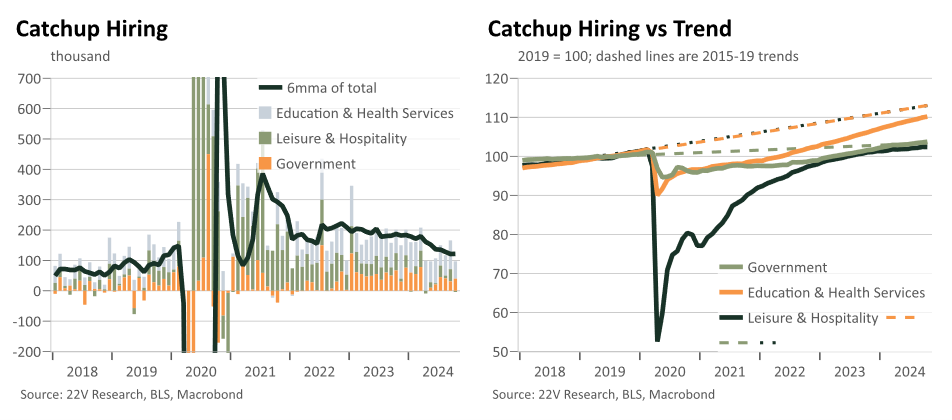
Hiring in government, education and healthcare, and leisure and hospitality has seen substantial catchup effects which have helped set a somewhat acyclical floor under overall hiring since early-2022. The reasons for the catchup are different across the three sectors (a respective guesses slow HR processes and wage growth; secular trends and pandemic dislocations; and the slow pace of rehiring since-2021 after the massive layoff rounds in spring-2020). For much of 2022-23 catchup hiring in these sectors was running fairly steadily around 200k a month; on net these sectors saw relatively small downward preliminary benchmark revisions in August suggesting that while the beginning of the deceleration may have taken place a bit earlier the broad trend remains in place.
This catch-up hiring was one of the essential tailwinds which kept the broadly pre-recessionary environment from late-22 into early-24 from spiraling into an outright recession. This provided aggregate activity and hiring with a buffer allowed hiring to slow and the labor market to gradually rebalance without rolling over. There remain substantial gaps relative to pre-covid trends in leisure and hospitality and, to a lesser extent, in education and healthcare. In recent months, education and healthcare hiring has continued apace while L&H has slowed notably suggesting that a new equilibrium might have been reached in the sector.
My concern here is that the net slowdowns in these sectors remove an important source of less cyclically sensitive hiring and thus future consumer spending growth. This reduces the buffers for a smaller demand or FCI shock which could then more easily move into negative aggregate growth which seems more traditional, if still quite mild, recessionary dynamics emerging.
White Collar Hiring is and has Been Anemic
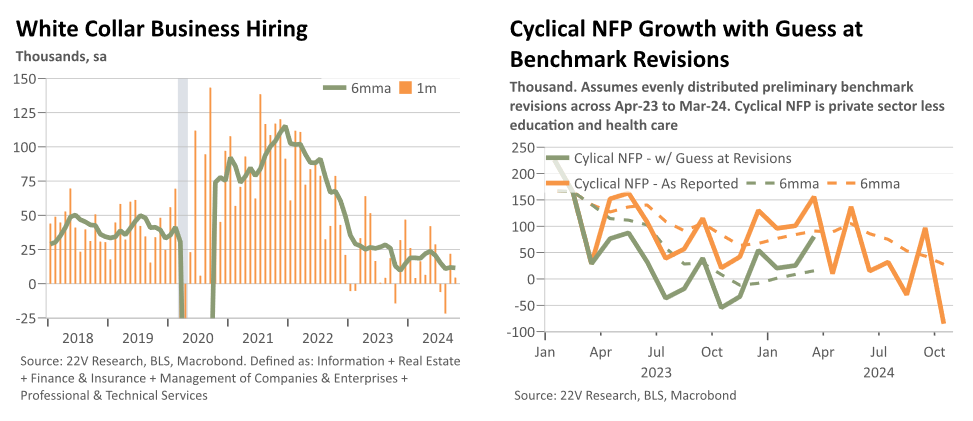
Not surprisingly given trends headlines over the past 2y but white collar hiring has been remarkably anemic in the US since late-2022. Starting with the megacap tech layoffs in 2022Q4, there was a sudden deceleration in the currently as reported pace of white collar hiring in the NFP data. Since this drop downwards there’s has been a more gradual deceleration in white collar hiring from a sluggish to very slow pace. These trends may be somewhat different than underlying reality though as the topline sectoral preliminary benchmark revisions in August suggested cyclical hiring (private sector less education and health care) was negative at least a few different points in summer and fall 2023, with possibly a mild rebound since. Professional and business services (which includes classically higher-paid white collar roles as well as administrative positions, which have been notably weak) net hiring saw its monthly average pace of hiring move from +13k a month from 2023Q2-24Q1 to -17k based off of the preliminary revisions. We’ll see how all this data shakes out in the final revisions due with the January employment report (in early Feb) but the trends suggest that while hiring could have ticked up a smidge post-revisions, from a notably worse pace in 2023, the recent pace remains quite weak.
Given the top-heavy nature of income and spending in the US, if white collar hiring was to continue barely treading water this could start to create problems farther down in the income spectrum and eventually lead to enough falsified future employment expectations so as to start to leave more well-off households in financial strain (so far consumer credit stresses have been concentrated at the low end). The base case is that after so long in the doldrums after the excesses of 2021-22 hiring here will eventually start to rebound as firms finish growing into the headcount and look to more actively expand, but so far that’s more forecast than reality.
Construction Employment Has So Far Not Responded to Weaker Starts and Falling Units Under Construction
Housing starts have decreased notably off their post-covid low rate peak (see more on the housing markets’ base case doldrums here). For both single- and multi-family housing starts are now roughly back to their pre-covid levels or a bit below as new homes are the markets primary escape valve amid broader affordability challenges.
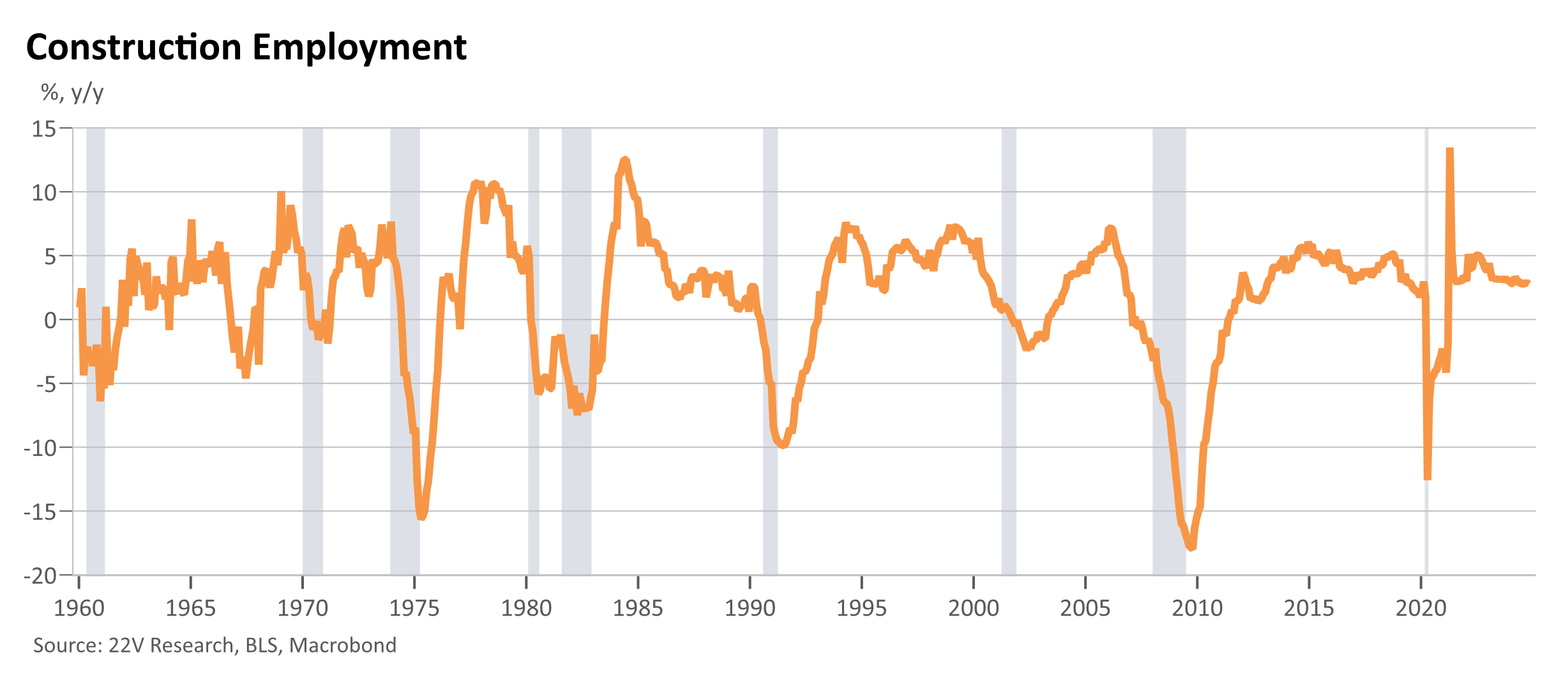
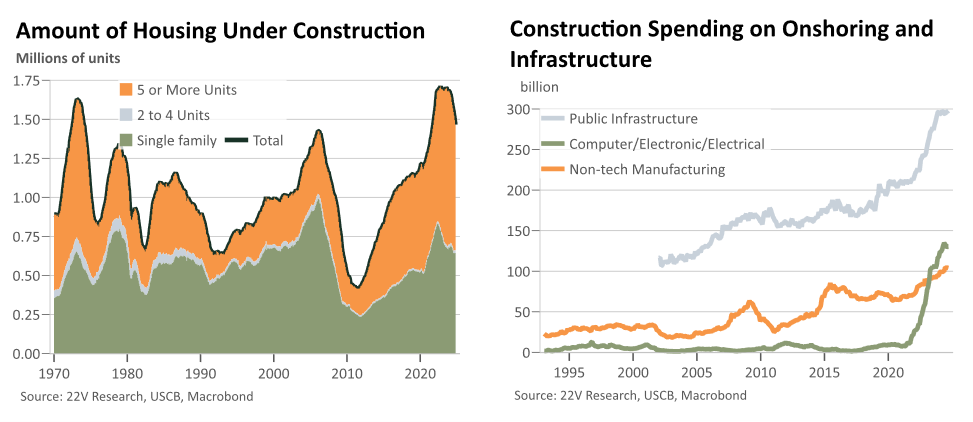
Given the move down in starts, the robustness of construction employment, which almost always starts to rollover before recessions (I’m not sure if housing still is the business cycle but it certainly remains one of the highest contributors to broader macro cyclicality), is quite notable. The move down in single family units under construction has been modest so far, although it is still above its pre-covid level, while the decline, and future much more extensive decline given the size of the relative surge in 2021-22 and much longer build ties, in multifamily likely has a ways to go. Relative to 2019 averages, SF under construction is up 23% (it peaked at almost 60% in early 2022) while MF is up 32% (having peaked at +65% in mid-2023). The surge in infrastructure and CHIPS act related spending has also served as a notable source of demand for construction employment, but spending there seems to flattening out and may start gradually declining.
Over the past year, the durability of construction employment has clearly been a key reason to lean against recessionary calls but now it is a more open question if firms will be able to keep headcounts growing given falling aggregate under-construction numbers (particularly so given the risks across-the-board tariffs on Canada could have for housing input costs in an already unaffordable market).
Risks of Fading Pent-up Demand
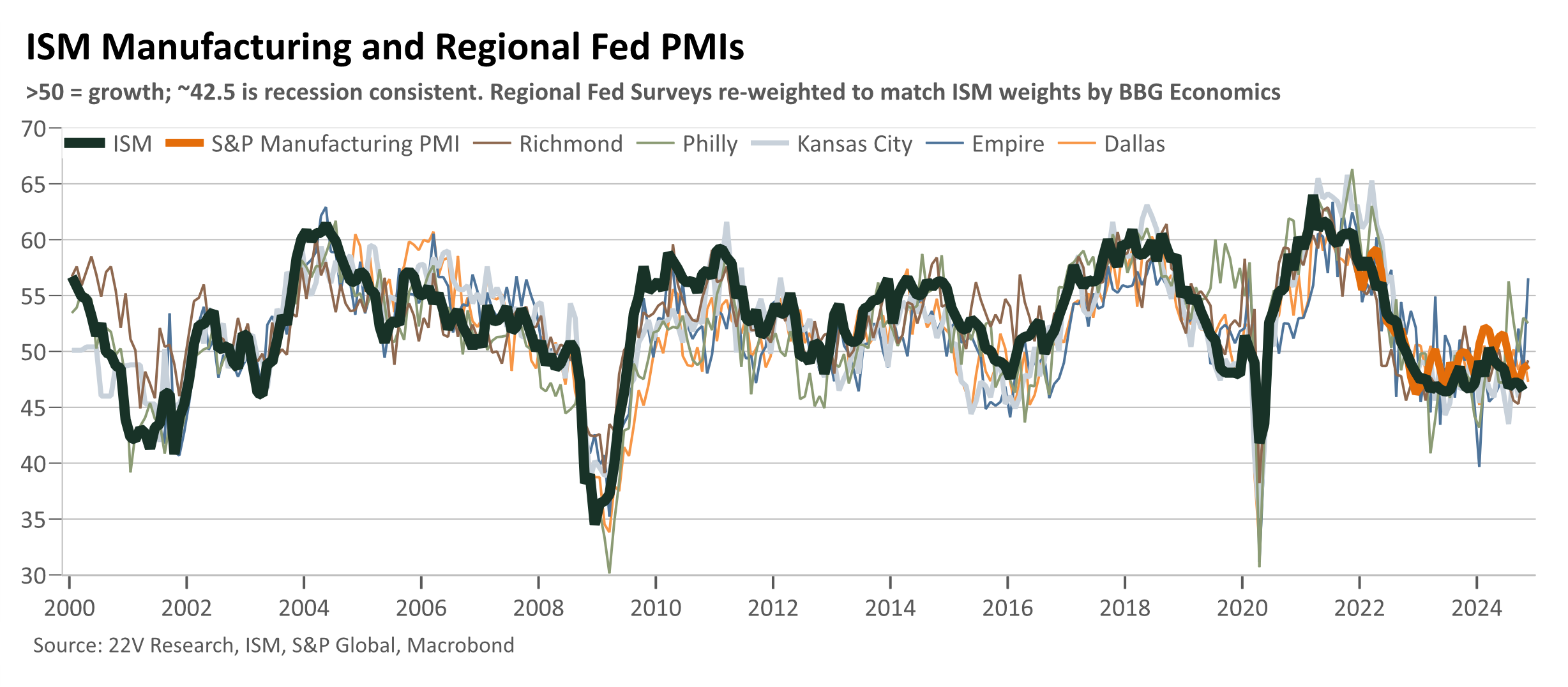
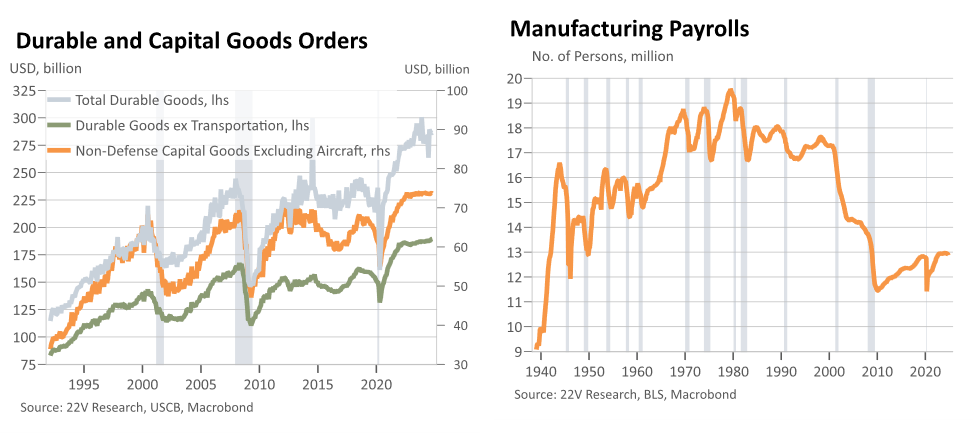
While manufacturing has been in a secular decline as a share of employment for decades (longer than anyone reading this has been in markets), it remains an important source of procyclicality in the economy. Fundamentally this concern is quite similar to the above on regarding housing and is even more linked to possible tariff or USD related concerns.
After flatlining during the 1990s manufacturing accounted for effectively all the job losses in the 2001 recession (other industries obviously saw notable moves as well but they net out, manufacturing also never recovered) and was roughly 30% of job losses during the GFC. After the GFC, manufacturing payrolls saw a gradual partial recovery and since 2019 have been roughly flat (covid excepted). Over the past few months, manufacturing payrolls have started to tick down slightly. This comes as durable and capital goods orders have been remarkably flat in nominal terms since early-2022.
This risk was highlighted by a couple comments I saw in the KC Fed’s manufacturing PMI (“we are in a holding pattern waiting for orders” and “we laid off 5% of our workforce in October. May have to do another if orders don’t increase soon”, see more here); other PMIs post-election generally seemed stronger and the commentary remains mixed, although a sentiment pop seems to be tentatively happening (S&P’s commentary noted that “manufacturing production declining at an increased rate. However, the promise of greater protectionism and tariffs has helped lift confidence in the US good producing sector, which is already feeding through to higher factory employment” which seems to be a bit of be careful what you wish for to me. ISM’s October release noted a tension between some pent-up demand in places and sluggish recent sales).
My base case remains that demand will start to gradually reaccelerate as we moved past the rate hike cycle and supply-chain distortion related hits to manufacturing demand (a stabilization in the RoW would also help) but the risk of forestalled layoffs becoming realized ones looms here as well, if we get any further downside surprises or just spend more time in the doldrums.