Back Economics

Raise your own productivity “in” manufacturing

Published on November 18, 2024

Download the PDF Report

By

Gerard MacDonell

We often hear from Team Biden about how much he has done to restore American manufacturing, primarily through incentives to capital spending.  Such praise always strikes me as odd, because it seems to take as a given that Americans want to work in factories. My guess is that people have a misplaced sentimentality about the 1950s and associate that with manufacturing. When they say they want manufacturing back, what they mean is that they want not to have to worry about stuff generally, like in the 1950s that they imagine, probably wrongly.  People may also miss American hegemony. I confidently expect to miss Pax Americana.

Looking back 50 years to when they looked back 20 nostalgically

Source: Youtube

Anyhow, the Federal Reserve updated its industrial production data on Friday, and it showed manufacturing output falling 0.5% in October, which represented a slight intensification of weakness from the 0.3% decline in September.  “Under” Biden, manufacturing output growth has indeed recovered a bit from Covid on balance, but it remains about 3% below the peak achieved during the expansion prior to the Covid shock and about 10% below its peak prior to the Global Financial Crisis.  Biden has not stoked a manufacturing Renaissance.

Alas, still benighted


Source: Federal Reserve Bank of St. Louis (FRED), NBER, FH calculations
Data are actual to October. 

What Biden and the earlier Democratic Congress have done is provide incentives for American companies to invest in microchip manufacturing structures, via the CHIPS Act, whose acronym sounds like it was produced by a child.  The H is for helpful. And it explains the boom in the BEA’s measure of overall manufacturing structures equipment capex shown in the left panel of the chart above.  I do not have data on real spending in manufacturing structures specifically dedicated to chips, but nominal data to Q2 suggest about 75% of the gain in overall manufacturing structures capex has been in chips.  


I assume that the reason that this is a win has something to do with defense priorities. We need a domestic source of chips for weapons and to protect the economy from a possible boycott from an enemy or an ally / neutral that has been somehow taken out of the game.  That is beyond my paygrade, but it would seem to make more sense than the idea that creating space for more people to manufacture stuff is somehow a win for the youth.

Manufacturing structures capex has boomed
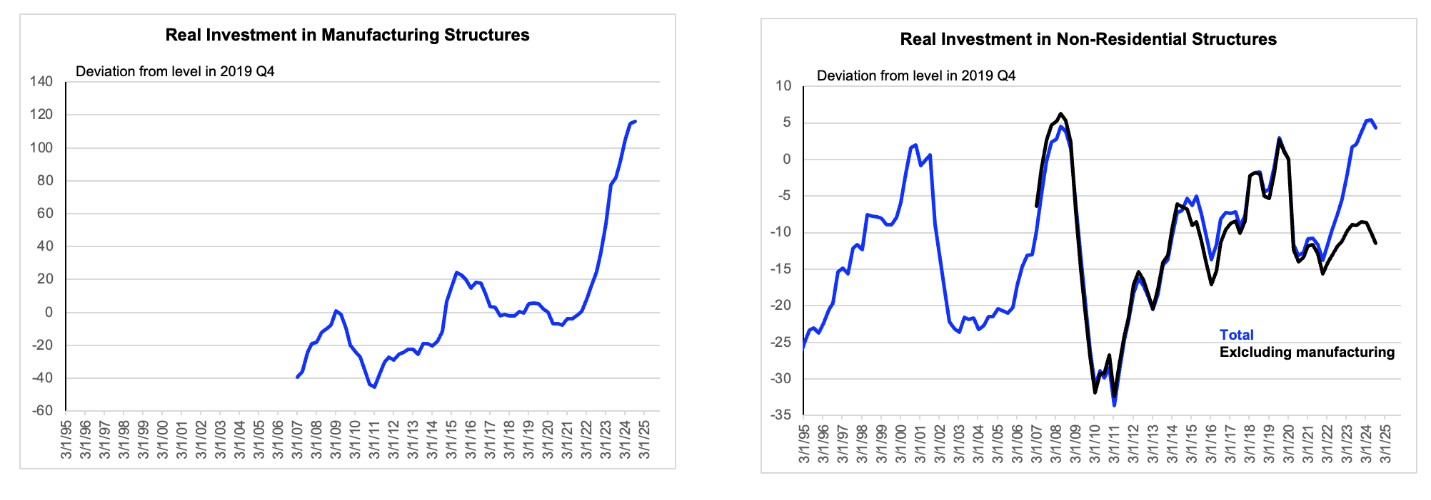

Source: BEA, FH calculations including chaining
Data are actual to Q3

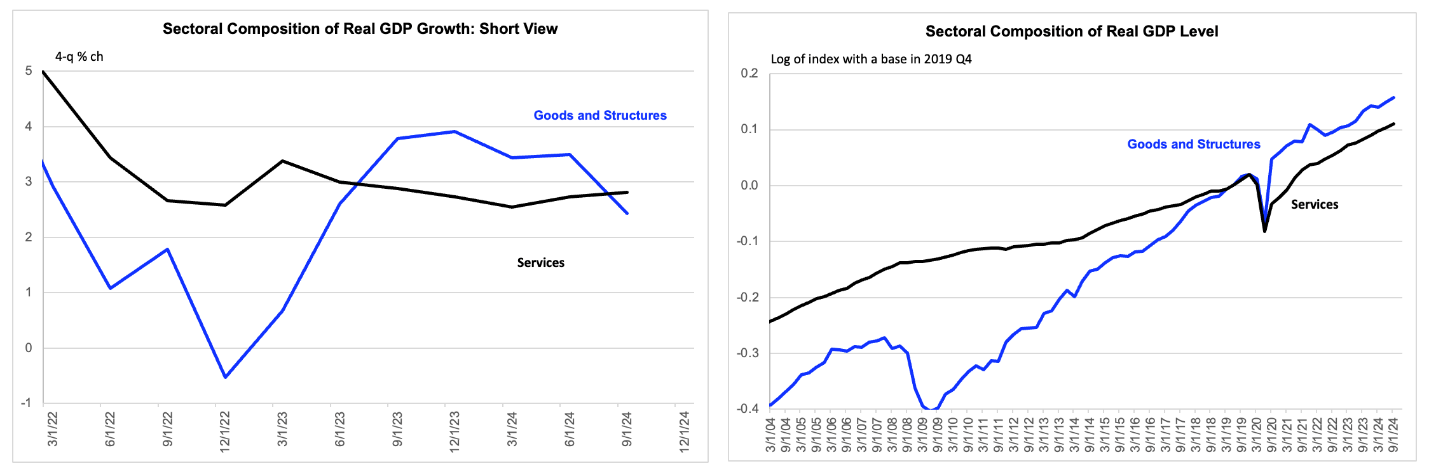
A related question here, though, is why has manufacturing output growth been so weak for so long? On the official data, it has been two lost decades. I am not an expert in how the Fed puts together their manufacturing output data and nor will I become one.  But I am a bit more familiar with how the BEA measures output in goods and structures, which is logically connected to manufacturing in the sense of making tangible stuff.  The unit of account in such measures is effectively (indirect) utility measured through the real value that markets place on various forms of output.  During the past ten years, real goods production has risen at an annualized rate of 3% on average.  It took a header at the Covid shock and then bounced back very strongly and has done nothing of much interest since Biden became president, which is the win from the perspective of the economy itself.   


Real output of tangibles grows more quickly over time than that of services, because productivity growth is higher in tangibles, entirely because of goods production.  This creates downward pressure in the relative price of tangibles, which helps keep realized (relative) demand in line with the (relative) rise of supply there.  


What is most striking is how little is going on here, now that the flow and ebb of the Covid shock has largely played out.  The only interesting bit here might be that the manufacturing structures capex boom has probably played out, which may contribute to tangibles overall looking a bit sluggish relative to services for a bit. But it is not a major macro story.  Despite the measurement issues here, a deep header in the manufacturing indicators themselves from here would be a macro story. It is just that there is no reason to expect one. 


You won’t get these five minutes back. But I hope to have allowed you to waste them just this once


Source: BEA, FH calculations including chaining
Data are actual to Q3

DISCLOSURES AND DISCLAIMERS

Analyst Certification

The analyst, 22V Research Group, primarily responsible for the preparation of this research report attests to the following: (1) that the views and opinions rendered in this research report reflect his or her personal views about the subject companies or issuers; and (2) that no part of the research analyst’s compensation was, is, or will be directly related to the specific recommendations or views in this research report.

Analyst Certifications and Independence of Research.

Each of the 22V Research analysts whose names appear on the front page of this report hereby certify that all the views expressed in this Report accurately reflect our personal views about any and all of the subject securities or issuers and that no part of our compensation was, is, or will be, directly or indirectly, related to the specific recommendations or views of in this Report.

22V Research (the “Company”) is an independent research provider. The Company is not a member of the FINRA or the SIPC and is not a registered broker dealer or investment adviser. 22V Research has no other regulated or unregulated business activities which conflict with its provision of independent research.

22V Research, LLC is a professional services and independent publication organization. 22V Research, LLC is not a securities broker-dealer, not a member of the Financial Industry Regulatory Authority (FINRA), not a registered investment advisor (RIA) and not a member of SIPC.

Securities transactions, when offered, are offered by 22V Securities, LLC through LPS Capital, LLC. Certain employees of 22V Securities, LLC are dually registered as securities representatives of LPS Capital, LLC or Analyst Hub Securities, LLC. 22V Securities, LPS Capital and Analyst Hub Securities are members FINRA, SIPC.

https://brokercheck.finra.org/

Current Ratings Definition.

SECTOR OUTPERFORM: An “outperform” rating anticipates the company will outperform the S&P Regional Banking Index (peer group).

SECTOR PERFORM: A “market perform” rating anticipates the company will perform in line with the S&P Regional Banking Index (peer group).

SECTOR UNDERPERFORM: An “underperform” rating anticipates the company will underperform the S&P Regional Banking Index (peer group).

Limitation Of Research And Information.

This Report has been prepared for distribution to only qualified institutional or professional clients of 22V Research Group. The contents of this Report represent the views, opinions, and analyses of its authors. The information contained herein does not constitute financial, legal, tax or any other advice. All third-party data presented herein were obtained from publicly available sources which are believed to be reliable; however, the Company makes no warranty, express or implied, concerning the accuracy or completeness of such information. In no event shall the Company be responsible or liable for the correctness of, or update to, any such material or for any damage or lost opportunities resulting from use of this data. Nothing contained in this Report or any distribution by the Company should be construed as any offer to sell, or any solicitation of an offer to buy, any security or investment. Any research or other material received should not be construed as individualized investment advice. Investment decisions should be made as part of an overall portfolio strategy and you should consult with a professional financial advisor, legal and tax advisor prior to making any investment decision. 22V Research Group shall not be liable for any direct or indirect, incidental or consequential loss or damage (including loss of profits, revenue or goodwill) arising from any investment decisions based on information or research obtained from 22V Research Group.

Reproduction And Distribution Strictly Prohibited.

No user of this Report may reproduce, modify, copy, distribute, sell, resell, transmit, transfer, license, assign or publish the Report itself or any information contained therein. Notwithstanding the foregoing, clients with access to working models are permitted to alter or modify the information contained therein, provided that it is solely for such client’s own use. This Report is not intended to be available or distributed for any purpose that would be deemed unlawful or otherwise prohibited by any local, state, national or international laws or regulations or would otherwise subject the Company to registration or regulation of any kind within such jurisdiction.

Copyrights, Trademarks, Intellectual Property.

22V Research Group, and any logos or marks included in this Report are proprietary materials. The use of such terms and logos and marks without the express written consent of 22V Research Group is strictly prohibited. The copyright in the pages or in the screens of the Report, and in the information and material therein, is proprietary material owned by 22V Research Group unless otherwise indicated. The unauthorized use of any material on this Report may violate numerous statutes, regulations and laws, including, but not limited to, copyright, trademark, trade secret or patent laws.