October CPI – The Song Remains (Largely) the Same
- The immediate relief rally in rates on the 0.28% m/m core CPI print shows how primed markets had become for something notably more hawkish (our survey had an 0.4% median expectation with hawkish skews generally).
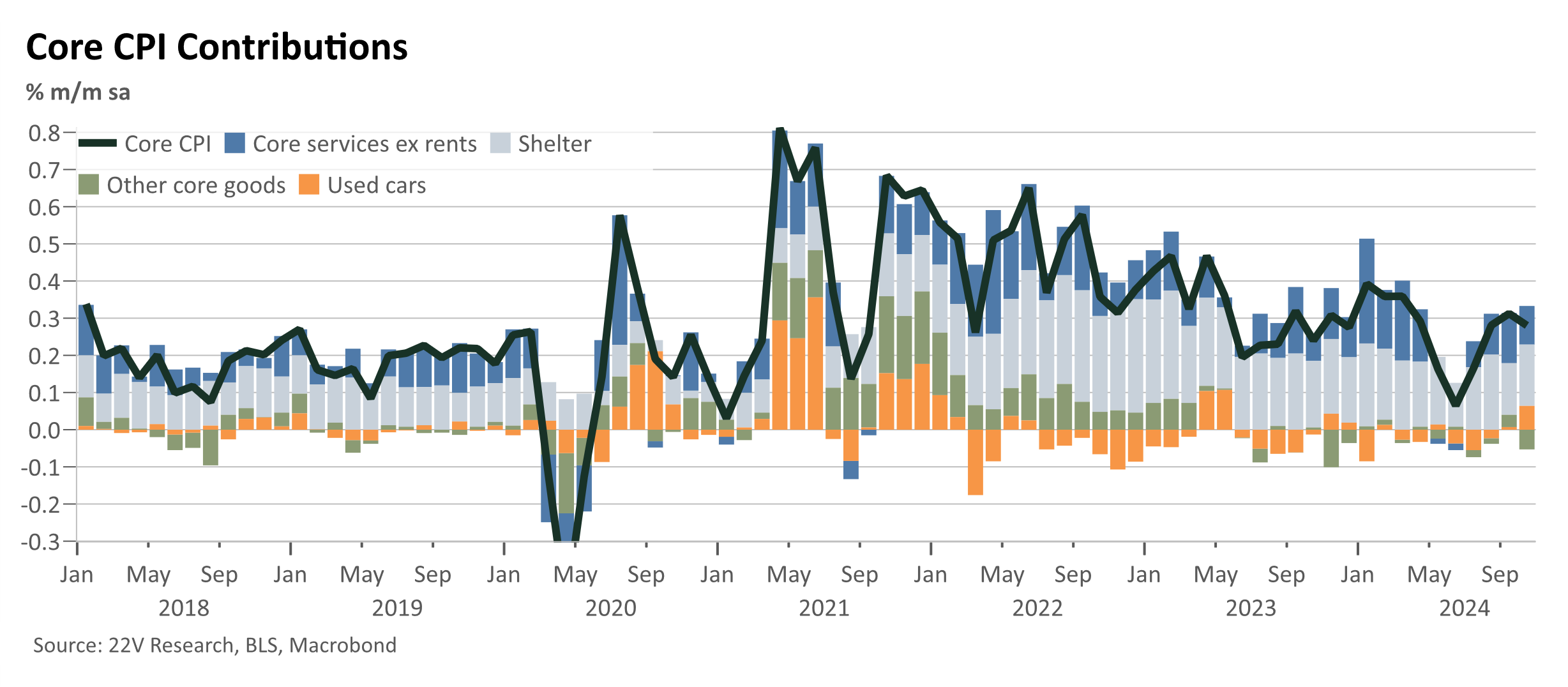
- The internals of the data are a bit all over the place but the broader multi-month trends generally seem intact: core goods was pulled in very different directions by used cars (+2.7% m/m sa) versus the rest of the data (-0.25%); shelter bounced higher again, continuing its haltingly gradual descent; and core services ex housing was just below 4% m/m saar, too hot if sustained.
- It seems hard to say that underlying inflation trends are obviously taking core PCE back to 2%, that looks more like a bouncy floor to me at present, but enough disinflation has happened that the Fed should still be comfortable with paying back the 100-150bps of cumulative insurance hikes it took out.
- With another employment report and CPI release before the December FOMC meeting the data can always change what appropriate policy looks like but this is ok enough to keep a December cut as fairly strongly odds on.
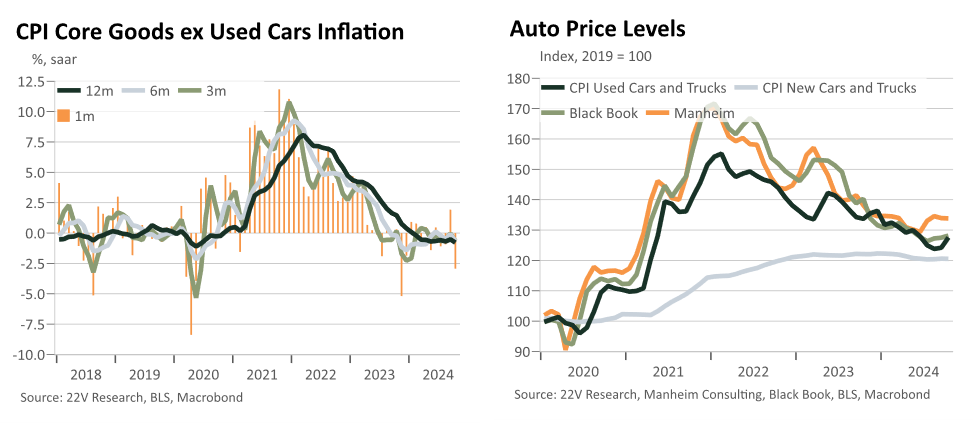
Core goods showed large internal dispersion this month. After a bounce in core goods ex used autos last month, something a number of fundamental analysts who pinged me at the time were scratching their heads over, we saw a full reversal of that jump, swinging from +15bps m/m sa to -25bps. New cars (included in the prior number) were flat and seem to be losing what limited deflationary momentum they had. Used autos jumped 2.7% m/m sa. This is not shocking given the jump seen in Manheim’s auction data over the past few months. What the equilibrium price level used cars are headed towards remains anyone’s guess but one should assume that there will be some further deflation here. Potential tariffs could complicate autos, and all of core goods, deflationary trajectories. Its possible companies try to front-run tariffs by surging inventories ASAP but given timing constraints that would be challenging to pull off.
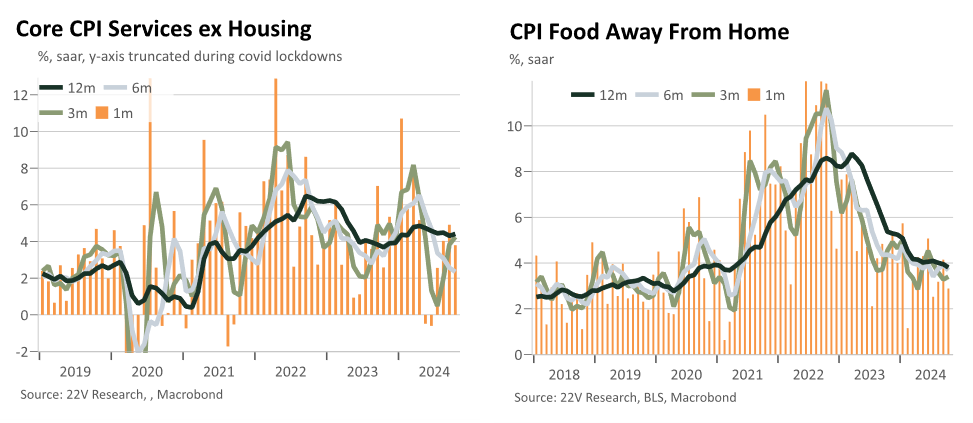
Core services ex housing continues to be bouncily above target-consistent levels. The short-term trends there have been quite noisy this year but after the lagged-inflation-driven heat in Q1, the largely mechanical slowdown in May and June, and then the reacceleration to something more like trend from July-onwards. Too many overly-embraced a full look-through of the heat in Q1 but a more sober assessment, taking the YTD as a whole, suggests that while lagged price-level adjustments are still have surprisingly large impacts on related prices, underlying trends suggest that we are not quite there yet.
Food away from home, which is a part of headline CPI but core PCE (the different treatment escapes understanding but I think core makes more sense), is one of my favorite underlying inflation indicators and has been looking a bit better in recent months. It is still above 2018-19 type levels but seems to be slowly moving back down towards target-like levels.
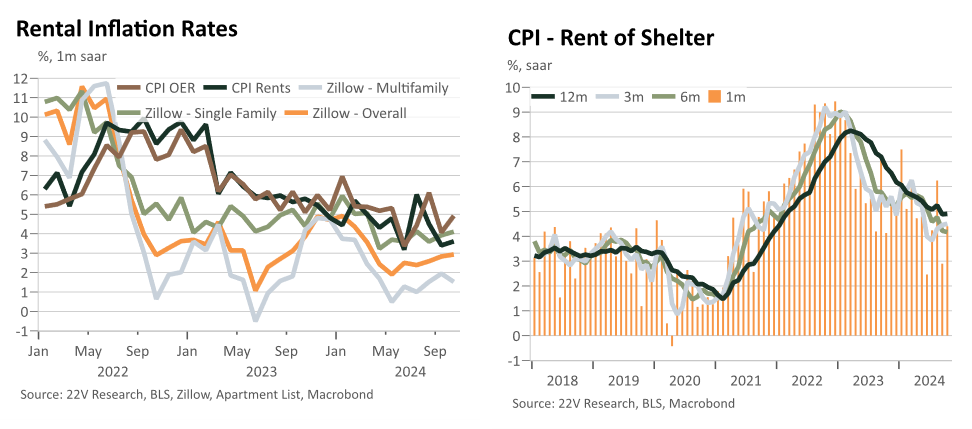
Shelter inflation continues to be a mixed bag. The Fed has said they are largely looking through the substantially slower than they, or most other analysts, expected disinflation in the area so long as market rent trends are below the CPI and PCE numbers. Perhaps more accurately, the Fed continues to need permission from the inflation toplines to keep cutting, of which shelter is a part, but beyond that they are not paying too much attention to it.
Across all of 2024 both primary rents and owner’s equivalent rents have been surprisingly noisy m/m given the usual steadiness of the series. But on a longer horizon the disinflation is quite clear, although it has come much slower than expected. Still though there remains a substantial level catch-up between in single-family rentals that is a continuing support for both OER and CPI rents (OER to a much larger extent). Multifamily’s overall price level, which tends to be much more professionally managed, seem to have largely caught up with new rent levels. A key part of this forecasts, often lost amid the noise, is that new lease growth continues to be solid in the 2-3% range and has shown little sign of outright deflation; perhaps unsurprisingly given housing purchase affordability issues, new lease growth for single family is running roughly 2p.p. above multifamily. This makes the catchup process slower and puts a floor under overall rents (wage growth around 4% is also a medium-term support for rental inflation given the usual tight links between wages and rental prices).