

One principle of Fed watching that is probably worth following involves distinguishing between the leadership’s expressions of intentions and their sense of how things work. To be clear, this distinction is probably not very relevant in the heats of the moment, e.g., during post-FOMC press conferences, because investors tend to react to whether the Fed sounds “dovish” or “hawkish” somewhat indiscriminately. So, if Powell has, say, a dovish forecast for inflation, then people will think that is constructive. And there is no point fighting that on the day, even though it is probably wrong, strictly speaking.
However, once the cameras are turned off the distinction that I highlight becomes more important. If the Fed Chair makes an interesting claim about what the objectives are, then we need to think of that as causal and likely to have a long shelf life. A good example of this was the Press Release issued in September 2020, following up on the conclusion of the Framework Review in August 2020, in which the FOMC stated clearly that they were willing to get systematically behind the curve on both sides of their dual mandate by letting the economy run hot. That was not a forecast. It went to intentions and was therefore durably very important, more so than even I recognized at the time, although at least I was not among the dopes looking for a signal on QE.[1]
Similarly, if the Fed Chair says something about what he intends to do on the rates side, given his forecast of how things will play out, then we need to pay close attention to that to – and durably go with. For example, recently, the Fed has been telling us that they intend to cut rates in a way that has not sounded all that data dependent. They are operating from the premise that the funds rate is just abnormally high and needs to be renormalized. Love or hate the take, you don’t fight it, although arguing about the pace is fine.
Expressions of how things work, including the forecasts of growth, employment and inflation, are different beasts, though. If, for example, the Fed Chair tells you that he plans to cut rates further and then follows up with a suggestion that a big part of the reasoning for that plan is an extremely constructive forecast of inflation, then the strong move is not to say, wow, he wants to cut rates and is super dovish on inflation. No, the better take would be, his plan to cut rates is premised on an inflation take that seems quite likely to be overturned by events. So, you should probably fade him, the day after he speaks.
I am imagining an extreme scenario to make a point. In reality, the Fed’s forecasts are not often far off consensus. And to the extent that the Fed’s staff is respected, their forecasts can move that consensus. But I assume you get the point. And there have been plenty of examples recently where the Fed leadership has made some very dovish claims about how the world works (in 2021 and over the past couple months) and then gotten falsified. It is ok to fight the Fed — over the medium term if you know they are wrong. It is knowing that is the tough part.
Powell hints that maybe I am underreacting by assuming just a slight inflection at Covid

Productivity data are actual to Q3.
I mention this because it relates directly to how Powell came across yesterday. As I mentioned to a colleague at the time, Powell seems to be just one delta more constructive / dovish than I am on every point of how the world works. So, that was constructive for yesterday, and perhaps less constructive going forward, to the extent Powell may be too optimistic.
For example, consider Powell’s take on productivity. The Fed has not quite yet gotten around to posting the transcript of the Press Conference on their site, you will have to wait a few hours or a day to see the actual exchange. But during the Q&A, Powell’s description of productivity and how that links up with the pace of wage inflation that is consistent with the Fed hitting its 2% inflation objective over time sounded awfully familiar to me – but just with that one delta of optimism.
Let me repeat my own take quickly for context. Based purely on a conservative / inertial eyeballing of the trailing productivity data, I have recently updated my best guess of underlying productivity growth from 1.1% (false precision) to 1 ½%. Separately, I put the underlying trend of compensation growth, defined so that it is commensurate with productivity at 4%, for reasons I discussed yesterday. This implies underlying unit labor cost inflation (ULC) of 2.5%.
And Powell follows exactly this accounting when working up his own sense of things, although he comes to a slightly more dovish conclusion. In his comments yesterday, Powell did not give us the actual numbers relevant here. But I can confidently apply the usual mind reading to extract them.
Powell mentioned that we need to fade short run swings of the productivity data because history teaches us that the growth rate always mean reverts. Ok, that is circular reasoning, as I will get to below. But he must have in mind a 2% productivity trend growth rate, because the measured 1-, 4- and 20-quarter growth rates are all within 20 bps of that figure. And if we fit a line back to immediately pre-Covid, we are sitting right on 2%, as the “counterfactual” simulation in the picture below shows.
Powell clearly hinted at 2%, although without committing to it
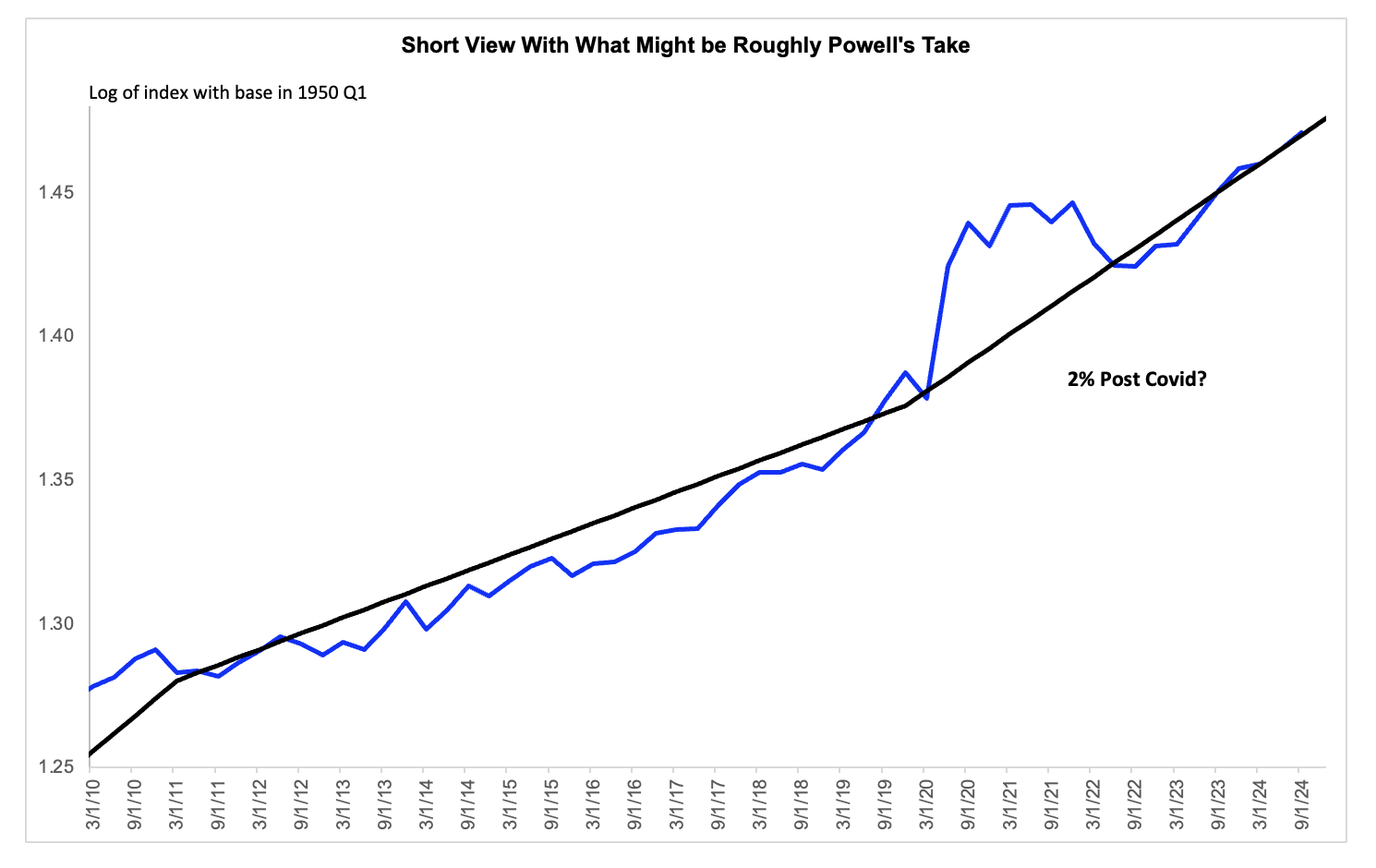
Data are actual to Q3. Please note that I have shortened the pre-2012 trend by two quarters to tighten things up a bit here, now that this discussion matters more. NBD just FD.
So got with 2% productivity and assume that Powell is reading the nominal wage data in the same way that I am, 4%, et voila, 2% underlying ULC growth, fully consistent with the inflation side of the Fed’s mandate – and with Powell’s recurring claim that labor market tightness is not really an issue. I am almost certain that I am following Powell’s arithmetic, via mind reading. Sometimes it is easy.
The challenge becomes figuring out if he is right. To be fair to Powell, he was careful to emphasize that we ought not extrapolate the recent productivity data. The reason is that history supposedly shows that the growth rate always mean reverts. But that is circular reasoning because we all assume that the mean itself evolves with structural changes of the economy, and we are always trying to use the real time data themselves to suss out if that mean has evolved. For example, the CBO’s latest forecasts assume that trend productivity growth is 1.1%. Is that too low? Both Powell and I now suspect it is, and that is mostly because the actual productivity data have been stronger. The mean that we will observe ten year from now for now is irrelevant.
Just for the sake of argument let’s assume that the CBO’s estimate of trend productivity growth (at 1.1%) is 50 basis points too low, for being stale, and that they are therefore 50 bps too low on their estimate that potential GDP growth is 2%. That would have tons of implications, almost all of them good. But let me focus here on how this would affect my now-regular analysis of what the bond market is telling us appropriate fiscal policy might be?
One simple way to approach this is to overwrite the CBO’s estimate of 5-year forward potential growth dating back to immediately pre-Covid with a nice constant 2 ½%. You can see from the notch in the black line on the chart where the overwriting begins, just before Covid. Note that this tweak entirely eliminates what would otherwise be a signal from the bond market to deliver tighter fiscal policy.
To be sure, the case for fiscal laxity is much reduced from a couple years ago when the bond market was screaming at us to ignore the scolds and continue with fiscal expansion, although perhaps at a steadier pace than Biden had delivered. But there are two reasons to be suspicious of the claim that the bond market might be on the verge here rejecting fiscal expansion:
- First, and most importantly in the current context, the signal from the bond market being delivered here incorporates the bond market’s own sense of the likely trajectory of fiscal policy. And the consensus is that the debt / GDP ratio is going to rise steeply further. The consensus is the consensus and it would be a stretch to assume the bond market has a unique one.[2]
- Second, there is some chance of a gap between my proxy of the market’s estimate of forward r* and what the market believes, i.e., the pure expectation. The reason is that the term premium at the 10-year maturity might be higher than the term premium at the five-year maturity, creating a wedge between the forward discount and the pure expectation. We do not know. It is possible. (Please note that I am not suggesting that the Treasury gets to ignore the term premium in borrowing rates, say at the 5-year maturity. They do indeed have to pay that. I am making a point about the forward rate on that term-premium-inclusive borrowing rate being slightly distorted relative to the expectation.)
Returning to the main theme, then, does the prospect of higher productivity growth mean that the bond market is a buy because fiscal sustainability concerns are overrated. No. In fact, the opposite, at least arguably. This analysis takes as a given that the fiscal risk premium in the bond market is or should be zero. Indeed, within the analysis presented, if the forward real yield includes a fiscal risk premium, then r* is lower (outright and relative to g*) than even the arithmetic implies. So, the larger the fiscal risk premium there, the stronger the case for there not being one! But that is just fun with irony. I think we can all agree that there is no fiscal risk premium there yet, which conveniently allows us to assess whether we are getting close to a situation on the debt side where there should be one. Or might be one. And the higher the productivity growth rate, the weaker that case.
But that is not actually a bond bullish thought, because I start (and conclude) with the view that the fiscal risk premium is not the issue here. Rather, there are a couple reasons to believe that a higher potential GDP growth rate implies upward pressure on r* and therefore on bond yields. There are the very familiar arguments involving the marginal return on capital (which might go up in response to the technological innovations driving higher productivity) or the rate of intertemporal substitution, which would favor higher interest rates if people were to anticipate greater wealth in the future. Right or wrong, those are old arguments.
And there is one that strikes me as more fun. It seems obvious that policy makers are going to press the fiscal lever until the debt / GDP ratio rises enough to push up r* relative to g* enough for fiscal sustainability concerns to become relevant. When they do, we will get a market response that will probably tilt the US back to fiscal orthodoxy, just as happened in the UK. Keep in mind that the rentier class is now fully in control here. And the higher the productivity growth rate, the higher g*, and therefore the higher the r* at which fiscal consolidation is forced. So, within my fiscal framework (Ponzi Public Finance) and sense of the politics (economic elites fully in control), faster productivity growth is ultimately bond bearish. It may seem counterintuitive, but it is hardly at odds with what we have observed so far. And if I am right, people miss this because they assume that fiscal worries operate directly on the fiscal risk premium without teasing out the implications of that issue necessarily going through r*.
Powell’s productivity suggestion might alone eliminate the case for delivering tighter fiscal policy,
even relative to the expectation
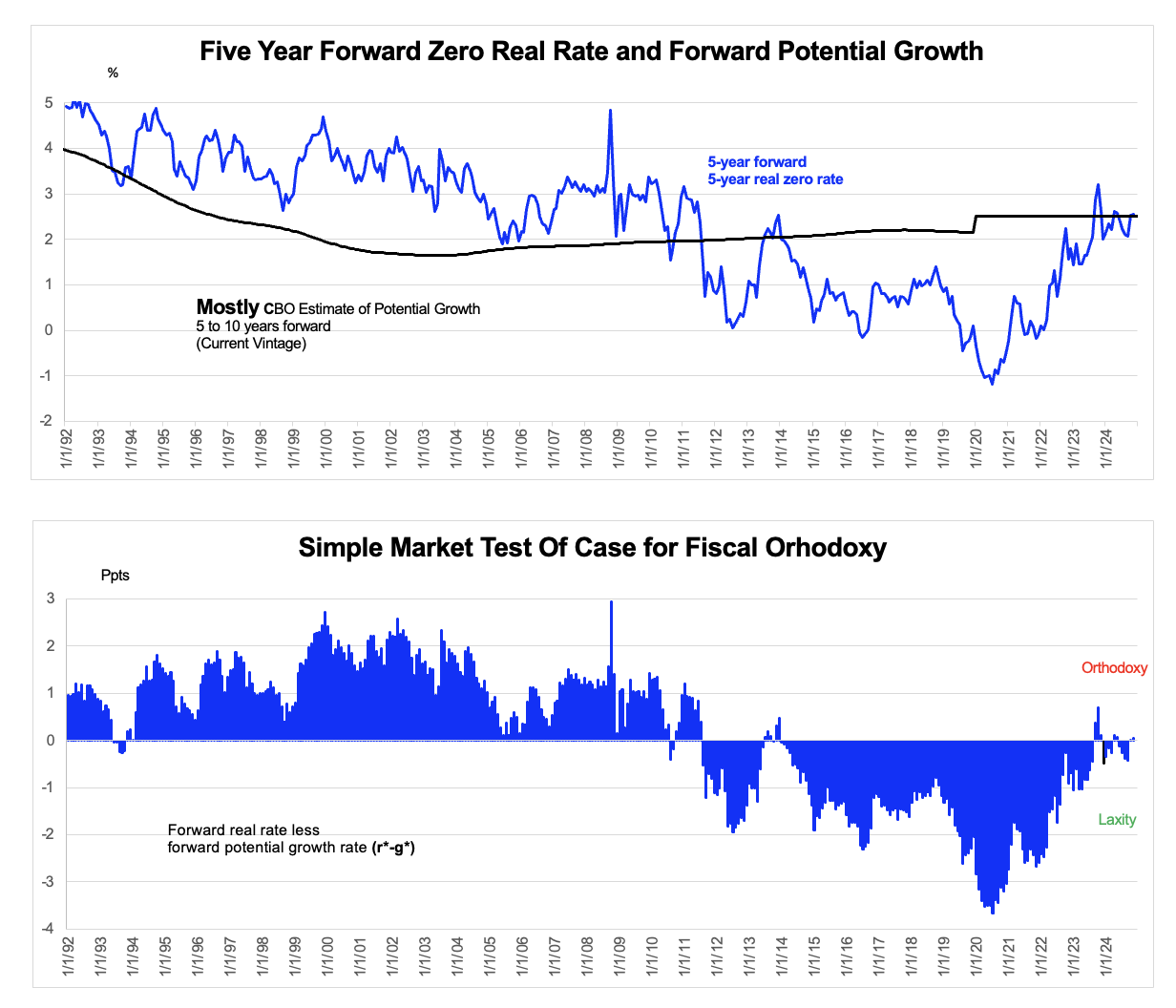
Bond market pricing is meant to be live, but it could be off by a couple bps because I am updating zero rates formally published to the close two days ago.
[1] The usual amnesia applies, but in real time the Fed watchers were more interested in the absence of a QE signal than in the fact that the Fed had committed itself to a policy involving time inconsistency, which was sacrilege, and surprisingly / durably dovish by virtue of that. I noticed that at the time and emphasized it, but ended up underreacting anyway.
[2] Keep in mind that the forward real yield I show is meant to be a proxy of the expected path of r*. By construction it does not include a fiscal risk premium. The fiscal hawk might say, yes, but the fiscal risk premium is inclined to rise, precisely because people are ignoring the debt trajectory. But that misses the logic behind Ponzi Public Finance. If r* is below g*, then there is very likely no real need a fiscal risk premium. What makes this admittedly tougher is that r* is no longer far below g*. We are now in the ambiguous zone. If a higher public debt or any other structural force were to put further upward pressure on forward r*, which I hardly exclude, then the need for fiscal contraction would become more obvious.

