

This morning’s productivity and cost report to Q3 would seem to be good news or at least to reflect good things, but it is a bit complicated.
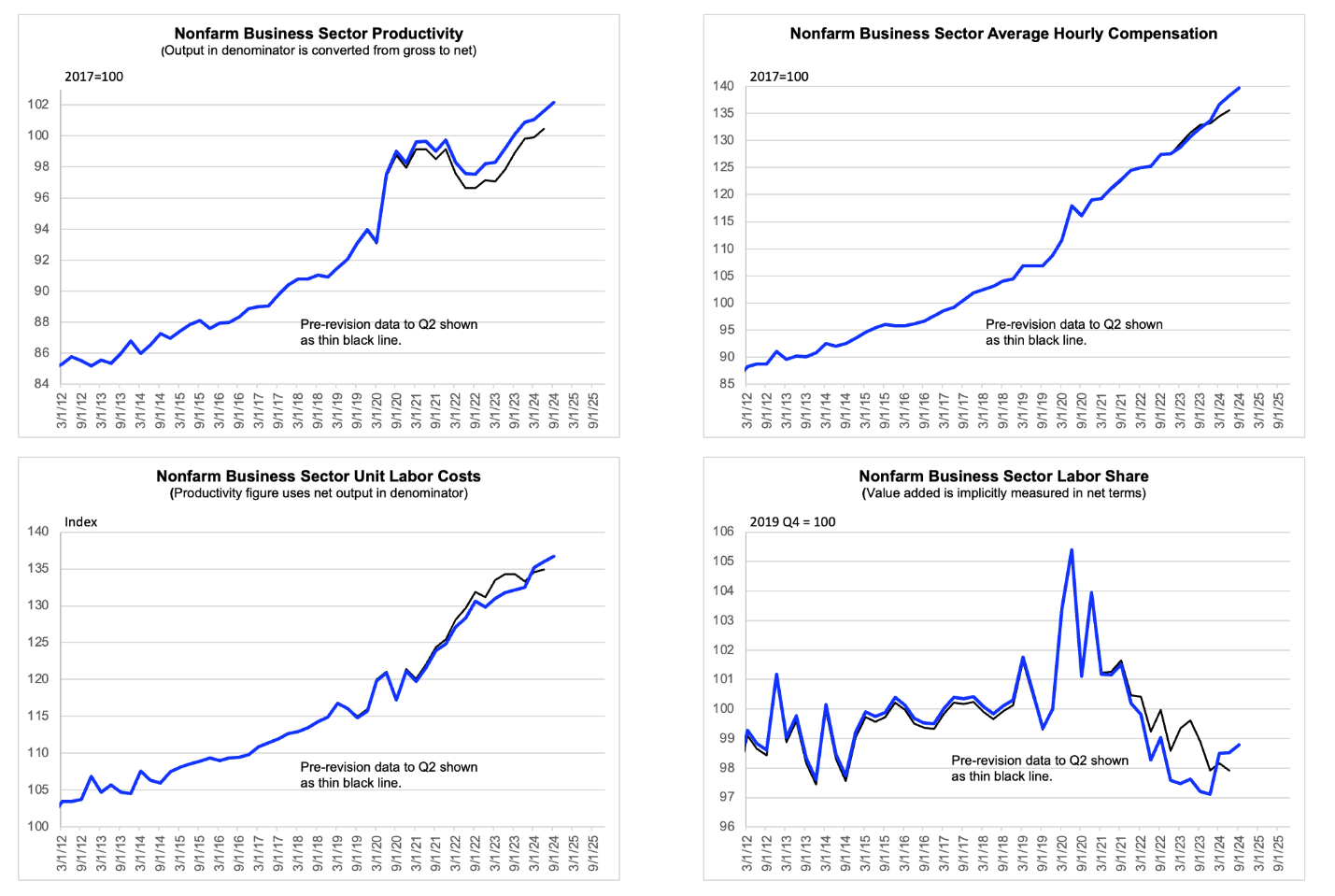
You will recall from just over a month ago that they revised up the Gross Domestic Income (GDI) figures, which resulted in a smaller statistical discrepancy in the National Accounts. As a result of this, we all took a bit more seriously the notion that the headline expenditure-based measures of output, such as the GDP, were picking up legitimate strength. We also took more seriously the contemporaneous vintage productivity figures, which seemed to point to an inflection stronger. And with the revisions to the Productivity and Cost data this morning, the productivity figures look stronger still. I am not sure if this is a huge surprise to those paying attention. This was flagged by the GDP revisions themselves in late September. I am just pointing out that the good news on productivity has come in two forms. First, we take the old perkier data a bit more seriously, because the statistical discrepancy went away. And then secondly, we see those data revised higher. This makes me a bit more confident that underlying productivity growth has inflected higher post Covid. I had been working with 1.1% as the trend. But I have been talked up to 1.5%, based on an eyeballing shown in the picture at the bottom of this note.
A complicating factor, though, is that much of the income they “found” within the GDI monitoring was labor compensation. And that had to make its way into Average Hourly Compensation and thus Unit Labor Costs (ULCs). We knew this was coming and today it arrived. So, I am not inclined to call it news. The 4-q change of ULCs looks high, because of that revision mostly hitting Q1, but the shorter-term growth rates look ok. I am not inclined to drag my 2 Stage Disinflation Thesis back out of the closet on this, even though I think full employment is a larger consideration for the rates path than the consensus believes – or believed.
Source: Federal Reserve Bank of St. Louis (FRED), FH calculations
Data are actual to Q3, although pre-revised data to Q2 are also shown for context.
With the revisions to the productivity and compensation data, the labor share of net value added now looks more intuitively sensible. Rather than being down sharply and falling as the old data suggested, the labor share is now just slightly below its pre-Covid level and firming a bit. At the margin, this weakens the notion that reasonably firm wage data are just a “catch up” to the earlier spike of inflation. Indeed one could go further. I think the fact that nominal wage growth remains firm even in the face of a re-entry on the goods and services price inflation side is corroborating evidence that the labor market is slightly tight. It’s pretty subtle, though. We do not have some smoking gun here.
Sorry this is nuanced. But there are a few moving parts here. The net net here is that things look a bit better on the productivity side. And with the rest, there is probably less than meets the eye. Yes, they found a lot more income, mostly in Q1. And it came through this morning.
I recently added a kink (squint) just before Covid and am inclined to stick with that

Source: Federal Reserve Bank of St. Louis (FRED), FH calculations
Data are actual to Q3. Eyeballing of trend lines is subjective and entirely backward looking.

