Back Economic Research

The Fed Will Continue to Be Data Driven

Published on November 6, 2024

Download the PDF Report

By

Peter Williams

The Fed Will Continue to Be Data Driven

  • In the very near term, the election seems unlikely to notably change the Fed outlook. Afterall, as Powell has repeatedly emphasized, they will continue to aim for their dual mandate goals in a data and risk management dependent way. Farther out in the medium-term the Fed will need to see more concrete fiscal, tariff, and immigration plans in order to incorporate them into its baseline outlook and make reasonable risk management inferences about them.
  • At the press conference tomorrow, Powell will do all he can to avoid commenting on the politics of the election and (re)emphasize the dual-mandate centric message above.
  • The Fed still think the setting of policy is notably above neutral (in the September dot plot the median was 2.9% nominal, likely to keep drifting higher, with a 2.4-3.8% range), inflation has improved substantially but is still somewhat too hot, and the labor market risks are skewed to the downside even if the likelihood of a near-term recession is notably lower than it was 6-12 weeks ago.
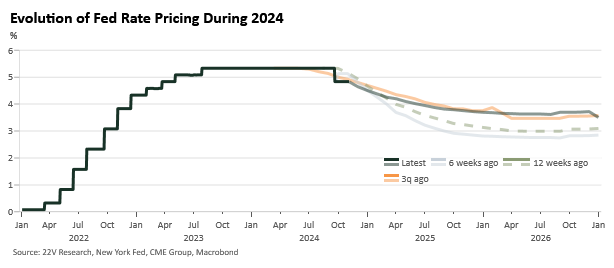
  • My baseline remains that the Fed will cut 25bps in November (tomorrow), December, March and June before going on an extended pause. Of those meetings, a June skip seems most likely and the one most likely to be impacted by Trump administration policy, with December as a possible skip as well depending upon how the November employment report rebounds from the October whiff and the Oct-Nov inflation data. This is now fairly close to market pricing.
  • Longer-term rates, 10y yields up 19bps at present, will serve as a natural counter-cyclical force, moving, as they have, in response to 3-6m long mini-cycles of data surprises and misses. This built-in cyclical governor takes some of the Fed’s work away from it.
  • Assuming, and it is not obviously a done deal yet given October’s employment report, that Sahm Rule-like concerns of more acute labor market weakness do not come to pass then the economy’s baseline path into 2025 looks solid. Of course, largescale immigration, tariff, or geopolitical shocks could disrupt that outlook but the endogenous baseline continues to look solid with many cyclical headwinds turning more neutral or outright supportive as we move into 2025.
  • It will take time for the new administration’s policies to solidify more appreciably, then to be enacted, and then to filter into the data. This isn’t to say that the Fed won’t react to policy announcements and the broad contours of policy but that reaction needs to be premised on something fairly concrete and close to implementation or enactment rather than selective read-throughs of, often conflicting or inconsistent, campaign promises.
  • Tariffs are a classic supply shock, dinting activity while raising inflation. Typically, monetary policy is limited in its response to supply shocks (oil price movements being the most common example) concerning itself primarily with second order impacts given most supply shocks’ one-off price-level, rather than medium-term rate of inflation, shift impact. Given the legacy of high inflation and an economy which is close to a neutral position, depending a bit upon where you look in the growth and labor market data, the likely pass-throughs from tariffs into prices will likely be somewhat higher than in a weaker economy and the Fed more concerned about more persistent second round impacts. Still, moderately sized tariffs are likely to see some response even if it is, in the first order, only in truncating away some more dovish possibilities.
  • Immigration policy is also a potential negative (i.e. inflationary) shock the Fed may have to contend with as well. Actions to crimp the flow of immigration would be a slow drag on potential growth, gradually retightening the labor market while large scale deportations (or enough of them to shift workers into a lower labor participation rates) would be a more immediate spot impact, both of which would retighten labor markets. Immigration flows have already slowed notably regardless, so the short-term NFP trend consistent with a flat unemployment rate is likely to be gradually downshifting anyway.
  • Fiscal policy looms more directly impactfully on the 2025H2 horizon given the pending expiration of much the personal side of the 2017 TCJA. Trump’s announced plans are widely seen as more deficit expanding than Harris’ were, although the extent of deficit expansion available and aimed for remains to be seen. Realistically, assuming the economy evolves broadly in line with expectations out to 2026, the likely multipliers on any stimulus above current policy (distinct from the usual current law baseline more commonly referenced in DC) will be fairly close to 0 given the limited ability of procyclical policy, especially that targeted at lower MPC households, to stimulate demand when it is above supply thanks to rate, whether policy or LT, and FX offsets as well as short-term supply constraints.
  • It remains to be seen if Powell serves out the rest of his term but my very tentative suspicion is that he will. Who Trump appoints next as the Chair remains quite uncertain and will be one of the key debates for markets to watch in 2025.
  • I am skeptical that any of the other Bidan appointees will resign early, meaning that the Board will continue to have a fairly dovish makeup on net but how much that matters given the Fed’s usual Chair-deference on monetary policy matters remains to be seen (it’s a possibility worth entertaining that the Fed could implicitly move more towards a median voter model like the BoE if Trump appoints a more extreme or clearly partisan Chair but that’s long way from being top of mind).
  • It is unclear how hawkish a Fed chair Trump would really want. Yes, inflation was clearly a very winning issue for him, but Trump has historically been more a low rates guy (the background in RE clearly has a lean here), is fairly stock market sensitive, and may see himself as cleanly separated from the post-covid inflationary shock. Given that the baseline outlook is for solid growth and inflation noisily a bit above target this may not end up mattering too much, barring a recession or notable inflationary resurgence.

DISCLOSURES AND DISCLAIMERS

Analyst Certification

The analyst, 22V Research Group, primarily responsible for the preparation of this research report attests to the following: (1) that the views and opinions rendered in this research report reflect his or her personal views about the subject companies or issuers; and (2) that no part of the research analyst’s compensation was, is, or will be directly related to the specific recommendations or views in this research report.

Analyst Certifications and Independence of Research.

Each of the 22V Research analysts whose names appear on the front page of this report hereby certify that all the views expressed in this Report accurately reflect our personal views about any and all of the subject securities or issuers and that no part of our compensation was, is, or will be, directly or indirectly, related to the specific recommendations or views of in this Report.

22V Research (the “Company”) is an independent research provider. The Company is not a member of the FINRA or the SIPC and is not a registered broker dealer or investment adviser. 22V Research has no other regulated or unregulated business activities which conflict with its provision of independent research.

22V Research, LLC is a professional services and independent publication organization. 22V Research, LLC is not a securities broker-dealer, not a member of the Financial Industry Regulatory Authority (FINRA), not a registered investment advisor (RIA) and not a member of SIPC.

Securities transactions, when offered, are offered by 22V Securities, LLC through LPS Capital, LLC. Certain employees of 22V Securities, LLC are dually registered as securities representatives of LPS Capital, LLC or Analyst Hub Securities, LLC. 22V Securities, LPS Capital and Analyst Hub Securities are members FINRA, SIPC.

https://brokercheck.finra.org/

Current Ratings Definition.

SECTOR OUTPERFORM: An “outperform” rating anticipates the company will outperform the S&P Regional Banking Index (peer group).

SECTOR PERFORM: A “market perform” rating anticipates the company will perform in line with the S&P Regional Banking Index (peer group).

SECTOR UNDERPERFORM: An “underperform” rating anticipates the company will underperform the S&P Regional Banking Index (peer group).

Limitation Of Research And Information.

This Report has been prepared for distribution to only qualified institutional or professional clients of 22V Research Group. The contents of this Report represent the views, opinions, and analyses of its authors. The information contained herein does not constitute financial, legal, tax or any other advice. All third-party data presented herein were obtained from publicly available sources which are believed to be reliable; however, the Company makes no warranty, express or implied, concerning the accuracy or completeness of such information. In no event shall the Company be responsible or liable for the correctness of, or update to, any such material or for any damage or lost opportunities resulting from use of this data. Nothing contained in this Report or any distribution by the Company should be construed as any offer to sell, or any solicitation of an offer to buy, any security or investment. Any research or other material received should not be construed as individualized investment advice. Investment decisions should be made as part of an overall portfolio strategy and you should consult with a professional financial advisor, legal and tax advisor prior to making any investment decision. 22V Research Group shall not be liable for any direct or indirect, incidental or consequential loss or damage (including loss of profits, revenue or goodwill) arising from any investment decisions based on information or research obtained from 22V Research Group.

Reproduction And Distribution Strictly Prohibited.

No user of this Report may reproduce, modify, copy, distribute, sell, resell, transmit, transfer, license, assign or publish the Report itself or any information contained therein. Notwithstanding the foregoing, clients with access to working models are permitted to alter or modify the information contained therein, provided that it is solely for such client’s own use. This Report is not intended to be available or distributed for any purpose that would be deemed unlawful or otherwise prohibited by any local, state, national or international laws or regulations or would otherwise subject the Company to registration or regulation of any kind within such jurisdiction.

Copyrights, Trademarks, Intellectual Property.

22V Research Group, and any logos or marks included in this Report are proprietary materials. The use of such terms and logos and marks without the express written consent of 22V Research Group is strictly prohibited. The copyright in the pages or in the screens of the Report, and in the information and material therein, is proprietary material owned by 22V Research Group unless otherwise indicated. The unauthorized use of any material on this Report may violate numerous statutes, regulations and laws, including, but not limited to, copyright, trademark, trade secret or patent laws.