

The equity markets appear to be in a holding pattern for now until we get past the election (with clear results). Higher bond volatility due to continued tail hedging on rates is unlikely to abate until we get more clarity on these results. That being said, we are about to get a deluge of earnings reports from some of the largest companies in the S&P. While the impact of an outsized move from any single result may not be big enough to move the index, it can absolutely impact a sector-based ETF that has a much higher weighting in that name.
There were two clear examples of this the past week that I want to highlight. First, Tesla (TSLA) put up an impressive quarter and the stock rallied 25% in the two trading days after the report. TSLA had a 14% weight in the consumer discretionary etf (XLY) before the results (now 15% after the move higher and the accompanying market-cap gain). Because of the very high weighting in Tesla, XLY rallied 3.5% over the past two days, even though the market (SPY) was essentially flat (the tech-heavy QQQ was up ~ 1.5%). The second was in the gold miners ETF (GDX) where Newmont Mining (NEM) is by far the largest weight at over 14%. The stock dropped by more than 16% in just the past two days after reporting disappointing results on Wed evening which led to a 4% decline in GDX (even though gold was up both days for a combined 1% gain). As you can see, a top-weighted name in any sector ETF can clearly have a substantial impact on the underlying performance.
Making the setup to own vol/hedges on certain sector-based ETF’s even more attractive now is that not only will owning November options capture upcoming earnings, but with the election on 11/5, the October jobs report on 11/1 and finally the FOMC meeting on 11/7, implied volatility on those options should remain well bid post-earnings. Typically, we see a sharp decline in implied volatility in both the single-names as well as the sector ETF’s once the companies announce and the stocks react accordingly. Therefore, I want to highlight two sector ETF’s that not only have top-weighted names reporting this week that typically have large realized moves on earnings, but can also serve as attractive election/Fed/market hedges even after those top-names report.
U.S. Home Construction ETF (ITB)
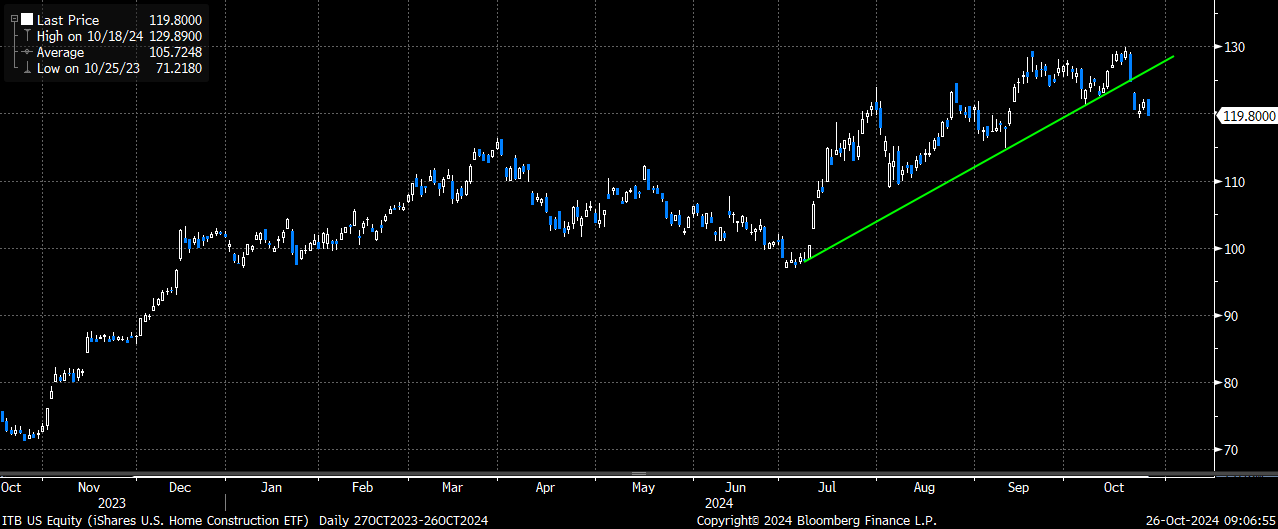
The housing trade had held up remarkably well until this past week, especially given the sharp backup in rates on the long-end since mid-September. The combination of continued weakness in bonds, and a few negative reactions to some high-profile housing names (PHM , MHK and SHW) led to ITB having its worst week of the year (a 7.38% decline). D.R. Horton (DHI) is by far the largest weighting in ITB at nearly 15%, and any outsized move should weigh heavily. DHI is due to report on 10/29 post-market, and the stock has had two realized moves of more than 9% in just the last three reports (a 10% gain in July and a 9.24% drop in January). Yes, ITB implied volatility is up a bit in November, but relative to the market (SPY) it actually screens “cheap”. ITB put vol also looks VERY attractive relative to rate (TLT) vol as well as it it trading at the cheapest levels of the year. Throw in the fact that DHI reports later this week, the recent weakness (break below July uptrend) in the sector and the huge negative impact a continued rise in rates on the long-end would have on the housing names and I think it’s an attractive buy here.
ITB just had its worst week of the year and a decided break below the July uptrend support
ITB 40-delta November put vol trading at the lowest relative skew to TLT 40-delta November put vol (bottom chart)

Here are two ITB trades to consider:
1) Buy ITB November 117 puts for $2.50 (ITB 119.80 ref)
2) Buy ITB November 115/105 put spread for $1.55 (ITB 119.80 ref)
Trade one gives you more exposure (36-delta) and full convexity to a sharp selloff on either continued weakness (perhaps led by disappointing DHI results/guidance) or a real big move higher in yields post-election (perhaps on a “red sweep”). Trade two is less delta (22-delta to start) but has a lower cost and has a 5.5x to 1 max payoff at expiration.
Communication Services Select ETF (XLC)
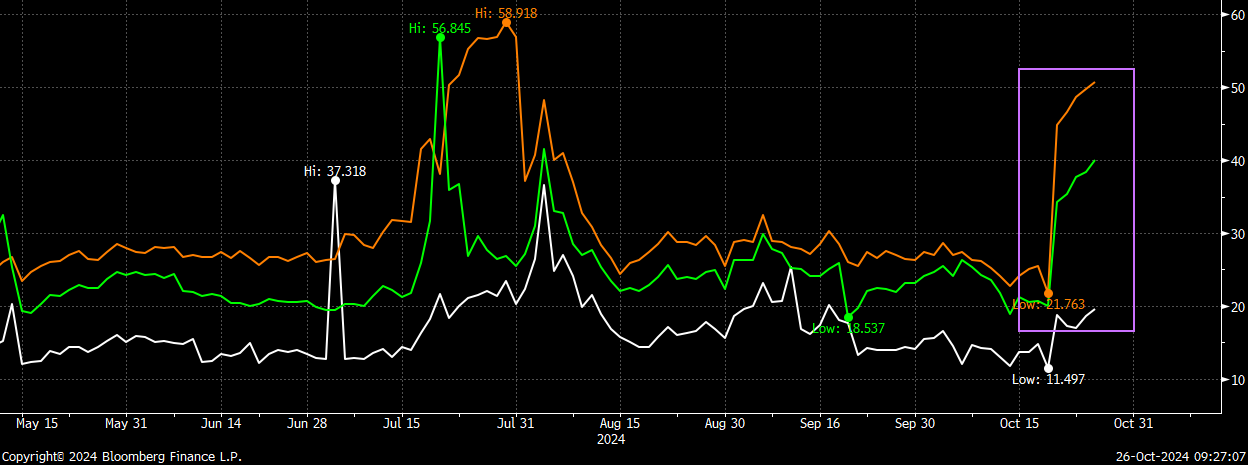
I find XLC very interesting in that you get not one, but two huge names that both carry significant weightings in the ETF. First is Meta Platforms (META) with a current weight of over 20% in XLC. META has followed-up last year’s huge rally with another impressive gain of over 60% YTD. They are due to report on 10/30 post-close and META has also become a very big mover on earnings (stock declined by over 10% in April following their report after jumping by more than 20% on the February report). META options are reflecting the probability of another large move on earnings, as November implied vol currently trades ~ 52. Alphabet (GOOGL) is the other large weighting in XLC with the Class A and C shares combining for a 19.53% weight. GOOGL has also become one of the bigger movers on earnings as of late with an average 1-day move of 7.6% over the last 5 reports with no move being less than 5%. Given the high weighting of both META and GOOGL in XLC, we have clearly seen the ETF react when both/either have outsized moves post-earnings. GOOGL is set to report on 10/29 post-close and November implied vol for GOOGL options currently is trading ~ 41. XLC November options are currently trading at an implied vol ~ 21-22, which looks “cheap” when compared with where both META and GOOGL vol trades (plus you get exposure to other names in the market). While I would expect META and GOOGL implied vol to move lower post-earnings, I think XLC vol will hold in much better given the already lower absolute vol as well as the election and Fed events the following week. XLC is just below the YTD highs but hasn’t been able to make new highs this month even with tech stocks once again regaining a leadership role in the market.
XLC implied volatility trading at a substantial discount to both META and GOOGL implied vol in November
XLC trade to consider:
Buy XLC November 89 puts for 1.05-1.10 (XLC 90.86 ref)
Buying the 30-delta (2% lower) November puts ahead of GOOGL earnings on 10/29 and META earnings on 10/30. Have seen large, realized moves for both names when they have reported as of late and XLC holds a 20% weight in each name. Good “cheaper” sector hedge instead of buying the more expensive single-name hedges. I also expect XLC vol to stay bid post earnings given all the catalysts still upcoming in November.
Gold/Silver Update
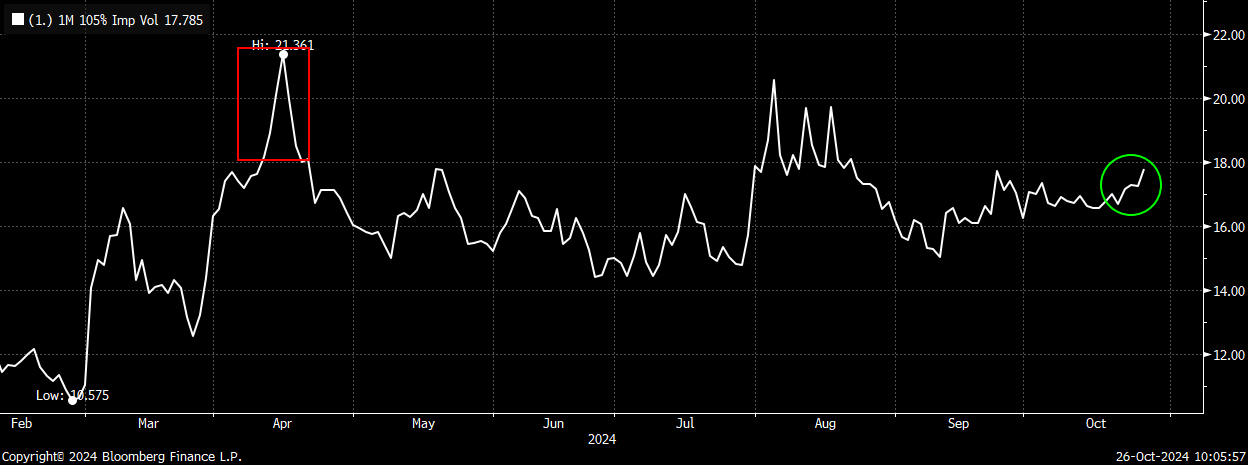
The 22V house call on both gold and silver remains decidedly bullish. As far as gold, the fact that it continues to climb even as both yields and the US$ continue to also move higher is extremely bullish and impressive. What I am watching for as far as gold (GLD) options would be a large bid to upside calls (much like we had in April). Typically, it is that type of action that marks short-term tops in commodities (especially gold) as it tends to be a great contra-indicator. To me, the fact that the GLD upside move has been so orderly AND no huge bid to the upside calls, means gold still has plenty of room to run.
GLD 5% 1-month upside call implied volatility remains subdued. I am watching for upside buying panic (like April) to turn less bullish
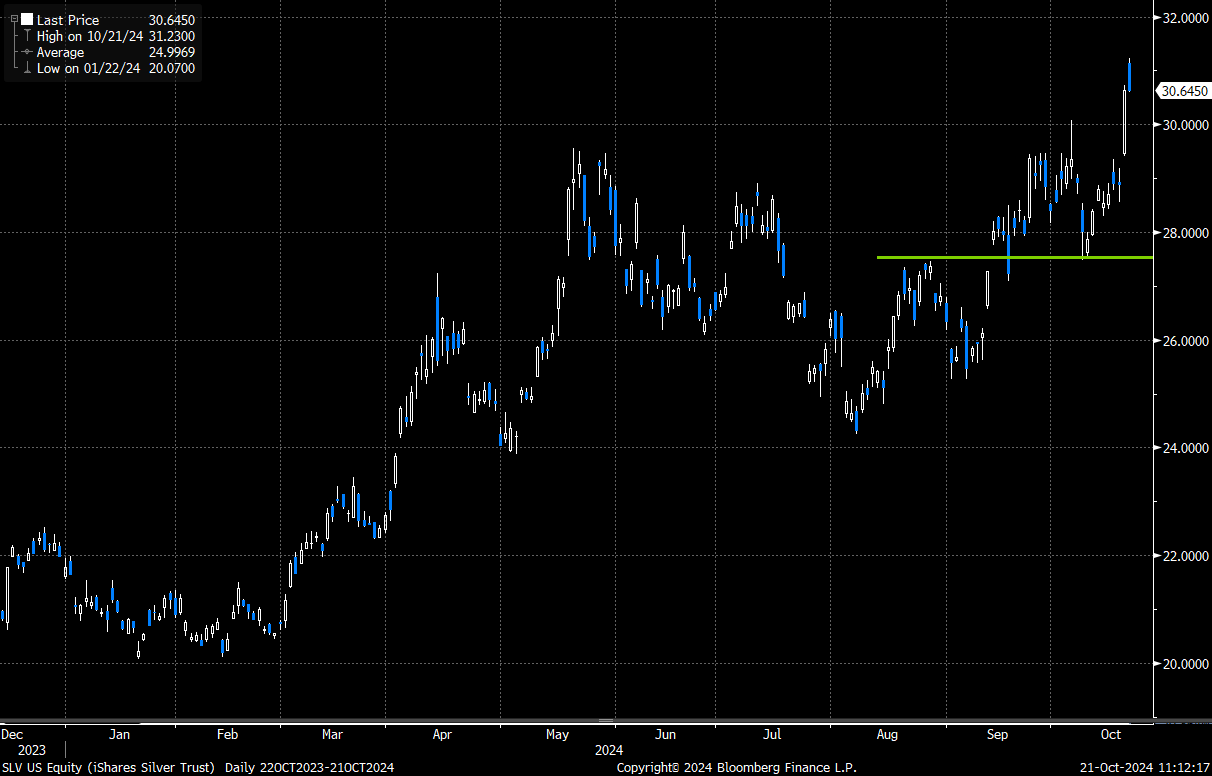
On the Silver front, 22V commodity analyst Colin Fenton is also rather bullish on Silver (see note here). This comes on the heels of 22V’s technical strategist, John Roque, who has also been very vocal about silver upside. He predicted the recent breakout and has a $40 PT on silver. Earlier this week I suggested the following SLV upside trade to play for continued strength in silver and a possible “catch-up” trade to gold following the recent breakout:
Trade:
Sell SLV Jan 28 put
Buy SLV Jan 32/40 call spread
Costs ~ $0.60 (SLV 30.65 ref)
Trade Details:
- Selling the 8.6% downside put to buy the $8-wide upside call spread that starts 4.4% above spot
- Large open-interest in upside SLV calls could lead to further gains
- Favor the January structure to allow time for bullish thesis to play out
- Trade offers a 12x to 1 max payoff at January expiration
- Structure could be added to an existing long/bullish silver position, or as an entry point trade (with a sizeable cushion to the downside)
SLV 3-month implied volatility at a 6-month high
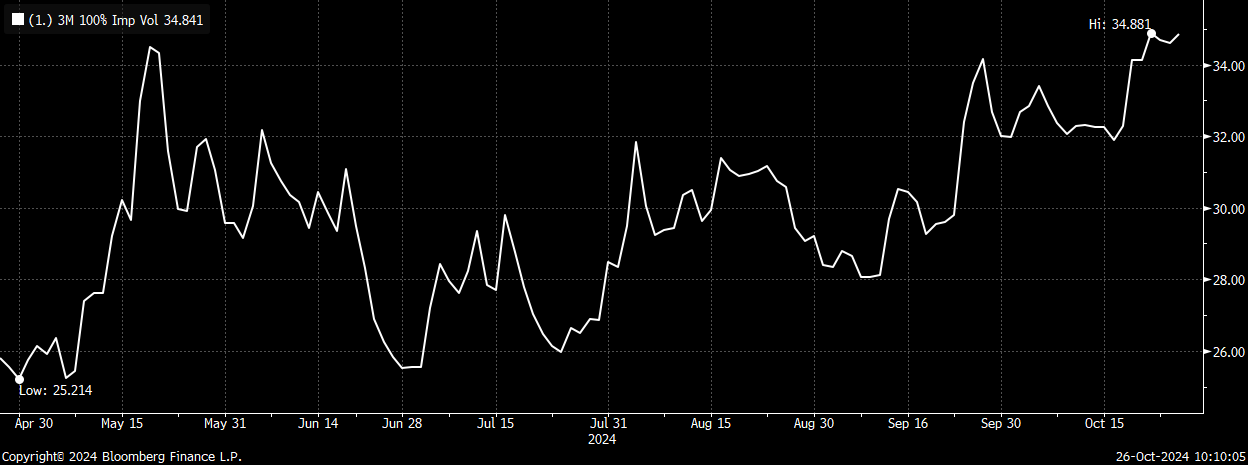
Selling the Jan $28 put to buy the upside call spread. Should be strong support between $27.50 and $28 on any pullback in silver
Please contact me or the 22V trading desk to discuss any of these ideas or for updated pricing.

