

The Macro Readthrough from Bank Earnings Season: Increased Optimism and Fewer Downside Risks
- While overall consumer delinquency levels keep increasing, the pace of that increase is slowing and bank management teams sound increasingly optimistic about the overall economy (JPM’s CFO Barnum noting that “the current central case of a kind of no-landing scenario economically” appropriately drew a lot of headlines).
- So far this earnings season, most firms reported modest y/y increases in delinquency rates or charge-offs but in recent quarters these have been roughly flat or in line with usual seasonality. BAC management said that “a few quarters ago we told you the consumer credit losses will go down this quarter given delinquency trends we had seen at the time. We also told you that office losses would be lower. Both of these proved true again this quarter,” even the lower-end exposed SYF said that they “continue to expect the second half 2024 net charge-off rate will be lower than the first half.”
- Consumer spending patterns continue to look solid with nominal growth paces in line with or a bit above pre-covid trends.
- The broad theme, for both spending patterns and delinquencies, is a return to something like normal after the post-pandemic period.
- There is a tentative initial hint of increasing demand for capital markets activity and business loan demand as we move further out from peak recessionary concerns and the Fed’s recalibration cycle begins. This, admittedly tentatively, suggests that the neutral rate may be higher than many seem to be assuming. Housing starts at or a bit above 2018-19 levels with mortgage rates roughly 2% higher also leans in that direction.
- We are coming off the largest non-recessionary tightening in credit standards in US history. This is both a source of current robustness in the economy (the tightening has already happened and there are fewer overly optimistic expectations to falsify) and, as it gradually reverses, a tailwind in 2025+.
- As the Fed debates monetary policy transmission and the appropriate stance of policy, the easing of the credit cycle and broader financial conditions both seem consistent with a higher terminal rate than the dot plot or markets currently expect.
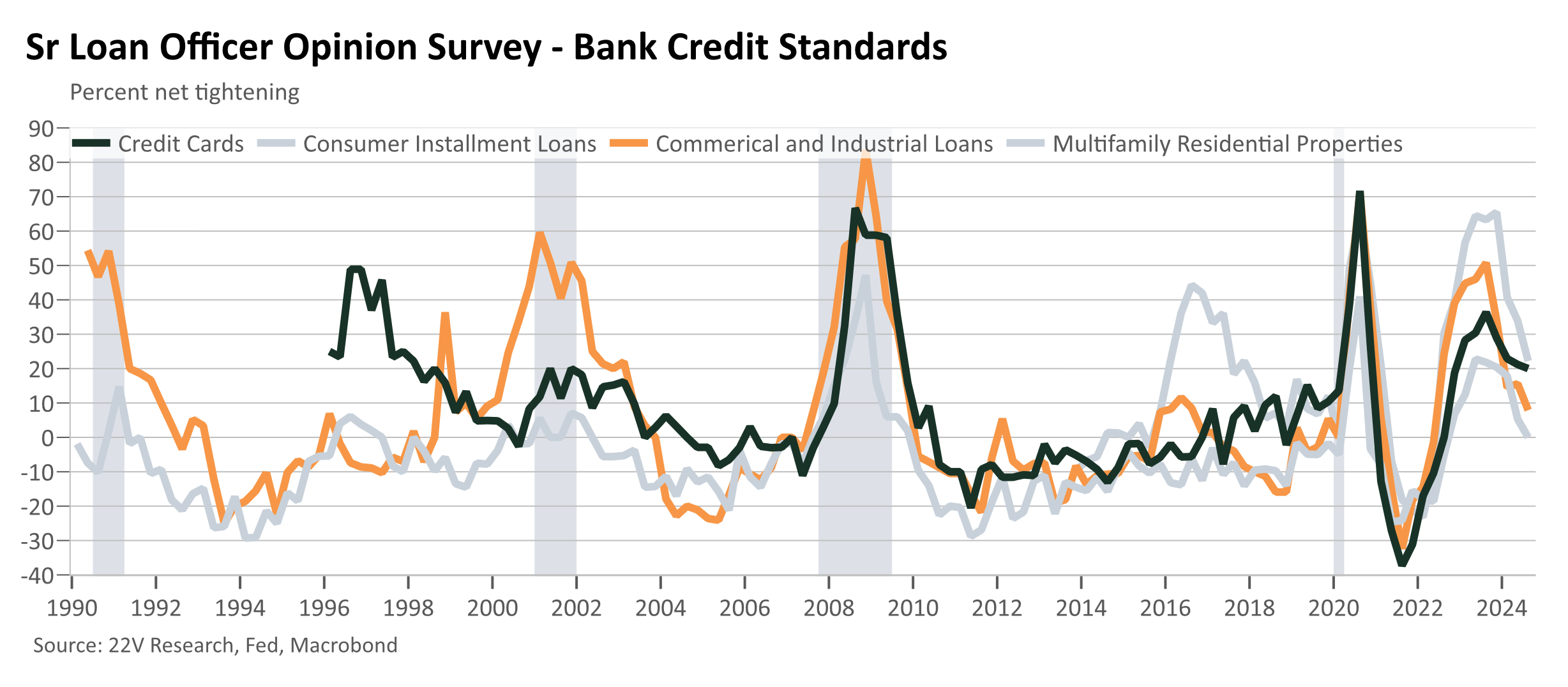
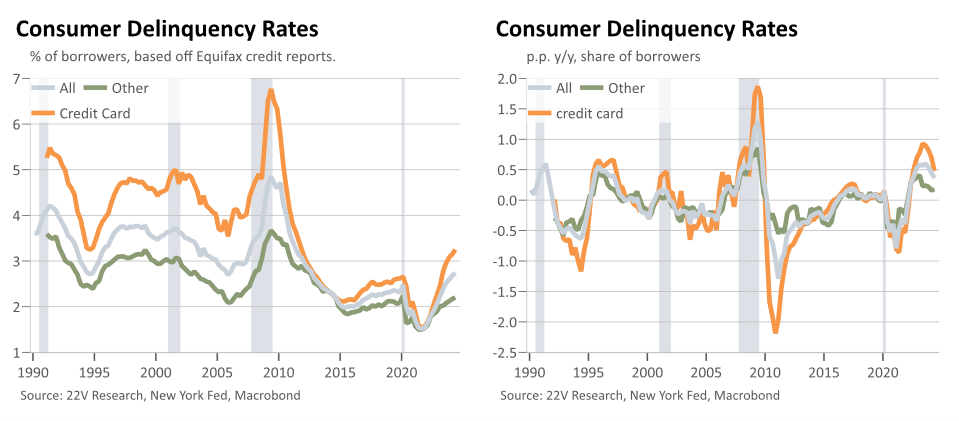
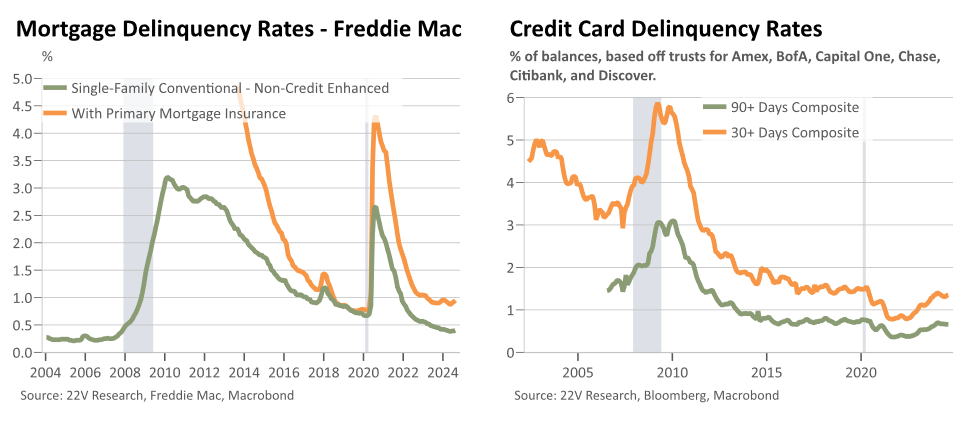
In the below charts note the gaps between the overall share of borrowers in the first two and the more selective credit quality of the large issuer trusts, as well as the gap between PMI and non-enhanced mortgages from Freddie Mac.
What Are the Banks Saying this Earnings Season?
Below are smattering of the most macro relevant quotes I noted during bank earnings calls so far in Q3. (Italics are mine).
JPM
- “You would normally think that rotation out of discretionary into nondiscretionary would be a sign of consumers battening down the hatches and getting ready for a much worse environment. But given the levels that it started from, what we see it as is actually like normalization. And inside that data, we’re not seeing weakening, for example, in retail spending.”
- “Overall, we see the spending patterns as being sort of solid and consistent with the narrative that the consumer is on solid footing and consistent with a strong labor market and the current central case of a kind of no-landing scenario economically. But obviously as we always point out, that’s one scenario and there are many other scenarios.”
BAC
- “[Consumer] payments were up 4% to 5% year-over-year for the quarter… The pace of year-to-year money movement has been steady since late summer this year after having fallen in the spring and early summer.”
- “Overall, activity is fine, unemployment is low and wage growth is steady, both of which bode well for the consumer overall and for consumer asset quality.”
- “We’ve seen consumer losses in a pretty tight range for a few quarters now.”
- “On asset quality, a few quarters ago we told you the consumer credit losses will go down this quarter given delinquency trends we had seen at the time. We also told you that office losses would be lower. Both of these proved true again this quarter.”
- “We’ve obviously seen pretty modest loan growth over the course of the past year, and its modest loan growth that we’ve put in our forward NII guidance. But we were pleased to see a little bit more loan growth at the end of the quarter there.”
WFC
- “We continue to look for changes in consumer health, but we have not seen meaningful changes in trends when looking at delinquency statistics across our consumer credit portfolios. Both credit card and debit card spend were up in the third quarter from a year ago, and although the pace of growth has slowed, it is still healthy.”
- “We continued to see more pronounced stress in certain customer segments with lower deposit and asset levels where inflation has partially offset strong employment and wage growth.”
- “Debit card spending increased 2.3 billion, or 2%, from a year ago. And credit card spending was up 10% from a year ago with growth in all categories except fuel.”
- “I think people are still being very prudent about borrowing. I think the 50 basis point reduction is helpful but not by itself a factor that will drive people to borrow or not. I think they’ll need to see that come down more meaningfully if that’s like the driving force.”
- “Consumer charge-offs declined from the second quarter driven by lower losses in our credit card portfolio while our other consumer portfolios continue to perform well, reflecting the benefit of prior credit tightening actions.”
- “Consumer net loan charge-offs declined $45 million from the second quarter to 83 basis points of average loans, driven by lower losses in the credit card portfolio.”
SYF
- “We expect delinquencies to follow seasonality in the fourth quarter. We also continue to expect the second half 2024 net charge-off rate will be lower than the first half.”
- “The credit actions we’ve taken from mid-2023 to early 2024 are improving our delinquency trajectory as the rate of year-over-year growth in both 30-plus and 90-plus delinquency rates continue to decelerate.”
- “We’re not seeing stress when it comes to payment.”
- “We don’t see stress in the consumer. We see them actually doing somewhat rational things right now. So it’s more normalization. But again, when you still look back against the prime customers, they are paying their rates still above the 2019 level. So we don’t necessarily see signs of stress in the low-end today.”
AXP
- “The third-quarter net write-off rate was 1.9 percent, compared to 1.8 percent a year ago, and down from 2.1 percent in the prior quarter.”
GS
- “The US economy continues to be resilient. Inflation has been coming down, the recent unemployment data is supportive, and while we’ve seen some softness in consumer behavior, the tone of my recent conversations with clients has been quite constructive. The beginning of the rate cut cycle has renewed optimism for a soft landing, which should spur increased economic activity.”
- “We see significant pent-up demand from our clients. Our backlog rose again this quarter, driven by advisory, and we expect our leading investment banking franchise to benefit from the continued resurgence in activity.”
DFS
- “Personal loan net charge-offs and delinquencies ticked up modestly but are well within historical norms, and vintages are meeting profitability targets. We continue to see a stable yet cautious consumer.”
- “In card, net charge-offs declined 27 basis points from the prior quarter, outperforming seasonality.”
TFC
- “Non-performing loans as a percentage of total loans remained relatively stable for the fourth consecutive quarter, while total delinquencies were also flat on a linked quarter basis.”
PNC
- “All year, we’ve yet to deliver the loan growth that we thought was coming at some future point, and for all the obvious reasons that you’ve seen, utilization is low. And there is a bit of a pause feeling, obviously, with the election coming up and the rate environment.”
- “The data remains strong. And as long as the data’s strong, consumers are spending, then the economy’s strong. So, everybody’s staring and watching and looking and there’s margin pressure on corporates. But… we don’t see in conversations some pending big layoff spike hitting the US economy.”
FITB
- “Early-stage delinquencies 30-to-89 days past due decreased 2 basis points to 24 basis points, which remained near the lowest levels we have experienced over the last decade.”
- “Overall, we are not seeing any broad credit weakening across industries or geographies.”
- “It just you’re talking about on an intermediate term basis, inherently more inflationary, dynamics, including the domestic manufacturing industrial policy, the green energy transition, the historic level of fiscal deficits that were running like, those are all things that should work against the long end of the curve moving meaningfully lower and potentially even you could see, if the Fed settles out of the, 3 or 3.5 the long end of the curve move up a little bit so you get more of a normal term premium.”
- “If interest rates come down and more M&A and capital investment starts to make sense, that hasn’t worked. You should see a pickup on that front. And then if we continue to see more certainty as it relates to the trajectory of the economy and have the uncertainty attached to the election out of the equation, I think we could see a better environment across the banking system.”

