

Why now is the time to buy November hedges
In my note last week I suggested that November market (SPY) hedges will be the one to own when looking to protect gains before year-end. I mentioned this for a variety of reasons; earnings, economic data, election and the Fed. In the note I said you didn’t need to run out and establish those hedges immediately, but they should be on the radar. As it turned out, it was a relatively quiet week on the equity front with SPY gaining ~ 0.25% on the week (helped in large part by the stronger jobs data on Friday).
As we head into a new trading week my position on this has changed. While I still favor owning November protective hedges, I believe the time to own them is now. So what has changed? First, there clearly is more geopolitical risk now then even a week ago. This can clearly be seen by the 9%+ gain in WTI crude on the week (not to mention the massive spike in upside oil call volatility – more on that later). Second, I continue to see a theme of stocks selling off on earnings whether they beat expectations or not. While still a small sample size, we saw meaningful declines in NKE, CAG, LEVI and STZ last week after they reported. Several of the larger banks will report at the end of this week, and then we get an earnings deluge over the following weeks heading into the election. Should we continue to see a “sell the news” pattern on earnings (especially in the tech names), that is likely to put pressure on the major indices even before the election and FOMC uncertainty (election day is 11/5 with the next Fed meeting/decision on 11/7). Lastly it was the action in volatility (VIX) last week, even as the markets rose, that has convinced me to want to own November hedges now and not wait much longer. The VIX index rose over 13% on the week and is now just below the August and September highs (when markets were considerably weaker). While we saw a minor pullback in VIX on Friday as markets rallied, it seems to me that given all the uncertainty on the geopolitical, economic and election fronts that volatility is unlikely to move considerably lower until we get thru all these events. At the same time, should we actually see equity weakness associated with this backdrop, volatility would very likely continue to climb even further. Since a major component of the risk of owning longer-dated (November) hedges is a drop in implied volatility, and I think that risk has been mitigated, I think the time is now to establish macro hedges. This is less of a market call, but more of just a smart insurance decision.
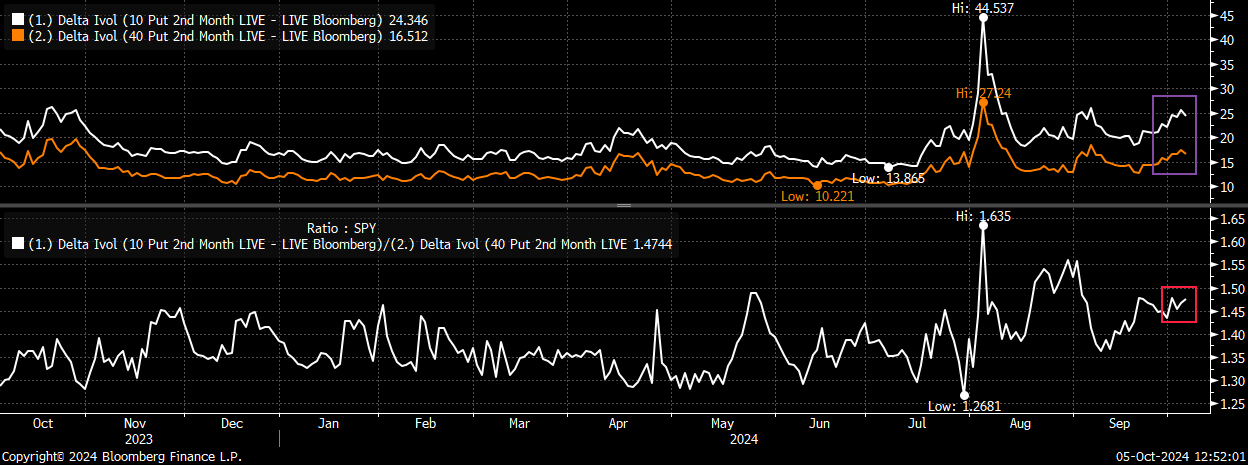
When trying to determine what the optimal hedge/structure is for these events I not only want to be mindful of where option volatility is priced, but what parts of the volatility curve have been most impacted. Our portfolio strategy team mentioned in their note Friday that tail risk hedging has increased substantially across the S&P 500, Nasdaq and small caps. This activity can clearly be seen when looking at the current skew between the 10-delta and 40-delta November puts (see chart below). Current skew shows the 10-delta puts trading at a nearly 50% vol premium to the 40-delta puts. This skew level was last reached when we had the sharp volatility spike in early August and then the subsequent market decline at the start of September. Rather than target buying this “rich” tail-risk protection, I prefer to use this very favorable skew to establish lower-cost put spread hedges that will protect a more normal market decline.
November 10-delta/40-delta put skew (bottom chart) has been steadily climbing since the September lows and is back near 1-year highs
Trade:
Buy SPY Nov 560 Puts (32-delta, 18.2 implied vol)
Sell SPY Nov 510 Puts (8-delta, 26.4 implied vol)
Costs $5.55 (SPY 573 price ref)
Trade Details:
- Buying the November SPY put spread with market having rallied back to just below the all-time highs ~ 574
- Put spread starts ~2% below spot and is capped to the downside at the 510 level. This is not only 11% below current levels, but the exact lows from the August selloff
- Put spread offers an attractive 8:1 max payoff thanks to fantastic put skew (the 510 put vol currently trades at a 45% vol premium to the 560 puts)
- Nov structure covers CPI this week on 10/10 (a stronger print on the heels of the better jobs number may spark renewed inflation concerns), then bulk of earnings season, October jobs report on 11/1, election on 11/5 and next Fed rate decision on 11/7
- Spending less than 1% of the underlying index to potentially protect against an 11% decline thru earnings season and election with index having a nearly 22% YTD total return
- Favor SPY macro hedge given large tech weighting. Tech (QQQ) peaked on a relative basis in July and has continued to be a laggard even as market has moved to new all-time highs
Commodity Corner
Ahead of the 22V commodity conference on Wednesday (I hope many of you will be attending) I wanted to point out two interesting dynamics I am currently seeing in the space:
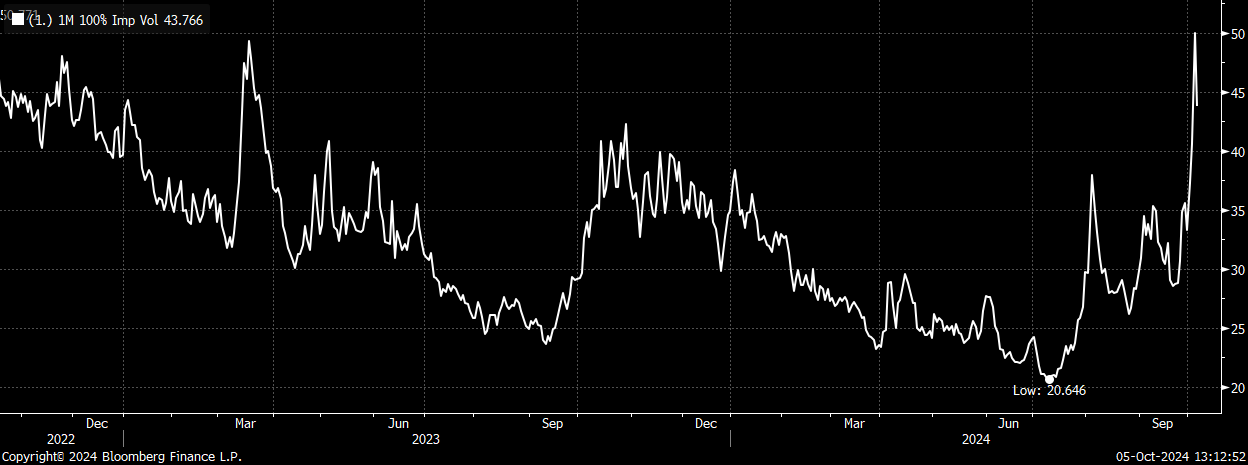
The first is in oil (USO) where we saw 1-month at the money implied volatility spike to as much as 50 before pulling back a bit on Friday to close the week ~ 44 (chart 1 below). But the real move was in the upside calls where implied volatility on the 20% upside calls nearly hit 60 (a 2-year high – chart 2 below). Typically, when we have seen such a spike in oil volatility, prices have tended to peak there or shortly after. At a minimum I would suggest considering an upside USO call sale if currently overweight energy names in the portfolio.
1-month at the money oil (USO) implied volatility spiked to a 2-year high this week on geopolitical concerns
1-month 20% upside vol. Oil has tended to peak when upside call volatility has spiked over the past year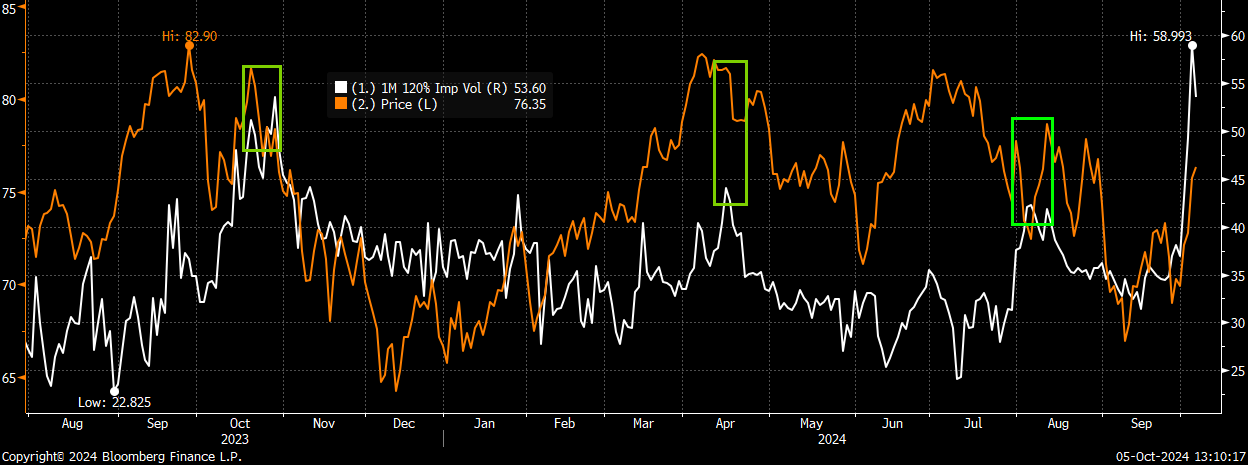
The second is in gold (GLD) which was flat on the week. While a flat week doesn’t sound super exciting, consider that the US$ index (DXY) was up over 2% on the week (its largest weekly gain in over 2 years). This $ strength (as yields spiked in the US) could easily have been used as an excuse to sell gold off from the highs and yet it closed the week unchanged. This, to me, is VERY bullish and shouldn’t be ignored. Which brings me back to the point I made on upside oil call implied volatility spiking and prices typically peaking there or shortly after. I have repeatedly been saying that GLD upside call vol continues to appear attractive and favor owning it as part of an overall bullish gold position. The orderliness with which both gold and upside call volatility have moved reinforces my positive position on both. If/when we see a large bid to upside GLD call volatility (much like we saw in April – chart below) then perhaps I will turn less bullish (or suggest selling the calls into a move higher in both the underlying and the upside implied volatility).
Gold (GLD) 1-month 25-delta upside call implied volatility remains subdued. Looking for a spike like we saw in April to turn more negative on gold


