Volatility setup into Q4
As Q3 comes to a close it’s time to start thinking about what the major market catalysts will be before year-end and what expirations should be targeted when considering portfolio hedges. As I look out on the calendar, all signs point to the window between the end of October thru early November as likely being the “make or break” period for the major indices. In just those two and a half weeks we will get all these significant events:
Earnings (with estimated release date) – TSLA 10/22, GOOGL 10/22, MSFT 10/29, META 10/30, AAPL 10/31 and AMZN 10/31. These six companies comprise 25% of the SPX (SPY) and 35% of NDX (QQQ) and their earnings, and stock reactions to those earnings, will likely go a long way to determining how the major indexes finish the year. These tech earnings become even more important since it was tech, and some really sharp declines on those earnings in late July, that fueled most of the drop into the early August lows. Technology stocks peaked on 7/10 and since that time have been a noticeable laggard as the market breadth has broadened out (a call 22V has been making for some time). QQQ is still down ~ 1% since 7/10, while SPY is +3%, IWM +5 and the equal-weight RSP up 7.5%. This tech underperformance has probably been downplayed since most other areas of the market have performed well. If we see a market decline in Q4 that is led lower by tech there will likely be a lot more attention paid to the tech relative weakness.
QQQ (white) is still down ~ 1% since peaking in early July and has significantly underperformed SPY, IWM and RSP

Economic data and the Fed – On 11/1 we will get the October jobs data. This number has surpassed CPI as the biggest market mover over the past few months. SPY has averaged a 1.4% move over the last three payroll reports, with both QQQ and IWM averaging 2% moves. With the October report being released right ahead of the next FOMC meeting, that number should once again play an important part in dictating the Fed’s next policy move. Speaking of the Fed, the next rate decision will be on 11/7 (right after the election). We did see a decided bid to vol into the last Fed meeting, and I would expect a similar type move in option volatility again into the November meeting.
Election – The election is now just over five weeks away. Since it appears to be a tight race, the uncertainty as to which candidate will win (and what sectors will benefit or not) will also likely keep a bid to option volatility. There is always the possibility too of there not being a clear winner which we know the market wouldn’t react favorably to.
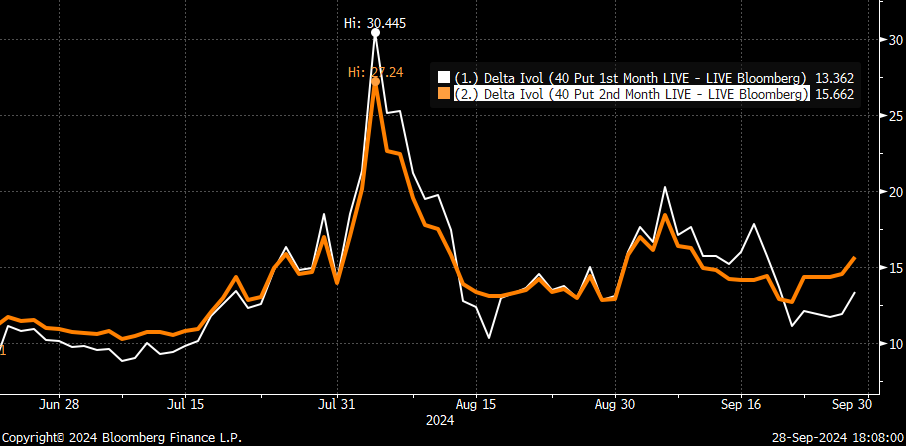
With that as a backdrop, let’s look at the current volatility setup as we head into Q4. As the chart below shows, 40-delta SPY put vol has come in considerably from the August highs. In addition, we are starting to see 2-month (November) vol trading at a decided premium to 1-month (October) vol. Given the slew of catalysts I mentioned above, I think the current vol premium is entirely warranted and it wouldn’t surprise me if we continue to see November vol move higher on both an absolute and relative (to October) basis. What should also be considered is that the market (SPY) is now up ~ 21.5% year to date. Given the known events occurring at the end of October/start of November, I think we will see many fund managers look to “protect” their year by owning downside hedges for these events (which should only give a further bid to volatility as we get closer). This doesn’t mean I am advocating that everyone should run out and buy November puts/hedges immediately, but I do think that if considering a market hedge at some point soon that November expiry (11/15) is the one to own. At a minimum, if currently long Oct puts I certainly would consider rolling them out to November before the sharp decay starts to negatively impact them. By the same token, I don’t think you need to go out to December and pay more on an absolute basis either.
November 40-delta put implied vol (orange) starting to move up relative to October 40-delta put implied vol (white)
China Update
Earlier this week 22V put out a bullish call on China after the PBOC’s initial easing measures were announced. We felt that sentiment had been so negative that these measures could kick-start a tradeable rally. The two option trades I suggested on Wednesday morning were to buy the FXI Dec 32/37 call spread as a way to add overall Chinese market exposure or buy the FCX Jan 55 calls given Colin Fenton’s very bullish view on copper (with the added upside kicker of China market strength). By the close on Friday the FXI trade had more than doubled, while the FCX calls were nearly a double.
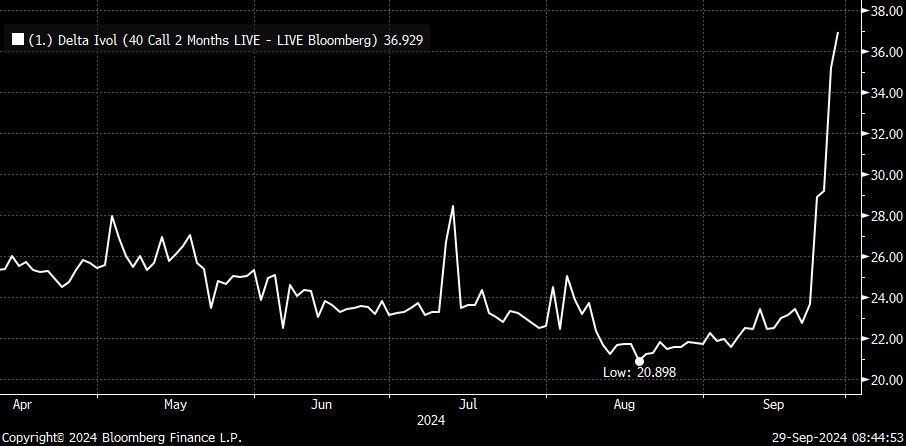
While we remain bullish on China, we now have to be mindful of the move in option volatility/pricing (specifically on FXI). Looking at the 2-month (December) implied vol we see a massive spike with 2-month 40-delta call implied vol having moved from ~ 23 at the start of last week to nearly 37 by the end of the week (chart below), Therefore, when considering FXI upside plays now I would want to be more of a net seller of vol in the context of adding further upside structures. Examples of such trades are 1) sell a downside put to own an upside call spread or 2) buy FXI stock and sell upside calls and/or a combination of calls and puts against the position. Please feel free to reach out to me to discuss specifics.
FXI 2-month (Dec) 40-delta call implied vol spiked from 23 to 37 just last week ( a 60% move)