Last Thursday we hosted a webinar with Sultan Meghji, Co-Founder and CEO of AI Pioneer Frontier Foundry, an AI platform with unique features to build specific deterministic systems and operate in a secure and highly regulated environment. This will be part of a series of webinars with Sultan. Replay HERE
A number of topics were discussed and we highlight a few below:
Deterministic vs. Probabilistic: There has been a lot of attention paid to Chat-GPT and other LLMs. There has been less focus on clear use cases. One concept to keep in mind is that ROI and productivity gains are more likely from companies that start with clear KPIs and work backward to the appropriate solution. That concept feeds into much of the rest of the webinar discussion.
Sultan noted that LLMs are great way for humans to interface with tech tools, but other AGI solutions are better for solving other problems. LLMs give probabilistic answers, not deterministic ones, which is an issue when users are looking for quantitative answers or need to justify/explain choices. Massive LLMs are cool tools but won’t be the key to getting a great ROI on AI investments.
Legacy Hardware vs. Nimble Software: Headlines focus remains on hardware and massive infrastructure spend but monetizing that spend is proving difficult/will take time. The AI buildout has been by captured by large, cloud-integrated companies, but the tools that are being built and used are not driving as high an ROI for the companies using them as AI applications should. That’s because the tools are either not fundamentally value drivers – LLMs being wrapped around existing infrastructure (Sultan references millions spent on tools to help write emails) – and/or because the cloud infrastructure does not provide the right privacy and security environment.
In 2Q, there were 75 S&P names with AI Usage readings in 2Q, sharply down from the 133 names in 1Q. Names with AI Usage and Mentions tend to be more exposed to Size, Quality, and Momentum, with less exposure to Value and Risk-off factors. In other words, even within large caps, the biggest names are still the source of MOST commentary and investment in AI.

Sultan also noted that software has improved radically over the past few years, which mean higher ROI solutions can be rolled out with little hardware spending. Software has improved to the point where Frontier Foundry has a full LLM running securely and privately on a laptop not connected to the internet. He noted that Frontier Foundry has 5 LLMS, dozens of models, but only ~5 GPUS. 2-3+ years out, large companies with cloud integration are not going to dominate the AI buildout. That point is outside of consensus. A lot of these companies can avoid traditional VCs because the necessary capital is so small. Companies only need 7 figure investments. That also means many of those companies fly under the radar.
Our own work suggests some of the AI frenzy has cooled over the past few quarters. Time and macro uncertainty seem to have increased the importance of questions around profitability/adoption trends of AI tools. The bottom line is fewer companies are talking about AI, particularly in concrete terms (specific projects vs. general commentary).
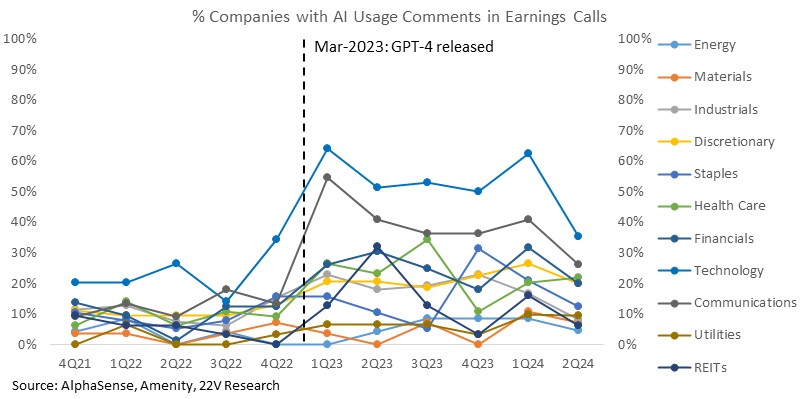
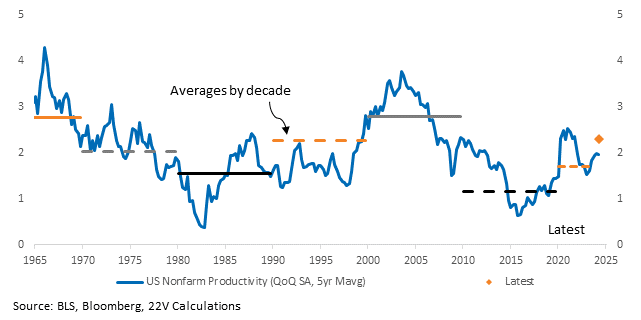
Productivity: We noticed some interesting economic readthroughs to productivity. The potential boost to productivity from AI is well understood (it’s the reason behind its popularity), but there’s one differentiated point – since the cost of AI tools is low, small companies can participate in the productivity boom. That’s a change in recent trends, where large companies were reaping most of the productivity rewards from economies of scale/monopolistic power. And macroeconomically, the service sector has been a drag on productivity. AI can help flip that.
For more on Frontier Foundry please find a link to their Substack, main page, and products page. We are really looking forward to the next conversation with Sultan and the team.