

EU leaders are meeting Thursday and Friday in Brussels for the regular March summit, focusing mostly on external affairs, including Ukraine, the Middle East, EU enlargement, and migration. Undoubtedly, the always successfully violent EU farming community will also secure that agricultural support is discussed, but of most economic relevance will be the EU leaders talk about the trajectories of future EU defense spending.
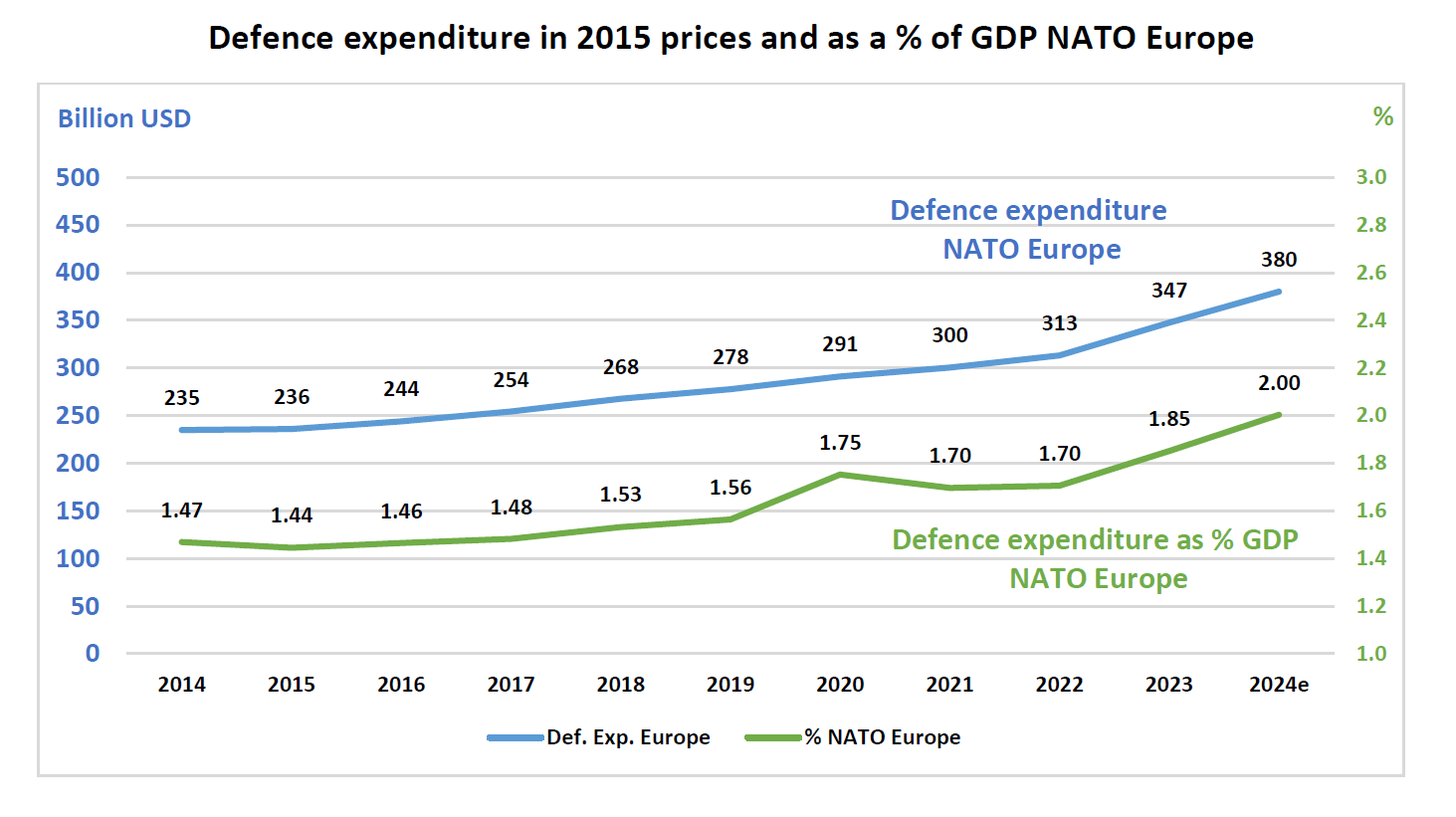
Defense spending among European NATO members (all EU members, minus Austria, Ireland and Cyprus, but plus U.K., Norway and Turkey) has been rising since Russia’s annexation of Crimea in 2014 and is estimated by NATO itself to reach 2 percent of GDP in 2024 (Figure 1).
Figure 1:
Source: Nato
Figure 1 illustrates that European defense spending began to rise slowly from 2014 onwards, as especially the euro area exited its double-dip recession and in response to Russia’s annexation of Crimea. The increasing trend hence precedes the election of Donald Trump (note that at least 2017 defense budgets were already approved when Trump was elected in late 2016) and merely continued during Trump’s presidency, before accelerating significantly after Russia’s full-blown invasion in 2022 towards the estimated 2 percent of GDP by 2024. Defense spending is estimated to rise by about half a percent of GDP and roughly $100bn in real terms from 2019 to 2024.
Given the extreme Russian aggression in Ukraine, and this week’s “post-election” announcement by the Russian government of a further expansion of the Russian army by 14 divisions and 16 independent brigades (quantitatively more than essentially all of the existing EU armies combined), this recent increase in European defense spending is not only likely to be permanent in nature, but also continue to rise after 2024.
Leading the increase in defense spending are unsurprisingly the NATO members bordering Russia in the North-Eastern part of the continent in Poland, the Baltic and Nordic regions, and in Germany, Czechia and Romania. In military spending terms, Europe’s internal balance of power is hence increasingly tilting away from the two traditional military heavyweights – France and the UK – and towards Poland and the North-East. Recent rhetorical refusal by French President Emmanuel Macron to rule out the deployment of French troops to Ukraine can arguably in part be interpreted as an attempt to compensate via the willingness to actually deploy troops for this shift in Europe’s military spending center of gravity.
The shift in European military spending towards many of the EU’s traditional “frugal members” generally opposed to more fiscal integration in the EU and the issuance of more common EU debt furthermore opens political space for potential European-level initiatives in the defense area. France and Estonia have already proposed the issuance of “European Defense Bonds” to help bolster regional defense budgets and Ukraine and secure adequate demand to enable Europe’s defense producers to expand production capacity. Opposition to these proposals are likely to be intense in some member states and noticeably Germany, but the fact that common defense bonds are openly discussed illustrates a shift in the EU “Overton Window” on common defense spending (simplified the Overton Window demarcates the range of policies that can be discussed among “responsible leaders” without jeopardizing their chance of reelection). While large amounts of European Defense Bonds remain unlikely in the near-term, this option will almost certainly be revisited by EU leaders in the event of a Trump victory in the US elections come November.
EU leaders this week however also discussed a range of other ways to increase common funding for defense and Ukraine assistance. The Summit Conclusions tasked the European Commission to “explore options for mobilizing funding and report back [to leaders] in June“. This is EU-diplomatic speech for asking the Commission to write a report outlining the different ways in which more funding can be generated for European defense. This report is now likely to include among a list of alternatives also variations of the “European Defense Bond” proposal.
Another legalistic way in which EU institutions are likely to find ways to increase common defense spending will likely see Commission and Council lawyers figure out a way around Article 41.2 in the EU Treaty, which prohibits “expenditure arising from operations having military or defense implications” from being funded directly by the EU budget. To date the EU has only been able to purchase weapons for Ukraine through a special purpose fund outside the regular budget, requiring direct contributions from member states on an ongoing basis. Agreeing that it would be permissible under Article 41.2 to use the regular EU budget to purchase weapons for third parties – e.g. Ukraine – as this would not be expenditure from an EU operation would potentially unlock sizable new resources for Ukrainian weapons support. Like European Defense Bond, this legal option will likely be included in the Commission’s report to EU leaders in June.
Similarly, the EU will in the coming months start channeling the estimated $3bn annual income from frozen Russian assets in the EU directly towards the purchase of weapons for Ukraine, including as part of the Czech initiative to purchase 800,000 artillery shells.
Lastly, on the financing side, EU leaders “invited” (i.e. ordered) the European Investment Bank (EIB) to “adapt its current policy for lending to the defense industry and its current definition of dual-use goods“. Or in other words, EU leaders told their jointly owned government bank to start lending to defense projects and dual-use production capacity in Europe. This, too, should shortly unlock funding for more investments in the European defense industry.
Overall therefore, while US military assistance remain critically important for Ukraine today and in the coming months, should the war as it looks likely continue for several years, European countries will gradually be able to provide a far larger part of also military assistance to Ukraine.

