

Pardon the pun. But a client pointed out to me that there is a disconnect between the trend in Indeed’s marginal wage growth tracker and the apparent rate of inflation in Average Hourly Earnings (AHE). He is right about that, and I think the issue he points out is worth considering.
Let’s start with what the raw data show, as depicted in the chart immediately below. It compares the 12-month change in AHE controlled for sector and rank mix shift in the usual way with Indeed’s wage tracker. As the analysts at Indeed point out themselves, their wage tracker is developed in a way that is analogous with the Atlanta Fed’s wage tracker in the sense that they survey the 12-month rates of individuals (in this case individual postings) and attempt to weight the results of that survey to correspond with the relevant economics (in this case the sector distribution of job classifications throughout the economy).
The key point is that Indeed measures the rate of growth of marginal wages, which in principle might lead the average wages picked up by AHE. And speaking of analogies, this makes it analogous with how marginal rents might lead average rents. (And incidentally, Powell yesterday expressed high confidence that average rent growth will slow because the marginal does in fact lead.) So, taken in isolation, the steep deceleration of the Indeed tracker shown below should incline us to expect some further moderation of wage growth. We know it does not itself point to acceleration.
Marginal may lead the way, in labor markets as in housing

All data are actual to February.
The question is how strong this signal is. And that is a tough one because we do not have a long run of the Indeed data. Moreover, it is the cumulative gap between marginal and average wages that should drive the acceleration or deceleration of average wage growth, picked up by AHE. And because the Indeed wage tracker has dropped below the rate of change of AHE, we know that the gap must be narrowing now. But from where? And where?
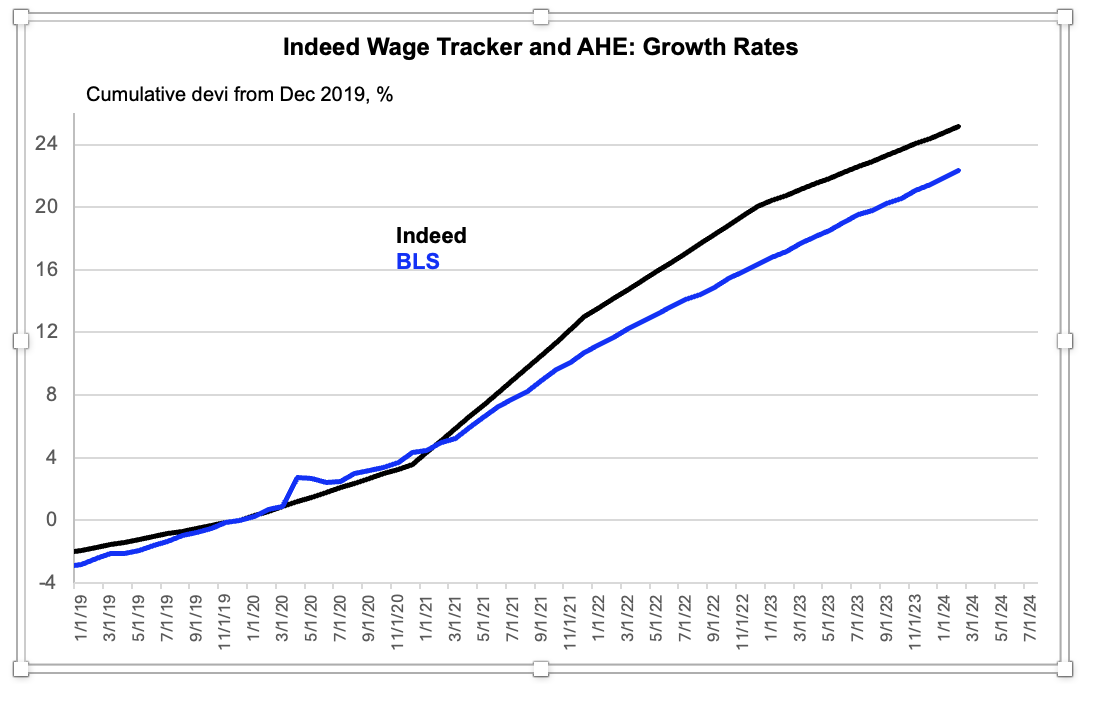
The lower panel of the chart above shows the estimated cumulative gap since pre-Covid separating the level of the Indeed wage tracker with AHE. I had to do some mental gymnastics to convert the surveyed growth rate within the wage tracker to level terms. But unlike with the marginal wage data in the Atlanta Fed wage tracker, the change metric in the Indeed series is commensurate with a level. And I made the conversion in the most conventional way, although there is some risk of imprecision there. (The chart at the bottom of this note shows my proxy of the level of Indeed and then the level of AHE, the latter of which is readily available from my regular data tracking.)
We see two things from this analysis. First, the cumulative gap has narrowed from a peak of 3 1/4% to about 2 1/4%. In principle, this should mean that the gravity tugging on the rate of change of AHE growth is less upward. So, if this were a reliable leading indicator, we might expect AHE growth to slow. And my guess is that there is something to that.
But second, there is little evidence that the gap actually leads. Both the gap and the pace of Indeed’s wage tracker peaked well before the peak of AHE, although all have been slowing recently. One might say the gap leads, but in principle it ought not. So, I cannot put a lot of weight on this indicator, although I concede it is probably picking up something relevant. Comments are most welcome.
The level metrics used to calculate the cumulative gap above
All data are actual to February.

