SUMMARY – First the Fed: If the Fed moves its 2024 PCE forecast from 2.4% to 2.6% or below for 2024 (some are at 2.5%) and keeps 3 cuts, that would be viewed as dovish. It’s hard to get to 2.6% or below on PCE for 2024 WITHOUT assuming most of the increase in inflation in January and February was seasonal and will be reversed. A 2.7-2.8% PCE forecast plus 2 cuts would be viewed as hawkish. But not a surprise based on our conversations. Also, actual inflation COULD surprise to the downside relative to a 2.8% forecast, increasing the odds of 3 cuts being priced. 2.8% is an easier bar to clear. The initial read would be hawkish though.
If the forecast shows 2.7% and 3 cuts, it’s likely the Fed will attempt to offset that with fewer cuts in 2025 and 2026 (who cares). The most hawkish SEP change would be a 2.6% PCE forecast and 2 cuts. 2.6% is a harder inflation bar to clear (too low) and the Fed would be at 2 cuts with an assumption that much of Jan/Feb CPI was seasonal. That would signal very little tolerance for PCE moving up from the current 2.4% forecast level.
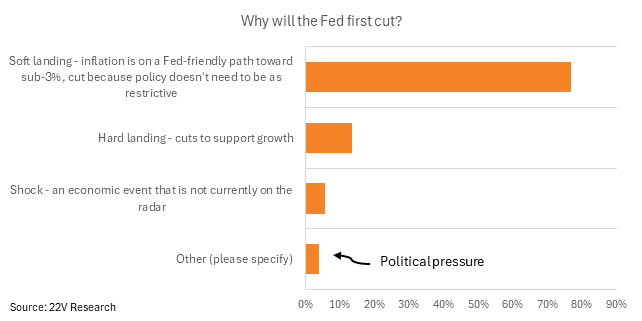
In any scenario, Powell will go to great pains to dismiss the forecast at the press conference. The March CPI data, released in April, is the most important macro focus now. 77% of our survey respondents think the first-rate cut will happen because inflation is on a Fed-friendly glide path (HERE). The next CPI print must show core inflation is reversing some of the large increase in Jan/Feb for investors to keep assuming inflation is on a Fed-friendly glide path.
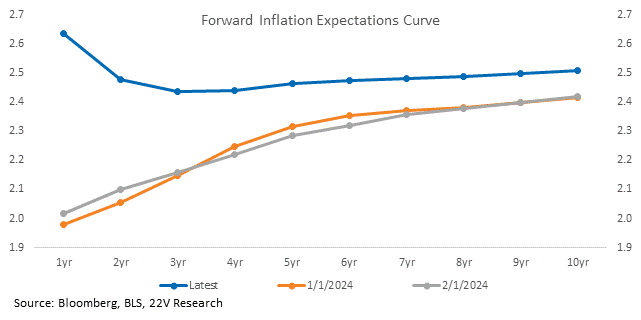
Inflation Sticky Relative to Economic Growth: Short term inflation expectations have shifted higher, relative to the start of 2024 and what was assumed on 2/1/24. Longer-term inflation expectations remain anchored and basically in line with how 2024 started. All the increase in inflation expectations has been in the shorter term. At the same time, economic growth trends have shifted lower, but remain at an acceptable level.
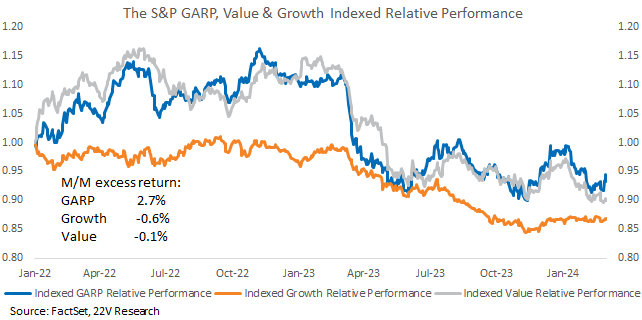
This shift to inflation being a larger driver of nominal GDP, relative to 2024, is consistent with the shift in market internals. After a slow start in January, when short term inflation expectations were VERY low, Deep Cyclicals (Energy, Industrial, Materials) have significantly outperformed Defensives (Staples, Utilities, Pharma) YTD after the unusually strong gains in February. Value has bounced back and GARP has had a very strong month. While Inflation is slowing, not reversing the Fed’s easing bias, expect recent Deep Cyclical, GARP, and Value trends to continue.
Full report below…
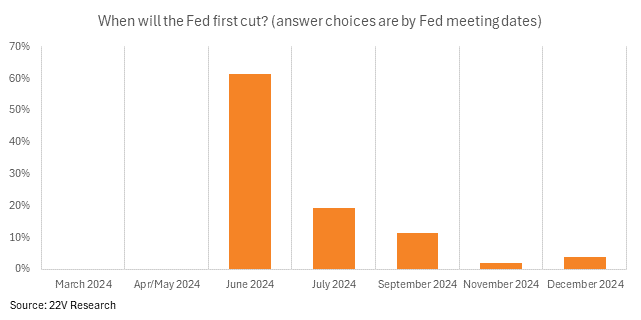
MARKET VIEWS: FYI – the Fed’s current forecast, as of December, calls for 2024 core PCE of, and 3 cuts. If the Fed pencils in A 2.6% or below PCE forecast for 2024 (some are at 2.5%) and keeps 3 cuts, that would be viewed as dovish. It’s hard to get to 2.6% or below on PCE for 2024 WITHOUT assuming most of the increase in inflation in January and February was seasonal and will be almost fully reversed. We would all know that the Fed is assuming inflation has been mostly seasonal. 2.7% or 2.8% PCE forecast, and 2 cuts would be viewed as hawkish, but data dependent. Inflation could surprise to the downside vs 2.8% and 3 cuts come back in. The initial read would be hawkish though. If the forecast shows 2.7% and 3 cuts, it’s likely the Fed attempts to offset that with fewer cuts in 2025 and 2026 (who cares). 62% of our Investor Survey respondents (HERE) think the first-rate cut will happen in June.
In any scenario Powell will go to great pains to dismiss the forecast at the press conference. The March CPI data, released in April, is the most important macro focus now. 77% of our survey respondents think the first-rate cut will happen because inflation is on a Fed-friendly glide path. Only 13% expect a hard landing. The next CPI print must show core inflation is reversing some of the large increase in Jan/Feb for investors to keep assuming inflation is on a Fed-friendly glide path.
Implications of Inflation Remaining Sticky Relative to Growth: We have noted a few times over the past week that inflation has remained sticky as economic demand downshifts. The forward inflation expectations relative to economic growth trends confirm this view. Short term inflation expectations have shifted meaningfully higher relative to the start of 2024 and what was assumed on 2/1/24. Longer-term inflation expectations remain anchored and basically in line with how 2024 started. All the increase in inflation expectations has been in the shorter term.

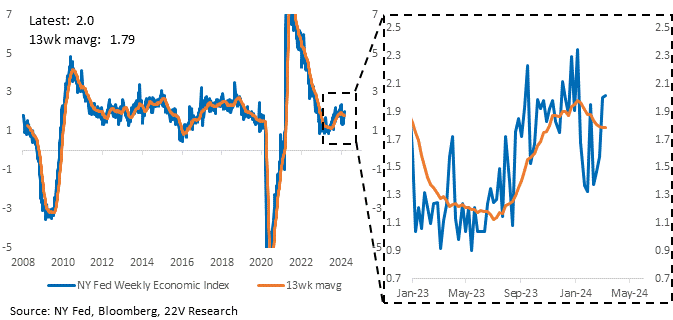
At the same time, the trend in economic growth has rolled over some. Economic growth is still firm but has started to downshift relative to inflation. The NY Fed Weekly Economic index has started to roll over after a sharp acceleration in 2023.
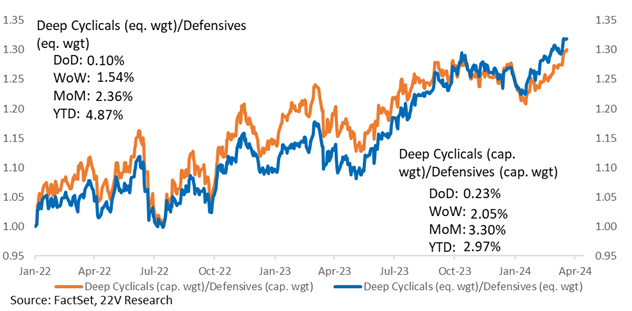
This shift to inflation being a larger driver of nominal GDP relative to 2024, is consistent with the shift in market internals. After a slow start in January, when short term inflation expectations were VERY low, Deep Cyclicals (Energy, Industrial, Materials) have significantly outperformed Defensives (Staples, Utilities, Pharma) YTD after the unusually strong gains in February.
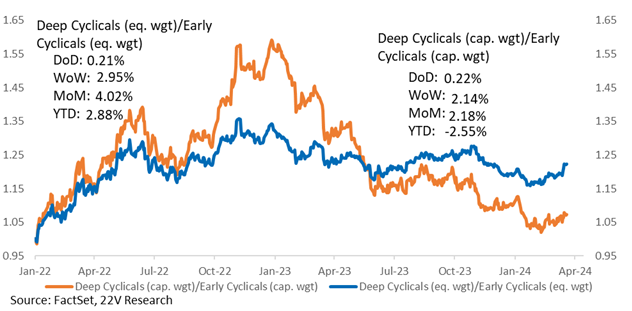
Deep Cyclicals are outperforming Early Cyclicals (Tech, Discretionary, Communications) on an equally weighted basis YTD. They are catching up on a cap weighted basis, but still have room to go.
And our favorite factor, GARP, has had a significant outperformance MoM. Value has outperformed the S&P MoM and we expect that to continue if inflation remains sticky. FYI – we expect inflation to remain sticky, but for the Fed to maintain an easing bias. Inflation is slowing, not reversing the Fed’s path. That is why Deeper Cyclicals and Value can outperform as inflation remains sticky. If the Fed needs to tighten financial conditions aggressively again, that would be a problem for Deep Cyclicals, Value, and GARP.