Back Economic Research

A Fairly Quiet Day for Powell on the Hill; Jan JOLTS Show More of the Same

Published on March 6, 2024

∙ Download the PDF Report

By

Peter Williams

A Fairly Quiet Day for Powell on the Hill; Jan JOLTS Show More of the Same

In today’s testimony in front of the House there was relatively little new news from Chair Powell.

That may have come as a bit of relief to markets, given Powell’s hawkish pushback at the January meeting, as rates barely moved in response to the testimony. Given looming NFP and CPI data, the March meeting being off the table, and the May + June meetings feeling forever away, the absence of response may not be too surprising.

Powell’s framing of cuts as a strong base case was in line with expectations, as was the stated view that the “policy rate is likely at its peak for this tightening cycle.” The default for the Fed seems to be a continued desire to make some cuts, reflecting their views on r* and the progress seen to date on inflation, but the data will tell them when and how many.

One exchange on the growth outlook stood out to me in particular for Powell’s relative optimism and the way it hinted at a much smaller downside growth tail necessitating less of a risk management concern there. Powell said that the base case is now “continued growth at a solid pace” and “there’s no reason to think that the us economy is in some kind of a short-term risk of falling into a recession.” I think this ‘solid’ range corresponds to roughly 1.2-2% GDP growth, comfortable, below trend to just a bit above. Overall, this suggests that we may see moderate revisions to the March SEP; 1.4->1.6 on 2024 GDP growth seems about right to me, perhaps the Fed is a bit more tentative in shifting its q4/q4 growth forecast this early in the year and we just get 1.5.

Powell also further reiterated that 2% PCE (implicitly on a 12m basis) isn’t the trigger for cuts. Rather the decision to start cutting will be driven by the FOMC gaining further confidence that they weren’t seeing an inaccurate signal from the good inflation readings in 2023H2. He said that the Fed need’s “just a bit more evidence so we can be confident”. Implicit in this is some m/m vol tolerance but also a bit of a concern that some of last year’s good data could be non-indicative of underlying inflation dynamics. Just like at the Jan meeting, the test is more about accumulating further good data points in an almost binary sense rather than continuing to being down 3-12m inflation rates; “we’d like to see more good relatively low inflation readings. We’re not looking for better inflation readings than we’ve had. We’re just looking for more of them.”

While lower inflation allows the Fed to become more symmetric in its relative weights on the two-sides of the mandate, “because the economy is so strong and the labor market is so strong, we think we can and should be careful as we approach” the decision to start cutting.

The rest of the testimony was the usual partisan wrangling and a series of notable exchanges on bank regulation, all of which suggested that the Basel endgame framework is under substantial pressure but I leave that to the banking analysts.

January JOLTS Data Keep the Story Largely the Same

This morning’s JOLTS release was overshadowed by Chair Powell’s appearance and saw no real departures in its general trends seen over the past few months.

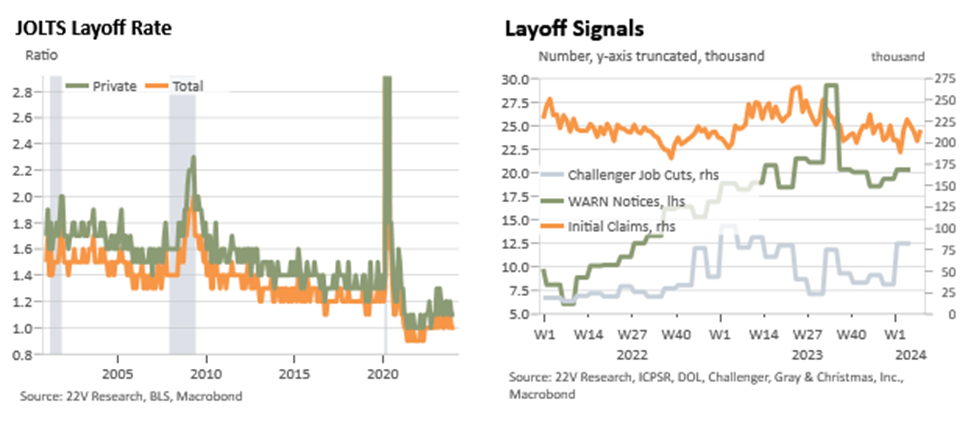
Most notably, the layoffs rate continues to be at low levels never seen before covid hit. While recent headlines have grabbed attention for layoffs, the JOLTS data, WARN notices, Challenger data, and jobless claims all point to a continued very low layoff rate which seems below its cyclical peak (so far) in 2023H1.

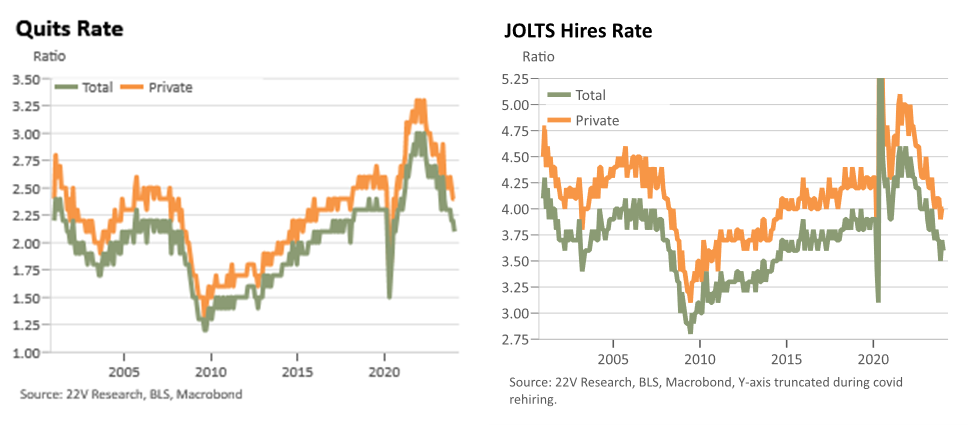
The quits and gross hires rates continue show a bouncy payback period after the surge in job market churn which characterized the 2020-22 period. Both measures give some of the most negative readings on the labor market, but this is somewhat illusory in my view cumulative churn so overshot its usual pace during the pandemic era that workers and firms are now in re-equilibration period. This decline in churn, and openings, has made regaining employment for laid off workers somewhat more challenging.

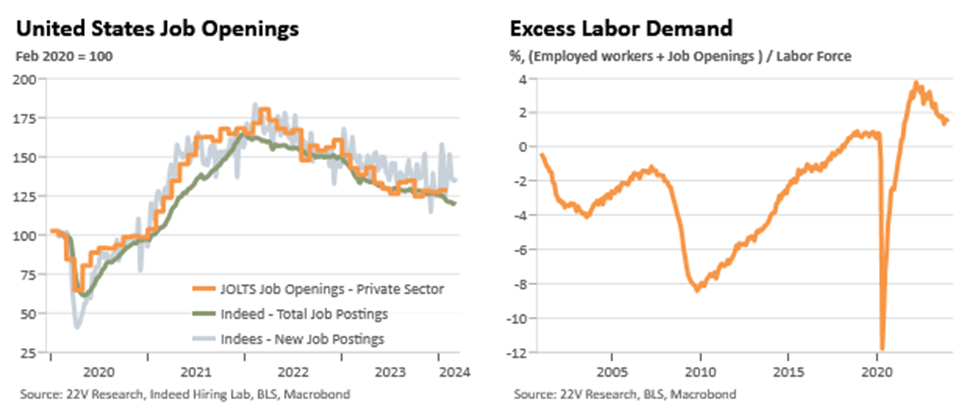
Openings were essentially flat m/m. The formerly very in vogue total labor demand (employed workers + job openings) relative to labor supply measure has now ticked up the last couple of months. At a minimum, the Fed sees this as evidence that the labor market remains fairly tight if less tight than it once was.

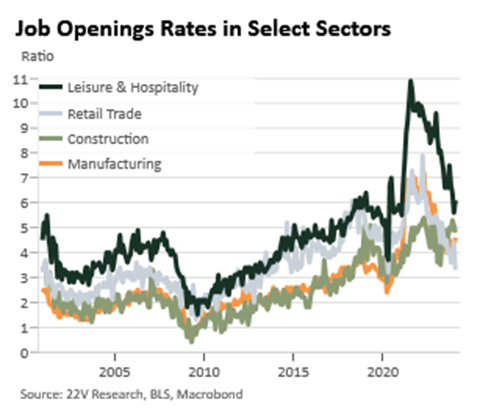
Given my underlying view that the ISM and housing cycles have started to gradually bottom, the relative strength in both manufacturing and construction job openings since mid-2023 is notable. Perhaps unsurprisingly, retail trade continues to look like one of the weakest, or at least in need of further expansion, areas of the economy. Leisure and hospitality, which has been a consistent source of upside job gains since the mass layoffs during the pandemic lockdowns, has seen its openings rate decline and NFP growth slow notably. This is one of the areas of the labor market I’m watching most closely given the way demand there has supported the overall recovery even as other cyclical sectors, now seemingly starting to recover, were hit by the tightening cycle.
DISCLOSURES AND DISCLAIMERS

Analyst Certification

The analyst, 22V Research Group, primarily responsible for the preparation of this research report attests to the following: (1) that the views and opinions rendered in this research report reflect his or her personal views about the subject companies or issuers; and (2) that no part of the research analyst’s compensation was, is, or will be directly related to the specific recommendations or views in this research report.

Analyst Certifications and Independence of Research.

Each of the 22V Research analysts whose names appear on the front page of this report hereby certify that all the views expressed in this Report accurately reflect our personal views about any and all of the subject securities or issuers and that no part of our compensation was, is, or will be, directly or indirectly, related to the specific recommendations or views of in this Report.

22V Research (the “Company”) is an independent research provider. The Company is not a member of the FINRA or the SIPC and is not a registered broker dealer or investment adviser. 22V Research has no other regulated or unregulated business activities which conflict with its provision of independent research.

22V Research, LLC is a professional services and independent publication organization. 22V Research, LLC is not a securities broker-dealer, not a member of the Financial Industry Regulatory Authority (FINRA), not a registered investment advisor (RIA) and not a member of SIPC.

Securities transactions, when offered, are offered by 22V Securities, LLC through LPS Capital, LLC. Certain employees of 22V Securities, LLC are dually registered as securities representatives of LPS Capital, LLC or Analyst Hub Securities, LLC. 22V Securities, LPS Capital and Analyst Hub Securities are members FINRA, SIPC.

https://brokercheck.finra.org/

Current Ratings Definition.

SECTOR OUTPERFORM: An “outperform” rating anticipates the company will outperform the S&P Regional Banking Index (peer group).

SECTOR PERFORM: A “market perform” rating anticipates the company will perform in line with the S&P Regional Banking Index (peer group).

SECTOR UNDERPERFORM: An “underperform” rating anticipates the company will underperform the S&P Regional Banking Index (peer group).

Limitation Of Research And Information.

This Report has been prepared for distribution to only qualified institutional or professional clients of 22V Research Group. The contents of this Report represent the views, opinions, and analyses of its authors. The information contained herein does not constitute financial, legal, tax or any other advice. All third-party data presented herein were obtained from publicly available sources which are believed to be reliable; however, the Company makes no warranty, express or implied, concerning the accuracy or completeness of such information. In no event shall the Company be responsible or liable for the correctness of, or update to, any such material or for any damage or lost opportunities resulting from use of this data. Nothing contained in this Report or any distribution by the Company should be construed as any offer to sell, or any solicitation of an offer to buy, any security or investment. Any research or other material received should not be construed as individualized investment advice. Investment decisions should be made as part of an overall portfolio strategy and you should consult with a professional financial advisor, legal and tax advisor prior to making any investment decision. 22V Research Group shall not be liable for any direct or indirect, incidental or consequential loss or damage (including loss of profits, revenue or goodwill) arising from any investment decisions based on information or research obtained from 22V Research Group.

Reproduction And Distribution Strictly Prohibited.

No user of this Report may reproduce, modify, copy, distribute, sell, resell, transmit, transfer, license, assign or publish the Report itself or any information contained therein. Notwithstanding the foregoing, clients with access to working models are permitted to alter or modify the information contained therein, provided that it is solely for such client’s own use. This Report is not intended to be available or distributed for any purpose that would be deemed unlawful or otherwise prohibited by any local, state, national or international laws or regulations or would otherwise subject the Company to registration or regulation of any kind within such jurisdiction.

Copyrights, Trademarks, Intellectual Property.

22V Research Group, and any logos or marks included in this Report are proprietary materials. The use of such terms and logos and marks without the express written consent of 22V Research Group is strictly prohibited. The copyright in the pages or in the screens of the Report, and in the information and material therein, is proprietary material owned by 22V Research Group unless otherwise indicated. The unauthorized use of any material on this Report may violate numerous statutes, regulations and laws, including, but not limited to, copyright, trademark, trade secret or patent laws.