

It is surprising that the Fed staff and much of the leadership are still pushing – although less than they had – the Excess Savings Stock thesis. I have reviewed in some detail the many analytical problems with that view and promise not to repeat here. But one issue I have not given much attention to is the idea that the saving rate is not what it seems in a measurement sense. And the issue here has nothing to do with how saving is not defined as the change of wealth. On that particular issue, I agree with the statistics mills.
There are two basic measurement problems affecting the saving rate. First, and most obviously, the official data are extremely subject to revision. This fact alone should be taken as a warning never to reason from the published level of the saving rate, neither its current value nor the path to that value. And yet people do.
The second issue is more subtle and is the subject of a couple notes, the first of which I present here today. In principle, the saving rate should be adjusted downward for the effect of excessive (surprise) inflation on the real value of government debt held domestically.[1] And separately, the saving rate should be adjusted upward for abnormal capital gains tax payments. Quite appropriately, we do not include the capital gains themselves in our flow measure of saving. And by extension, we certainly should not include tax payments on those capital gains as a detraction from disposable income and thus saving. These points were helpfully raised a couple decades ago by Jason Benderly, recently of Applied Global Macro Research. He is the innovator here and I am just updating, and responsible for my own errors here.
I had hoped just to send around his work from an archive on the internet, but I have failed in coming up with it. So, in this note I will channel his insight into the first point regarding the inflation distortion. And I will follow up with a note on the role of capital gains. I suspect the second issue is more important than the first, including in this environment, which may seem odd. But I don’t want to commit to that until I have done the work.
So, let’s get into the inflation distortion itself. It is important to recognize that the only nominal assets that should be included in calculations related to this are Treasury securities held domestically. Other forms of domestically held nominal debt are not net wealth to the private sector, which is ultimately owned by the household sector, because companies are ultimately veils. So, surprise inflation erodes liabilities here and assets there, for a net wash. But public debt does not have that feature. One weakness with this strictly logical approach, I concede, is that some of these real losses are recorded in pretty non-salient portfolios, such as pension funds or as capital losses on corporate balance sheets. There is no get around of that, without being subjective. And goodness, it would involve a lot of digging!
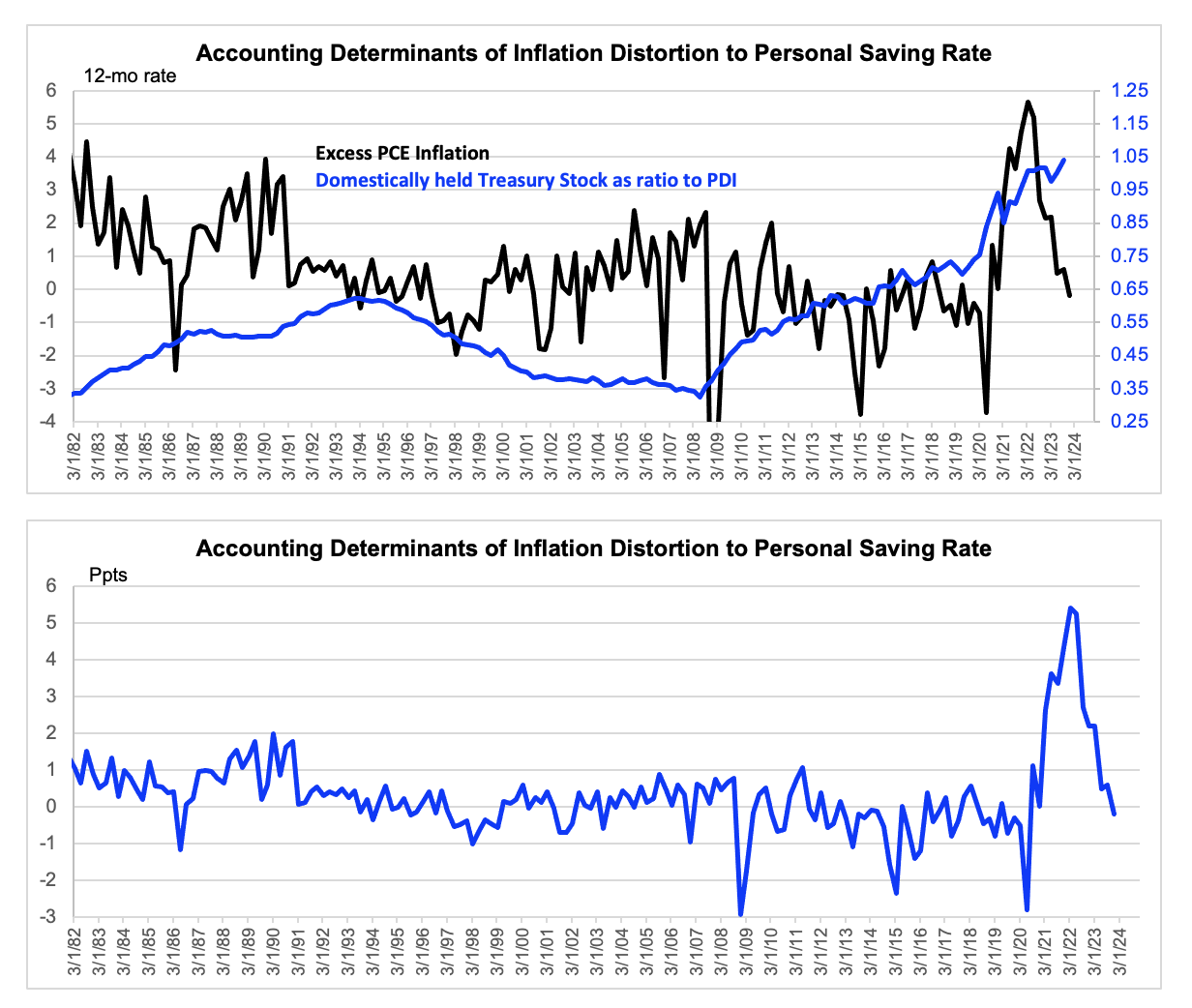
Data are actual to Q4, although the published personal saving rate for January is penciled in for Q4.
Excess inflation is defined as the headline PCE inflation rate less 2%, for distant historical periods (perhaps dubiously) as well as recently.
So, consider the chart above and the explanatory notes under it. The top panel shows on two separate scales the ratio of domestically held Treasury debt to personal disposable income as well as the quarterly change (ar) of the headline PCE deflator. The series are not meant to be correlated. I am not pushing the fiscal theory of the price level here! No, there are just the accounting determinants of the inflation distortion, which is shown on the lower panel. A positive value means that the reported personal saving rate is overstated from this perspective, because it is not picking up the erosion in the real value of public debt held by the domestic private sector, ultimately households. And vice versa.
Notice that the distortion spikes during the recent inflation episode. This reflects both that inflation itself accelerated and that there is now more public debt whose real value is subject to erosion. And of course, with the recent disinflation, that distortion has receded. At first approach, we might think this is a huge deal and before doing these calculations I was receptive to the idea it might be so.
But the issue pales in comparison with the volatility of the saving rate itself, as shown in the chart immediately above. Even with the adjustment for inflation we still get a huge spike of the personal saving rate around the time of the fiscal stimulus, and we still get a retreat recently.[2]Indeed, in both cases, the swings now look a bit larger. The only interesting item here is that the adjusted saving rate now looks to have recovered from what was a deeper trough. This might be taken as evidence that wealth effects have been slightly larger than we first imagined. But I don’t think this framework is amenable to such precise timing. We don’t really know at what horizon the adjustments are made by real people, and my modeling here just assumes it is contemporaneous at the quarterly frequency, because that is simplest. Later we will see how big a deal the capital gains issue is.

Data are actual to Q4, although the published personal saving rate for January is penciled in for Q4.
[1] This approach assumes there are no Ricardian effects associated with the public debt. To the extent that that assumption is extreme, the importance of all this discussion just gets scaled down. For whatever it is worth, I generally work with the idea that Ricardian effects are limited, but not zero.
[2] I hasten to add that this adjustment is not appropriate when assessing the argument that a massive fiscal deficit virtually has to be accompanied by a spike of the household sector financial surplus, simply as a matter of funding the deficit. How the consensus could miss this point is a mystery to me, but it does. But it means that the claim that the fiscal deficit was “saved,” is virtually meaningless in the sense that it literally could not be otherwise, in any environment. There is a sense in which marginal propensities to save out of surprise income will affect spending multipliers, but that has to be investigated at the microeconomic level, not in terms of macro variables, whose ex post realizations are trivial. (See, here for how to do it properly.) In any event, this important claim relates to the correlation between the deficit and personal saving without adjusting for inflation or capital gains, because it reflects an accounting identity related to financial flow, not real variables.

