There was a broad reversal of trends in February. Fundamental factors retook leadership as the January surge in lower risk names reversed. Our index level LightGBM portfolio was volatile and ended the month down -0.2%, bringing Jan/Feb returns to 4.9%. Our portfolio has been broadly short higher volatility stocks over the past several quarters. On net, that has added to performance, particularly during periods of increased policy vol like we saw in January. Over the past few weeks, as risk-on factors have recovered, some higher vol short rallied sharply. The short LGBM basket continued to underperform the market though, so aggregate stock selection remained good.
The index portfolio was an remains 1) long Low Vol and 2) short Earnings Risk. Macro readings and earnings remained strong in February, and financial conditions did not tighten. The result was a rebound in risk factors . Fundamental factors also gained including Momentum, Quality, Value, and Growth. Risk factors remain volatile, which should be expected while investors wrestle with the outlook for inflation and policy.

Return contributions for the index LGBM portfolio diverged between February and January across all categories: industry group, factor, and idiosyncratic. That reflects the broad reversal of internals. More than half of S&P 1500 sector returns in Feb were directionally different than in Jan. High reversal brings more challenge for our machine learning model, which tends to follow long-term trends. Over time, that has served us well with the model up 16.3% y/y.
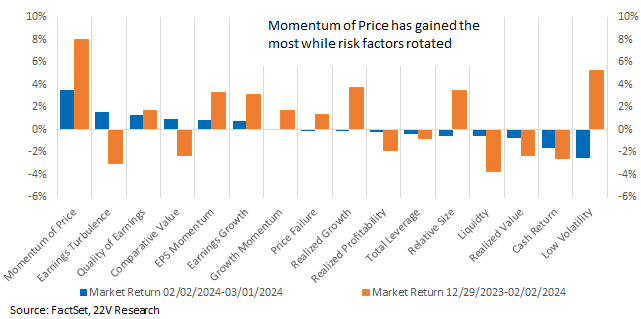
The leading contributor to returns in January, Low Volatility, became the largest drag in February. Price Mo and Comparative Value were the largest net positive contributors. Factor returns during the same period rotated as well with Low Volatility underperforming and fundamental factors gaining. Fundamentals are becoming a larger source of returns and a greater influence on the model’s rankings. That is a trend that has been developing for multiple quarters.
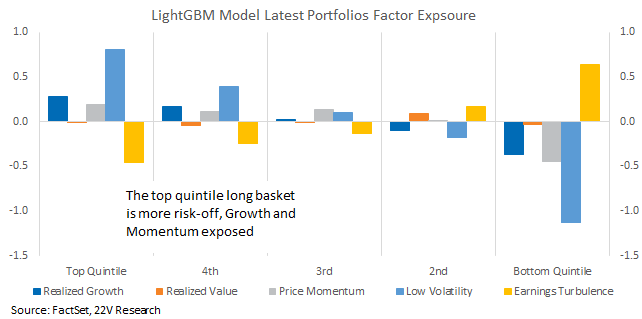
The latest LGBM long basket is most exposed to risk-off, Growth, and Momentum. The short side is more risk-on exposed. If payrolls/CPI readings are in line/weaker than expected, the recent risk-on rotation should continue, which would be a headwind to the modeled portfolio.
Fundamental Factors Support LGBM Returns While Risk Factors are a Drag: The S&P 1500 LightGBM portfolio index performance was roughly flat over the past month, falling -0.2%. Returns at the sector level were broadly positive with the model posting gains in 6 GICS groups. Health Care was the biggest drag. The portfolio remains up ~4.9% on gains across most sectors. Financials have been the best performing in both in February and YTD (0.5% and 4.9% excess returns respectively). Low correlation sectors including Health Care and Discretionary, where the model tends to perform best, has struggled.
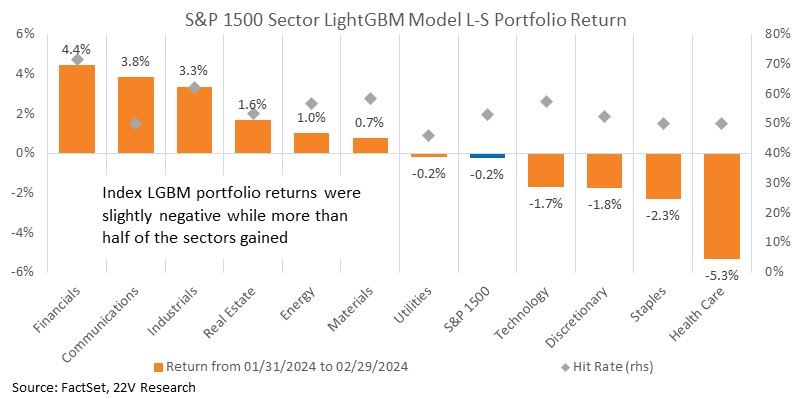
Index returns over the past month can be explained by rebounds in some high vol shorts. Our portfolio has been broadly short higher volatility stocks over the past several quarters. On net, that has added to performance, particularly during periods of increased policy vol like we saw in January. Over the past few weeks, as risk-on factors have recovered, some higher vol short rallied sharply. The short LGBM basket continued to underperform the market though, so aggregate stock selection remained good. Low Vol exposure has been the biggest drag.
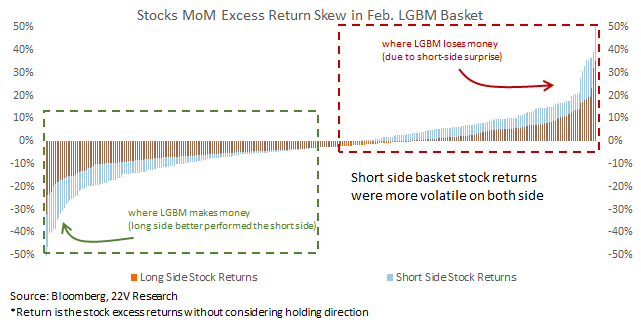
There was a broad reversal of trends in February. Fundamental factors retook leadership as the January surge in lower risk names reversed. In all, 10 of our 16 factors posted a different contribution in Feb vs. Jan. Industry group contribution and idiosyncratic returns reversed as well, reflecting more internal rotations. More than half of the sector returns within the S&P 1500 changed direction in February. The bottom line is the policy induced risk-off/mega cap rotation in January reversed in February as strong earnings and growth reduced slowdown/tail risks.
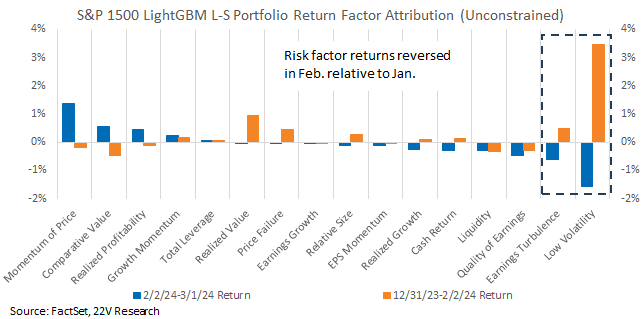
Though the S&P gained consistently in both February and January, risk appetites have been volatile. In February, as macro readings and earnings remained strong and financial conditions did not tighten, and risk factors rebounded. Fundamental factors gained including Momentum, Quality, Value and Growth. Risk factors remain volatile, which should be expected while investors wrestle with the outlook for inflation and policy. Fundamental factors are a better source of risk-adjusted returns.
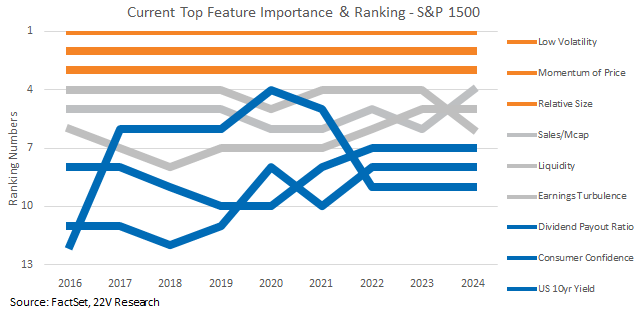
Currently this year, Low Volatility, Momentum, and Size remain the most important features for stock ranking. That is consistent with their large return attributions/sensitivities. The influence of macro factors has faded some. That leads to a couple of important points. First, the influence of fundamental factors increases in economic expansion periods like we are in today (HERE). Second, yields continue to exert outsized influence over the macro backdrop and COULD shift the market regime. So far, that has not been the case though, and while the economic expansion remains in place, fundamental factors matter more.
For March, our LGBM long basket is more risk-off, Growth, and Momentum exposed. The short basket is more risk-on exposed and has less overall fundamental factor exposure. Rotations within risk-on and off factors are likely near term and pose a risk to the LGBM portfolio.
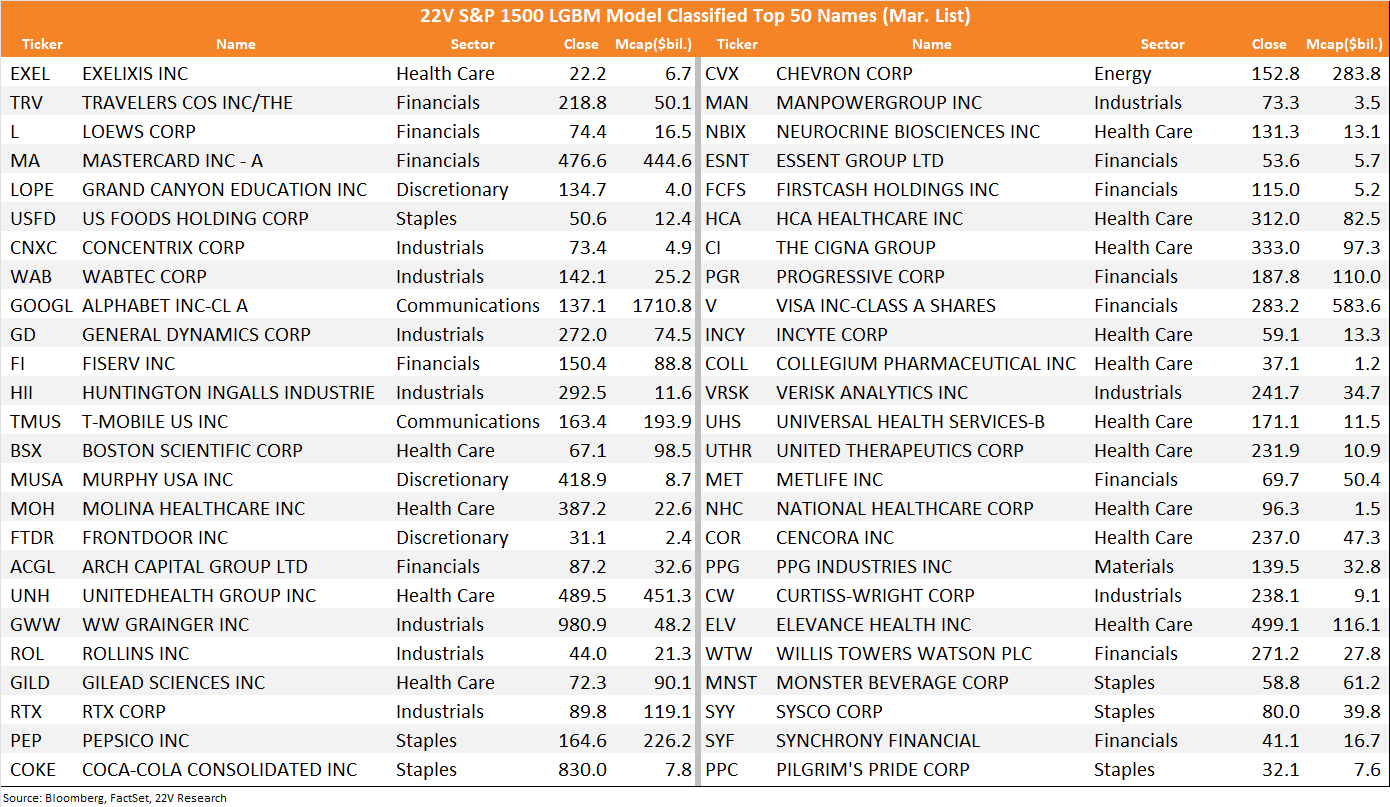
Stock List: Below we list the current S&P 1500 top 50 names falling in the long side basket ranked by the model. A full list of long and short sides are available by asking us.