Back Economic Research

BIS Note on r* Reiterates a Key Point: Data, Not the Stars, Should Drive the Policy Cycle

Published on March 4, 2024

∙ Download the PDF Report

By

Peter Williams

BIS Note on r* Reiterates a Key Point: Data, Not the Stars, Will Drive the Policy Cycle

Recent Fed speakers have all emphasized the importance of the near-term data flow in their decision-making process. The economy’s serial outperformance of near-term growth and labor market forecasts though is slowly causing the Fed to reduce its reliance on current spot real rates and the neutral rate of interest when discussing the policy and macroeconomic outlook (this is a pivot from much of the past few years, although more from others than Chair Powell who has tended to take a broader look when assessing the stance of policy).

The December SEP, which admittedly we have been told to partially discount by Chair Powell since its release, shows the macroeconomy more or less returning to equilibrium while the fed funds rate very gradually descends towards the Fed’s estimate of neutral.[1] While this slow descent of the fed funds rates can be seen as either the Fed forecasting continued anti-inflationary risk aversion or a view that short-run, but not long-run, r* is elevated, the long-run dot has been unchanged, despite all the shocks to the economy, since covid hit.

This likely will eventually start to change, although I don’t have any particularly strong views on when the long-run dot starts shifting up, but the reality is that the long-run dot is not particularly relevant for the Fed in the meeting-by-meeting setting of policy (as distinct from the Fed’s communication about the long-run, the impacts of the longer-term distribution of rates and inflation risk which get priced in farther out the curve, and how markets might react to a shift in the long-run dot).

The Bank of International Settlements (BIS) drives this point home in a piece in its quarterly review, released today. The authors’ note that their analysis, and the myriad of sources they draw upon, “suggests that r*, or at least perceptions of it, may have risen post-pandemic.” But this “assessment is surrounded by a very high degree of uncertainty.”

While a higher r* would be consistent with a higher rate path and less need to reduce nominal rates as spot real rates rise, the authors suggest that because r* is “a blurry guidepost for assessing the monetary policy stance and hence the tightness of monetary policy… it appears advisable to guide policy decisions based more firmly on observed inflation rather than on highly uncertain estimates of the natural rate.”

This comes back to my high-level framing of the current Fed outlook: they seem to want to cut at least a bit (partly reflecting their views on r*), the inflation data is what will allow them to start cutting, but the labor market is what will tell them how deeply to cut once 50-100bps of ‘starter cuts’ take place.

If the economy is able to tolerate higher rates in a sustainable way, that is to say if r* has shifted higher, then there ultimately be less need for cuts outside a recession and the Fed is likely to underdeliver on its current medium-term (2025 and beyond) forecasts. This may mean it starts cutting later but that’s more about the m/m inflation flow in my view.

Atlanta Fed Pres. Bostic sounded a similar note today, cautioning that “pent-up exuberance [after a first rate cut] is a new upside risk that I think bears scrutiny in coming months.” Implicit in this risk is the possibility that, at least short-run, neutral might be higher and the Fed could have much less need to cut deeply and preemptively, even if inflation does continue to slow. To some extent the Fed could have helped reset r* higher (a possibility the BIS authors also indirectly flag) by forcing firms to adjust to tighter financials conditions and a pre-recessionary outlook which ultimately did not emerge, making them more robust now that the shocks are dissipating.

Ultimately, the data will drive the show. The Fed path can of course depart from what many might deem optimal, and there are appreciable risks that my higher-neutral view is wrong, but as a base case it seems best to assume that the Fed will continue to be inflation cautious and cut only as much as it needs to in order to feel like it is keeping the risks between two sides of its mandate roughly balanced and not seek to proactively return to estimates of neutral just for its own sake.
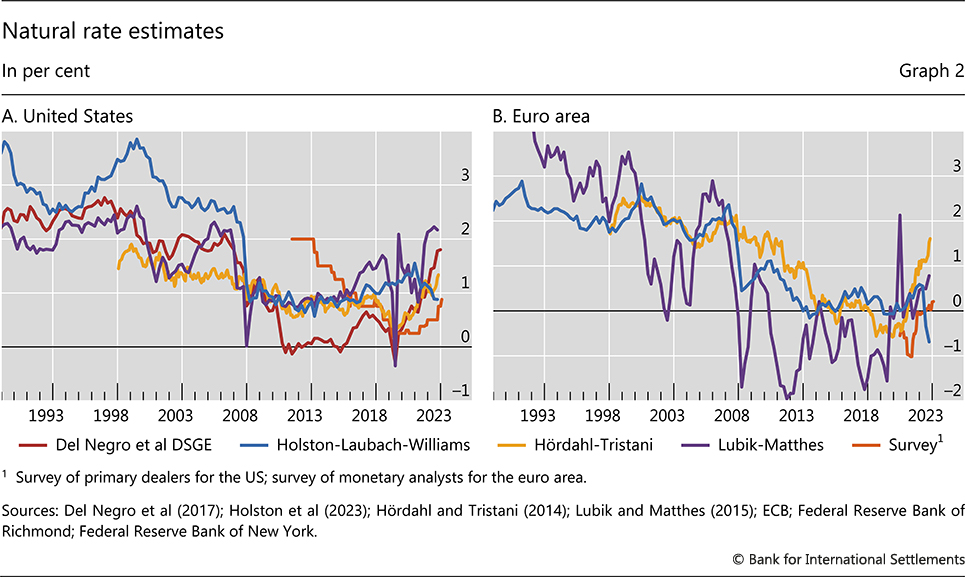
Natural rate estimates
  1. This may make sense as an average or modes of forecasts but Friedman’s ‘plucking model’ or Dornbusch’s ‘overshooting model’ (which admittedly applies to FX and not the business cycle) are extremely helpful ways of framing the business cycle over the medium-term (the generic part of the cycle after the more forecastable next 3-12m) that often get neglected in these types of exercises. Historically, the macroeconomy is almost never stable at equilibrium, usually slowly moving through views of it before the non-linearity of a recession happens. The closest we tend to come is when mid-cycle shocks hit the economy, ultimately don’t derail things, and the cycle is extended further leading to wiggles with smaller absolute values of slack. The two 1990s mid-cycle adjustments and the 2019 one stand as pretty clear examples of this. ↑


DISCLOSURES AND DISCLAIMERS

Analyst Certification

The analyst, 22V Research Group, primarily responsible for the preparation of this research report attests to the following: (1) that the views and opinions rendered in this research report reflect his or her personal views about the subject companies or issuers; and (2) that no part of the research analyst’s compensation was, is, or will be directly related to the specific recommendations or views in this research report.

Analyst Certifications and Independence of Research.

Each of the 22V Research analysts whose names appear on the front page of this report hereby certify that all the views expressed in this Report accurately reflect our personal views about any and all of the subject securities or issuers and that no part of our compensation was, is, or will be, directly or indirectly, related to the specific recommendations or views of in this Report.

22V Research (the “Company”) is an independent research provider. The Company is not a member of the FINRA or the SIPC and is not a registered broker dealer or investment adviser. 22V Research has no other regulated or unregulated business activities which conflict with its provision of independent research.

22V Research, LLC is a professional services and independent publication organization. 22V Research, LLC is not a securities broker-dealer, not a member of the Financial Industry Regulatory Authority (FINRA), not a registered investment advisor (RIA) and not a member of SIPC.

Securities transactions, when offered, are offered by 22V Securities, LLC through LPS Capital, LLC. Certain employees of 22V Securities, LLC are dually registered as securities representatives of LPS Capital, LLC or Analyst Hub Securities, LLC. 22V Securities, LPS Capital and Analyst Hub Securities are members FINRA, SIPC.

https://brokercheck.finra.org/

Current Ratings Definition.

SECTOR OUTPERFORM: An “outperform” rating anticipates the company will outperform the S&P Regional Banking Index (peer group).

SECTOR PERFORM: A “market perform” rating anticipates the company will perform in line with the S&P Regional Banking Index (peer group).

SECTOR UNDERPERFORM: An “underperform” rating anticipates the company will underperform the S&P Regional Banking Index (peer group).

Limitation Of Research And Information.

This Report has been prepared for distribution to only qualified institutional or professional clients of 22V Research Group. The contents of this Report represent the views, opinions, and analyses of its authors. The information contained herein does not constitute financial, legal, tax or any other advice. All third-party data presented herein were obtained from publicly available sources which are believed to be reliable; however, the Company makes no warranty, express or implied, concerning the accuracy or completeness of such information. In no event shall the Company be responsible or liable for the correctness of, or update to, any such material or for any damage or lost opportunities resulting from use of this data. Nothing contained in this Report or any distribution by the Company should be construed as any offer to sell, or any solicitation of an offer to buy, any security or investment. Any research or other material received should not be construed as individualized investment advice. Investment decisions should be made as part of an overall portfolio strategy and you should consult with a professional financial advisor, legal and tax advisor prior to making any investment decision. 22V Research Group shall not be liable for any direct or indirect, incidental or consequential loss or damage (including loss of profits, revenue or goodwill) arising from any investment decisions based on information or research obtained from 22V Research Group.

Reproduction And Distribution Strictly Prohibited.

No user of this Report may reproduce, modify, copy, distribute, sell, resell, transmit, transfer, license, assign or publish the Report itself or any information contained therein. Notwithstanding the foregoing, clients with access to working models are permitted to alter or modify the information contained therein, provided that it is solely for such client’s own use. This Report is not intended to be available or distributed for any purpose that would be deemed unlawful or otherwise prohibited by any local, state, national or international laws or regulations or would otherwise subject the Company to registration or regulation of any kind within such jurisdiction.

Copyrights, Trademarks, Intellectual Property.

22V Research Group, and any logos or marks included in this Report are proprietary materials. The use of such terms and logos and marks without the express written consent of 22V Research Group is strictly prohibited. The copyright in the pages or in the screens of the Report, and in the information and material therein, is proprietary material owned by 22V Research Group unless otherwise indicated. The unauthorized use of any material on this Report may violate numerous statutes, regulations and laws, including, but not limited to, copyright, trademark, trade secret or patent laws.