SUMMARY: While the S&P briefly touched its new all-time high of 5100 last week, internal dynamics suggest less bullish sentiment on the week. Low Volatility and Price Momentum were the most influential factors within both the S&P 500 and S&P 1500. Even after stripping out market beta, Low Volatility, Quality, and Price Momentum (risk-off factors) remained the major drivers of alpha generation last week. Fed speakers continuing to push back on the start of rate cuts is a large part of the reason risk-off factors worked. As we covered in detail yesterday, assuming 3 cuts this year and 2-2.5% real GDP growth, riskier assets will work. For riskier internals to outperform, the expected summer start to rate cuts needs to hold. That will be the case if economic growth remains around trend (2%ish).

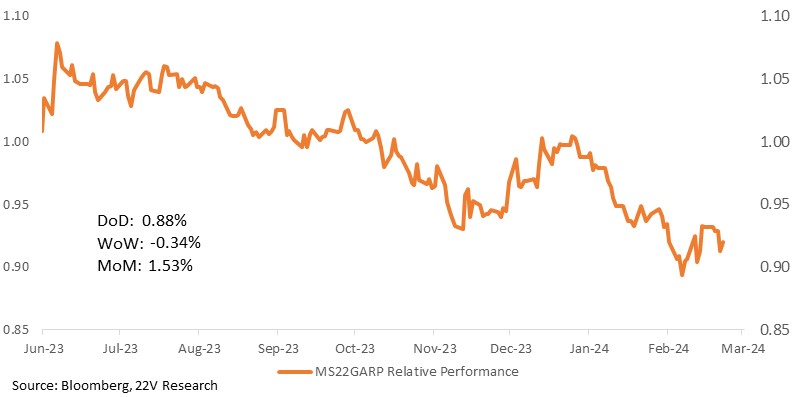
Realized Value and Realized Growth returns diverged last week (see table above). The performance spread weighed on GARP returns (check out MS22GARP Index on bbg for a trackable and tradeable version of GARP). The Value-Growth correlation has dropped, but not to an unusual level. During normal economic expansions, both Value and Growth tend to work. GARP should recover in our economic base case (wages continue to slowly move lower and demand growth stays around current levels). If our economic base case plays out, data is likely to be less hawkishly surprising, FROM HERE, giving room for fundamentals to drive returns.
FYI: Although last week’s internals indicate a risk averse trend, keep in mind that, credit spreads remain exceptionally low, Treasury yields are off their highs, Cyclicals are significantly outperforming Defensives YTD within the S&P and Deep Cyclicals +2.5% YTD (equally weighted) vs Defensives.
Some of the “riskier” parts of the market are likely suffering from concerns over the LEVEL of interest rates remaining too high (debt rollover risk and profitability risk for lower earnings quality and smaller cap stocks). Those fears will fade over time if growth remains firm. Improving Housing data suggests the economy can handle higher rates. Why would housing be OK with higher rates, but other businesses not? Rates are high because growth AND earnings are firm.
More details are in the full report below…
MARKET VIEWS: While the S&P briefly touched its new all-time high of 5100 last week, the internal dynamics suggest less bullish sentiment. Low Volatility and Price Momentum were the most influential factors within both the S&P 500 and S&P 1500. Even after stripping out market beta, Low Volatility, Quality, and Price Momentum (more risk-off factors) remained the major drivers of alpha generation last week.
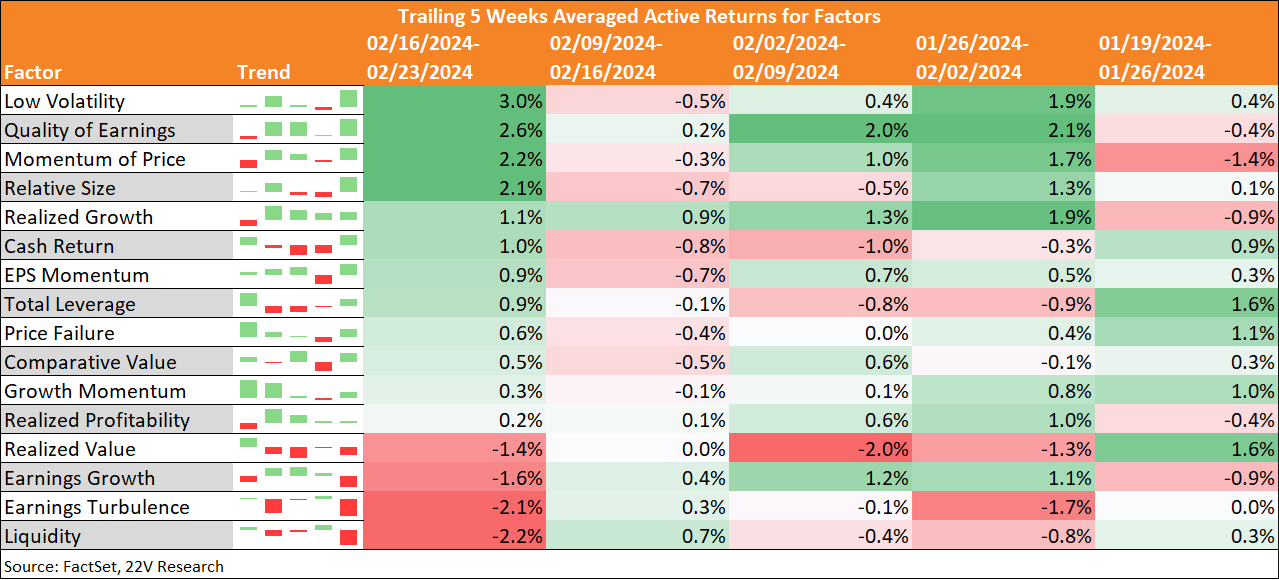
Last week, again stripping out market beta, Realized Value was down -1.4% and Realized Growth was up +1.1%. The correlation between the two factors has been atypically high for much of the past 3 years. Recently, the Value-Growth correlation has dropped sharply, back to its long-term median.
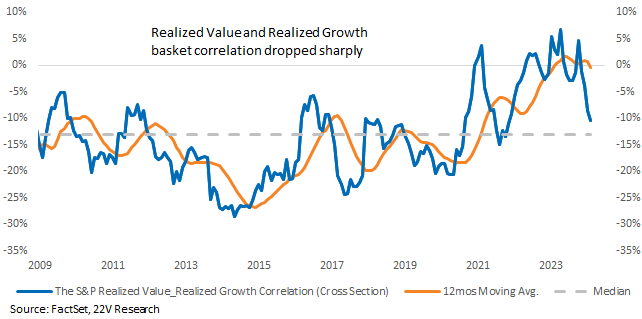
During normal economic expansions, both Value and Growth tend to work. Assuming the economy plays out in the way we are forecasting (wages slowly move lower and demand growth stays around current levels), data is likely to be less hawkishly surprising, giving room for fundamentals to drive returns. Our call for 3-4 cuts is priced and favors a broadening out of market leadership, GARP outperforming, better performance from Small and Mid caps, and the Low Vol Factor to Underperform. The Value-Growth correlation is at its median, which shouldn’t disrupt GARP returns.
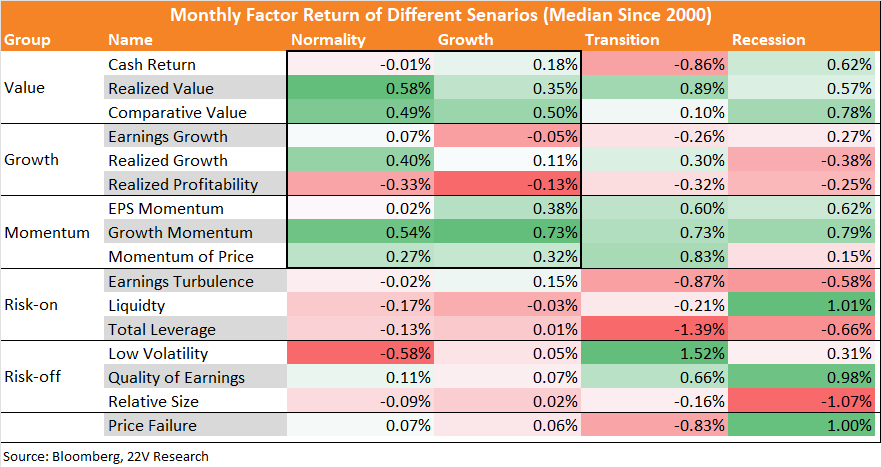
FYI, we have a tradeable GARP swap – MS22GARP Index on bbg. The Value-Growth performance spread last week weighed on GARP returns, but again, both factors tend to work in a normal economic expansion and the correlation is not at an unusual level.
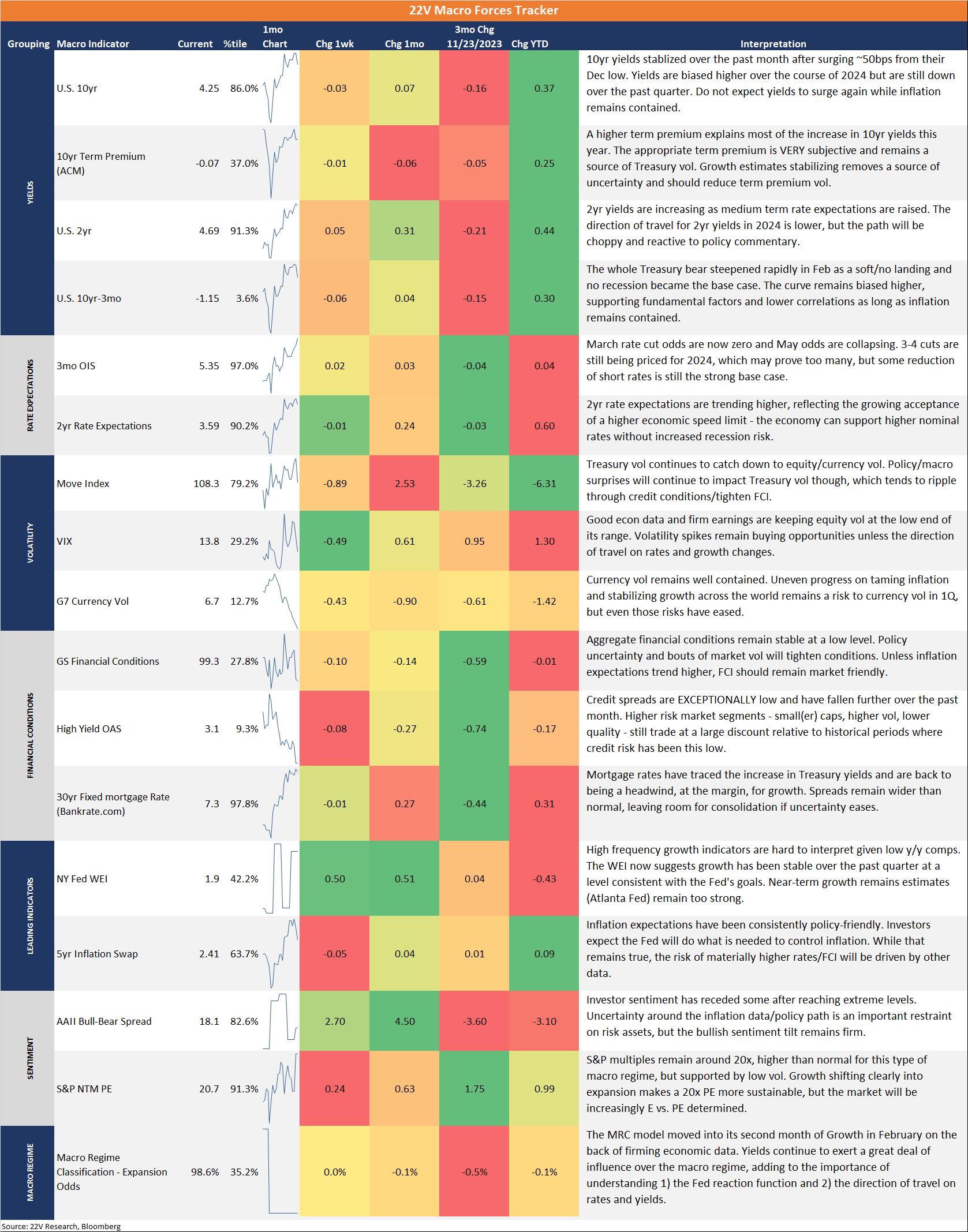
Macro Tracker: Stocks continued to move higher last week, supported by strong earnings and easing, at the margin, of macro uncertainty. While the S&P briefly touched a new all-time high of 5100 (thanks to NVDA’s stronger than expected earnings/guidance), internal dynamics suggest less bullish sentiment. Low volatility and Price Momentum were the most influential factors within both the S&P 500 and S&P 1500. Quality and Size were two of the largest contributors to alpha. Earnings Turbulence and Liquidity were the largest market drags. Utilities was one of the best performing sectors. Those internals indicate a risk averse trend. At the same time, credit spreads remain exceptionally low, Treasury yields are off their highs, and high frequency inflation expectations indicators remain in a Fed friendly range. Macro conditions continue to support a rotation into riskier assets and the average stock. That backdrop is reflected in the still sub-teen VIX and S&P PE >20x. Uncertainty surrounding economic resilience in the face of higher rates continues to be a headwind to a more forceful risk-on rotation. Odds of a rate cut before June are down to about 20% with March odds falling to zero. 3-4 cuts remain our base case estimate for 2024. Fewer cuts is an increasing risk though, largely due to surprisingly strong economic growth. A 0-2 cut backdrop is still good for risk assets AS LONG AS core inflation remains on track to be < 3% by year end. For now, inflation expectations remain contained and FCI easy.