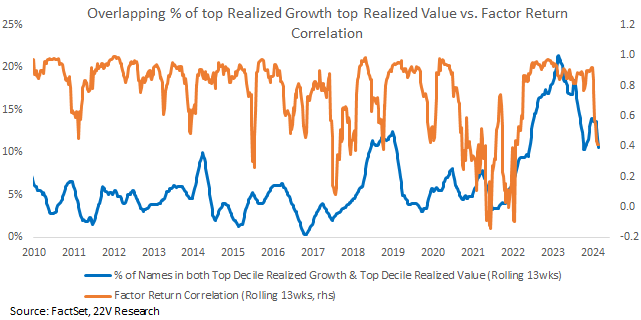
Realized Value and Growth stocks have diverged over the past few months as correlations between style stocks continue to break down. The number of stocks ranked as BOTH high Value and Growth has declined (less overlapping ranks) and return correlations to the two factors are easing as well. The divergence between style factors is part of a larger shift away from risk factors and should be expected to continue unless the macro backdrop deteriorates significantly.
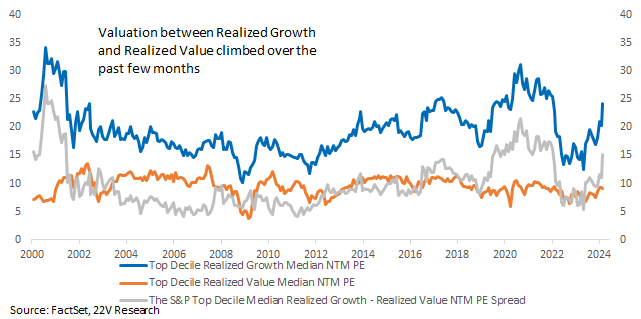
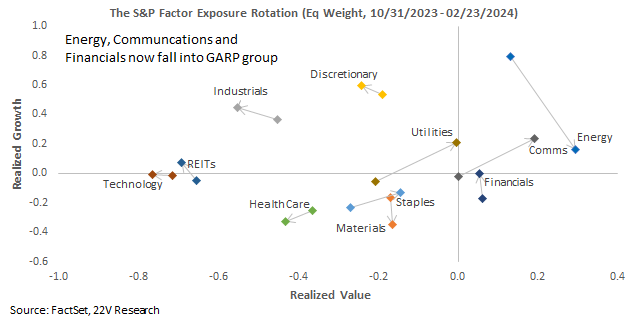
Recently, Realized Growth NTM PEs have climbed sharply relative to Value. GARP has remained an effective screening tool, but the returns have been driven by Growth factors recently. Factor exposures for S&P sectors are becoming more polarized as well. Defensives tend to be more exposed to both Value, particularly Staples and Healthcare. Energy, Communications, and Financials have moved more into the GARP space.

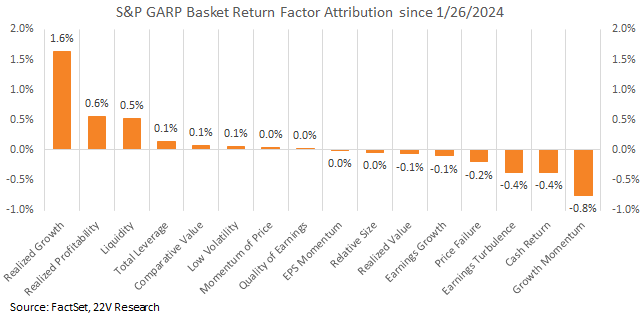
Growth and Value rotations will be more volatile over the coming quarters, leaving us favoring screening focused on GARP. The divergence between Value and Growth has left the pure GARP basket more Growth exposed today. Factor contributions with the GARP basket show Growth has been the largest contributor to returns over the past month. Risk factors, Cash Return, and Growth Momentum were drags on the basket. Value was largely neutral. The point is, the focus on Value within GARP was not a drag, just not a contributor.
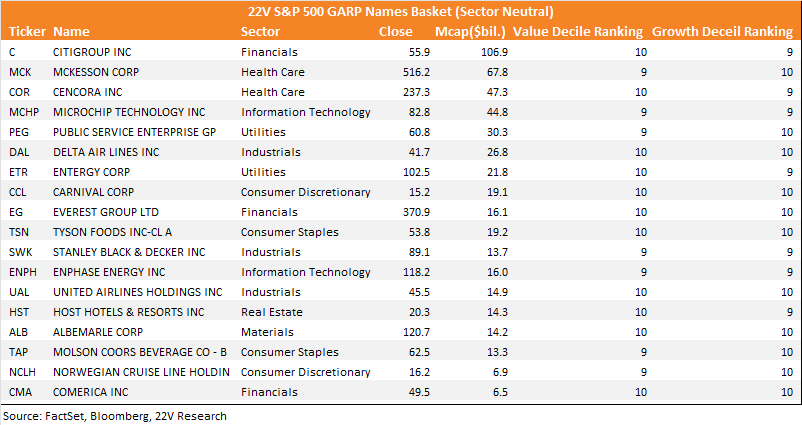
At the end of this report, we list the current S&P GARP basket names. The number of stocks falling in the basket dropped as Value and Growth returns have diverged. If policy uncertainty eases a near-term catchup by Value is increasingly likely. That being noted, GARP remains our preferred general screening tool from a risk management standpoint. Timing style rotations is difficult in the current backdrop, especially in a week where a LOT of economic data will be released.
Value & Growth Divergence Deepening: Value and Growth rankings and returns are diverging as we move through 2024. The number of stocks ranked as high Realized Value and Realized Growth has dropped from its peak in December. And the cross sectional correlation between them is negative again (fewer names are BOTH Value and Growth). The rank divergence has led to a sharp decline in the return correlation between style factors. Over the past month, Realized Growth outperformed while Realized Value underperformed. Interestingly, investors favor both Value and Growth based on our survey earlier this month (HERE).
Return divergence has led to a growing fundamental spread between Value and Growth as well. NTM PEs for Value names remained relatively stable while Growth PEs shot higher. The spread between the two has reached its 85th percentile. PE spreads are not a timing tool, so there isn’t a mean reverting argument to be made here. A macro catalyst is needed to narrow the style factor PE gap.
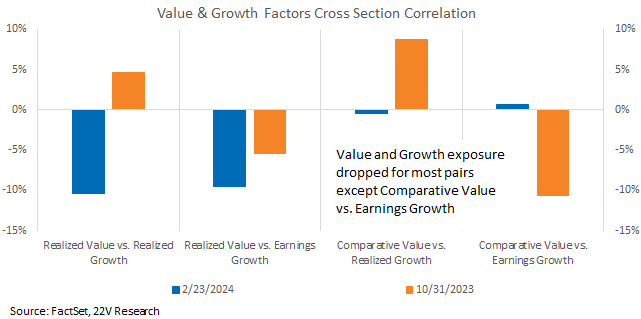
The divergence between Value and Growth has been broad on an absolute and relative basis. Pairwise stock ranking correlations between Realized Value and Comparative Value vs. Realized Growth and Earnings Growth show most pairs have become more distinct since October. The exception is Comparative Value vs. Earnings Growth, where stock rankings between those factors have climbed. In other words, screening for Value or Growth results in fewer names with BOTH characteristics today. Screening for Comparative Value, which is Value measured relative to a stock’s own history and industry rankings, will continue to capture several names with good Growth characteristics.
Factor exposure moves at sector the level has been roughly aligned with a growing divergence between Value and Growth rankings. Only 4 sectors have seen Realized Value and Growth exposures move in the same direction, and most fall in Defensives, including Health Care and Staples. Sectors falling in the GARP quadrant (top right) are Energy, Communications, and Financials positively exposed to both Value and Growth. Utilities are getting close as well.
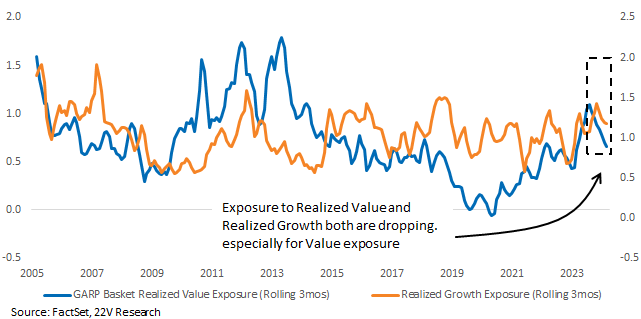
GARP basket exposure to Realized Value and Realized Growth both dropped since late last year. Though the current basket remains most exposed to Realized Growth, its exposure to Value has dropped behind Relative Size and Earnings Turbulence. In other words, GARP is becoming less of a pure play on style factors. This will increasingly complicate screening for these factors. It will be more important going forward to isolate style factor exposures from others (Size, Risk, etc.,).
Factor contribution of the GARP basket (equal weighted vs. the S&P 1500) shows Realized Growth was the largest contributor to returns. The biggest drag came from Growth Momentum, which GARP is negatively exposed to (Growth Mo outperformed, so negative exposure was a drag). The performance attribution implies Growth and Value tend to continue work in stock filtering.
Below, we list the S&P names falling into the GARP basket today. Though increasing divergence between Value and Growth has led to a smaller number of stocks, the selected names are expected to gain from their fundamental exposure.