

SUMMARY
Most of us accept and work through geopolitical, macroeconomic, and US legislative uncertainties, yet it is puzzling that some hold to moderate-to-high conviction about who will be inaugurated next January. Public opinion, global political developments, recent history, and personalities are among the factors that will shape views currently and likely in real time throughout this election cycle. Each US dominant political party frontrunner rubs some voters the wrong way while other voters reject both men. Given known and unknowable risks to both President Biden and former President Trump and their campaigns, it would seem prudent to entertain “what if.”
OUTLOOK
It is easily acknowledged that both presidential frontrunners face steady headwinds. Biden hardly sees a day without friends or would-be allies suggesting he give life to his 2020 “bridge to the next generation” commitment and cede the presidency to a younger Democrat. Political analyst extraordinaire James Carville points to Biden’s lack of campaign events and sees this as a sign of either a reluctant or tired candidate. Regular presidential gaffes during impromptu comments feed this perspective. Trump’s image takes hits frequently with the 93-page court opinion last Friday only the latest reminder of character vulnerabilities. Court cases will play out the reminder of this campaign likely exacerbating his messaging. Trump too experiences cognitive lapses. The following table from Gallup merely demonstrates the race as it currently stands and shows that it should be viewed as competitive. Both candidates poll almost evenly on general performance but Biden scores higher on policy issues while Trump leads on personal style.

Even if today the circumstance seems fantastical, given their challenges, it is certainly plausible that neither frontrunner holds that position before party conventions. We readily concede it may not be instructive to speculate “what if,” but we do so to underscore both candidates face persistent challenges and obstacles. We turn to former South Carolina Governor Nikki Haley’s consistent and targeted messaging to illustrate their challenges: “A vote for Biden is a vote for President [Kamala] Harris.” “All he [Trump] talks about are these court cases. He’s not talking about the American people, and it’s a problem. He’s going to be in court March, April, May, and June, by his own words.”
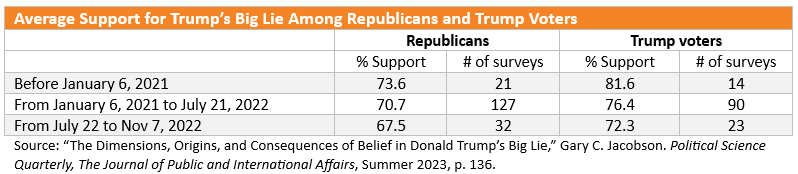
The table above comes from a report on Trump’s support among the GOP and his loyal base. The second column represents the number of surveys used to analyze results in each time frame. As more information about January 6 entered the public realm, some Americans soured on Trump, including members of both factions. It seems less important now to guess or know whether these data are predictive, but it seems likely that trials and rulings will offer voters additional information in their consideration of Trump.
Given our own biases against unforced turnovers, we’ll demur rather than guess circumstances and timelines of possible disruption to the candidates currently at the top of their party’s ticket. But if either Trump or Biden for whatever reason are not nominated this summer, likely a long list of partisans would join the fray to replace them. To help frame the ‘what if’ speculation, we note that as late as March 31, 1968, former President Lyndon Johnson decided not to run. Republican hopefuls likely would come from the band of GOP primary challengers, and possibly New Hampshire Governor Chris Sununu and former Representative Liz Cheney (Wyoming). Democrats could include mostly politicians proven at the state and/or local level, including Vice President Kamala Harris, Senator Chris Murphy (Connecticut), Michigan Governor Gretchen Whitmer, Secretary Gina Raimondo, former mayor of New Orleans Mitch Landrieu, Secretary Pete Buttigieg, and California Governor Gavin Newsome, among many others. If required, each national party would be guided by set rules (links: and Rules of the Republican Party and DNC Charter Bylaws) to process most disruptions and timeframes. That said, replacement becomes trickier once states print general election ballots.
Geopolitical headlines, events, and risks produce plenty of daily volatility and are likely to influence 2024 voter mindsets more than any presidential election since 2004 for similar reasons: the Middle East conflict. Nonetheless, public opinion survey respondents rate the economy as their primary focus. A recent Pew Research report (link here: Americans More Upbeat on the Economy; Biden’s Job Rating Remains Very Low) offers a potential sentiment base for this electoral factor, yet it remains a point of significant concern, particularly regarding food price levels. Only time will reveal whether this issue will be decisive or merely contextual for voters this fall.
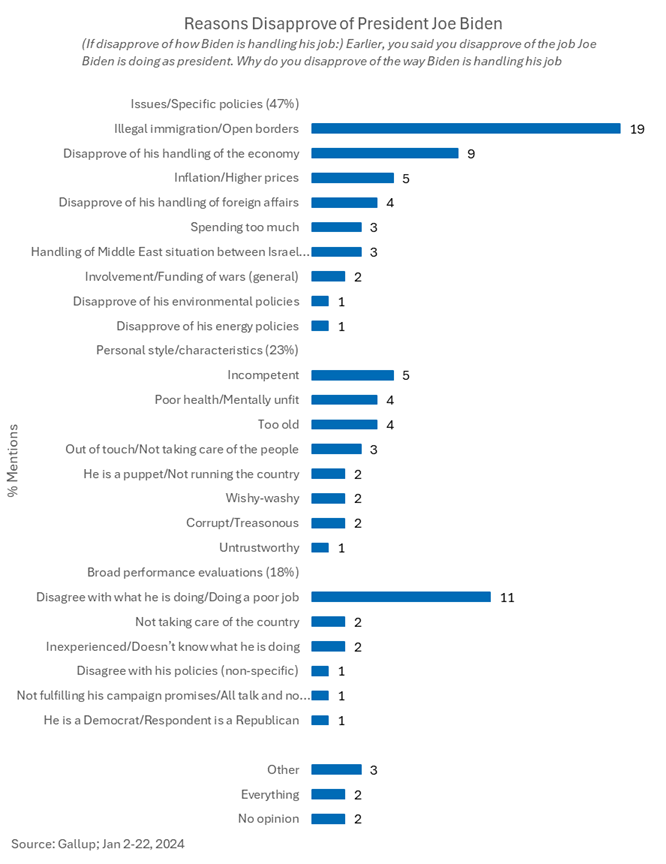
President Biden’s disapproval shows up in polling as a multifaceted millstone, something every president endures. We offer one table from an exhaustive Gallup report last month that illustrates this, and we raise two points. The obvious one is some issues haunting Biden are not new but continue to resonate among many voters. The related point is less obvious: his numbers can and in some cases are changing. Once more, the takeaway is that while extrapolation may prove to be a valuable tool for this election, its true utility will only become evident later this year.
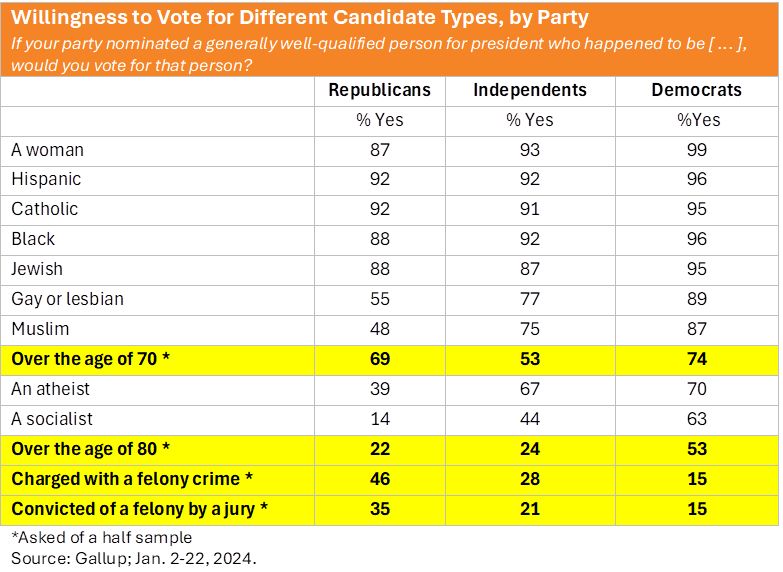
The same Gallup report shows that both Trump and Biden’s headwinds come from sources directly applicable to each of them. Our point here is that presuming one of them is less burdened by deep dive public sentiment seems misguided, especially so early in the campaign.
Despite the unusual, for many, upsetting, rematch, we are likely in for plenty more surprises given circumstances teased out at the beginning of our note. We possess nothing dispositive about this race, but then neither does anyone else. This fact alone should foster acceptance of outcomes this spring, summer or certainly in the fall that diverge from our or anyone’s current presumptions.

