

January Fed Meeting Minutes a Bit Hawkish but Aligned with Post-Powell Expectations
The key line from the Minutes, which all the reporters flagged at the top of their pieces, is “most participants noted the risks of moving too quickly to ease the stance of policy and emphasized the importance of carefully assessing incoming data in judging whether inflation is moving down sustainably to 2%.” There was little ballast against this with only a “couple” (almost surely Goolsbee but the other is less clear) pointing to risks of waiting too long before starting to ease policy.
I have two other main takeaways from the Minutes, both of which skew hawkish.
- The Fed continues to be surprised on the upside by growth and this seems likely to continue to be in the base case, given their below potential growth forecasts.
- There remains a substantial amount of inflation risk aversion present on the FOMC after the past few years and this will be slow to fade (while “the Committee’s employment and inflation goals were moving into better balance, they remained highly attentive to inflation risks” and, implicitly, not growth risks).
One way of framing the Fed’s threshold criteria for when they might start cutting is when the upside risks to inflation and the downside risks to growth are balanced in a spot sense and that medium-term stability in that balance calls for some easing in the restrictiveness of the policy stance. At the risk of getting overly anchored to specifics, I would frame this balancing between upside deviations from their tolerable levels of roughly 2.4% for core PCE and 4-4.25, just slightly above their estimated long run level, for the unemployment rate. Which, at the time of the meeting before the recent round of data, means that much of the hawkish, or at least less open to being dovish, shift we heard from Powell came from a falling growth and labor market tail rather than an increasing inflationary one.[1]
Much of the debate boils down to data that “doesn’t need to be better than what we’ve seen, or even as good. It just needs to be good.” (Powell on ’60 Minutes’ after the meeting). Developments since the meeting have reduced the risks to growth and labor markets, at least in the near-term, and highlighted the potential for continued upside inflationary surprises. They also may lead to more gradual upwards pressure on the Fed’s demand forecasts, which, without offsetting supply side developments, the Fed might feel compelled to lean against.
On net, the after-June / ‘never cutting’ (at least in 2024) tail continues to grow because the Fed may get spooked by any near-term upside surprises in inflation, its medium-term growth expectations remain too pessimistic, and inflation risks being sticky at a bit too high of levels.
Diving In
- Growth expectations continue to remain too low in base case states of the world. The staff expects that “output growth in 2024 and 2025 [will be] below the staff’s estimate of potential growth.” FOMC members
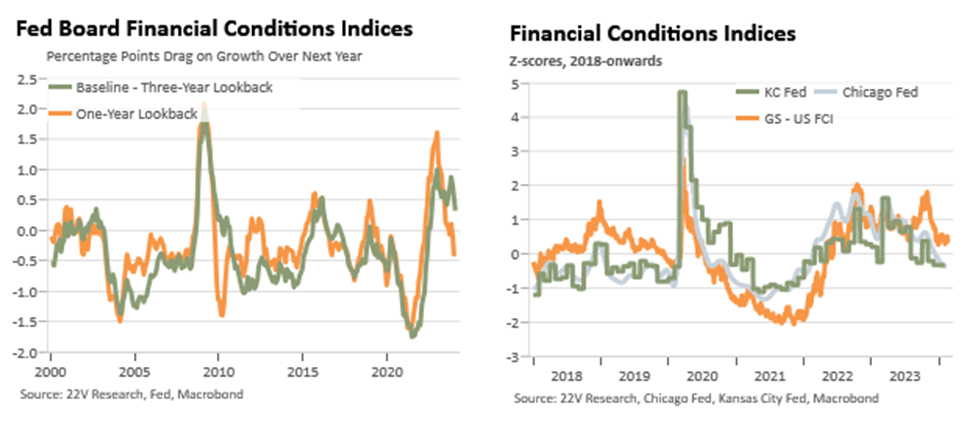
- This is because the staff (“the lagged effects of earlier monetary policy actions, through their continued contribution to tight financial and credit conditions, were still expected to push output growth in 2024 and 2025 below the staff’s estimate of potential growth”) and FOMC participants (“participants judged that the current stance of monetary policy was restrictive and would continue to put downward pressure on economic activity and inflation”) see policy as actively restrictive enough to push growth down below potential for a sustained period. Figuring out the mechanism for this is challenging given the seeming slow bottoming of activity and sentiment in the housing, manufacturing, and banking sectors. The Fed Board’s FCI measures suggest that the growth drag from financial conditions is either becoming less of a drag or outright easing, while other measure suggest peak tightness came in late-22 or early-23 and that financial conditions are slightly easy on the margin.
- Indeed, “several participants mentioned the risk that financial conditions were or could become less restrictive than appropriate, which could add undue momentum to aggregate demand and cause progress on inflation to stall.”
- The ‘real rates’ framework for cuts, which calls for easing nominal policy on the basis of falling inflation and needing to keep real rates constant, seems to continue to apply to the growth forecasting process, even though Powell leaned against it as a policy setting framework at the press conference, and it hasn’t really come up in Fedspeak since the meeting (to my knowledge at least).
- While some modest drag on growth seems reasonable expected given the current stance of policy and the multi-year moves in longer-term rates, the Fed seems to have been somewhat persistently suffering from weighing long lags and restrictive policy too highly and the underlying momentum in activity, even if its only in the more healthy 2-2.5% range, too little.
- This is a bit of an aside but the economy, and especially labor market, which is less noisy in its signals on a q/q basis, very rarely grows at a sustained positive but below potential pace (this would coincide with a long and gradual increase in the unemployment rate to above long-run levels). This type of forecast could make sense as an average across scenarios but as a base case strikes me as somewhat ahistorical, despite its ubiquity in recent years (see more here).
- One way to square this, which Powell seemed open to in the press conference and the Minutes said as well, is that the Fed views much or most of 2023’s growth surprise as partly driven by transitory supply side boosts which will have little impact on the growth of activity going forward in 2024 (“in addition to strong demand, many participants attributed the recent expansion in economic activity to favorable supply developments”). This is mechanically fair in some sense but I think assumes too little persistence to positive supply shocks ex supply chain developments or the underlying momentum in demand itself.
- This supply side boost from faster labor force and productivity growth is somewhat distinct from the more transitory gains in supply chain healing both for the links one can draw positive hysteresis and the more open-ended nature of those types of shocks versus supply chain shocks were are naturally finite (supply chains are certainly not showing signs of moving to a more friction free environment than in 2019).
- The Fed remains open to further disinflationary and activity boosting supply shocks, or at least “a few participants” are, but the dominant paradigm seems to be shifting towards more classic demand, financial condition or balance sheet, and geopolitical shocks which operate in the same direction, if with different magnitudes, on inflation and activity.
- The discussion of business contacts’ sentiment highlights the possibility that firm views may be perking up after being pre-recessionary for so long, noting that “in several others, contacts expressed increased optimism about the economic outlook and prospects for investment.”
- Given a desire for “in-depth discussions” of QT at the next meeting, it seems like announcement of QT’s gradual winddown is seeming ever more likely in 24Q2. It seems more than likely, as “a few participants” flagged, that some form of balance sheet runoff continues even after the Fed first cuts even if that could mean cutting after the pace of runoff slows. “Some participants remarked that, given the uncertainty surrounding estimates of the ample level of reserves, slowing the pace of runoff could help smooth the transition to that level of reserves or could allow the committee to continue balance sheet runoff for longer.”
Formally, I would characterize the Fed’s current framework as maximizing employment subject to keeping inflation at target over the medium-term. This is structurally dovish with low inflation but when the inflation constraint becomes binding it can be slow to fade given the expectations, wages, and pricing power dependence of medium-term inflation risks. ↑

