January CPI Comes in Hot and Gets a Big Reaction
Core CPI for January came in at 0.39% versus a BBG consensus of 0.3%. Core services ex housing costs was a very punchy 0.85% m/m (the hottest m/m pace since April 2022). Rates markets moved to price only 3.8 cuts in 2024, down from ~4.5 at yesterday’s close.
There a lot of possible sources of noise when thinking about the underlying signal for the PCE inflation data the Fed most cares about but we can fairly definitively say that this data:
- Was the final nail in the coffin for a March cut.
- Leaves the May vs June debates around the base case tentative and prone to data whiplash.
- Opens up the hotter side of the distribution of outcomes further, with this increase coming from the near-term recession tail a bit more than the soft-ish landing base case (while I think some of the recent activity numbers are a bit one-off, it clear that growth is above trend, hiring looks ok, and layoffs fairly contained).
- The recent Fed emphasis on seeing disinflation broaden out across a wider range of categories has been, at least temporarily, dashed somewhat.
The internals of the report all felt hawkish on the margin although given the difficulty in assessing the right seasonal pricing patterns post-covid mean that some of this m/m bounce may just be pricing level resets into the new year that aren’t adequately captured by the existing seasonal factors (the level of pricing resets may be partly a function of lagged inflation rates making this exercise exceptionally challenging in an environment of high lagging inflation and elevated inflation dispersion).
The Fed will be eagerly waiting for the next few months CPI data to see if this bounce is going to be ratified by the rest of the Q1 data; the PPI data will help give a better sense of the January PCE read-through when it comes next week given that the gap between CPI and PCE has been concentrated in the core services ex housing (and differing weights).
It’s important to note as well that the natural feedback loops between financial conditions and the macroeconomy will require tighter FCIs the higher inflation prints (for a given set of growth outcomes). Prior to today, much of the recent move up in rates had been about the fading recessionary tail as the growth and employment data come in better than expected. This had allowed ok if not spectacular stock performance. Hotter inflation data means a worse time for risk assets all around and a higher rates than would have occurred just through growth revisions. For now, it seems like we’re in a bit of hawkishly tilted digestion period as wait for PPI and PCE to tell us more about the Jan inflation data and the next few months data to give a verdict on whether it was largely a January effect or something a bit more persistent.
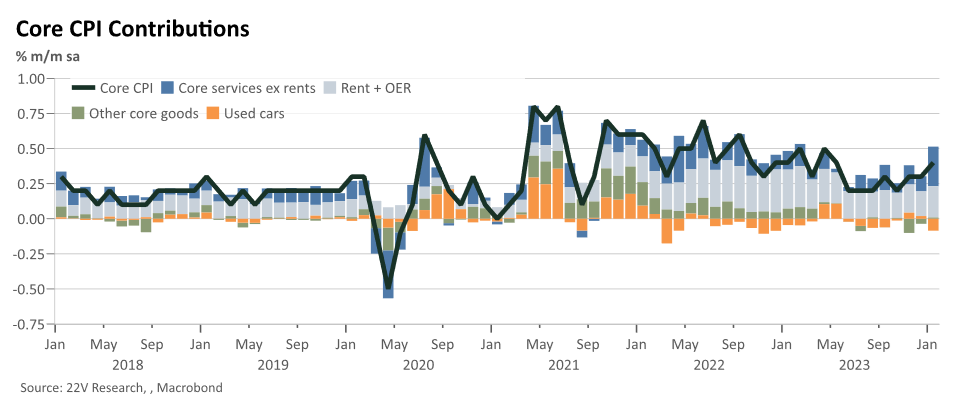
A few thoughts on the main components of the data:
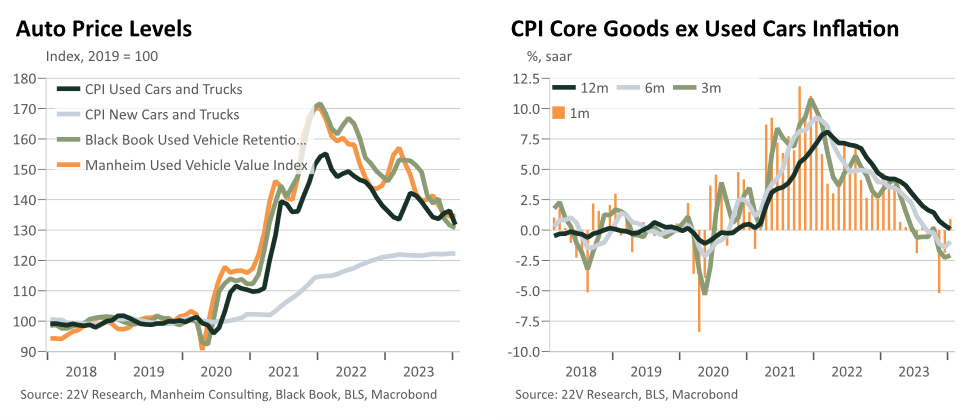
- Used car prices resumed their decline towards some post-covid equilibrium price level. I have no particularly strong inclination as to where their price level might ultimately find a new more sustainable steady state as production ramps up but it is seems likely that we continue to see deflation here for some time (the seeming plateaued level of new car prices suggests a possible anchor but that’s a weakly held view).
- Core goods ex used autos was actually slightly positive m/m. Given company reporting and the broader sweep of the data, I suspect there is some continued deflation still to come here but it unlikely to be continue to be as helpfully dovish as it has been and will likely trend towards a post-covid normal pace of roughly 0 by the second half of the year.
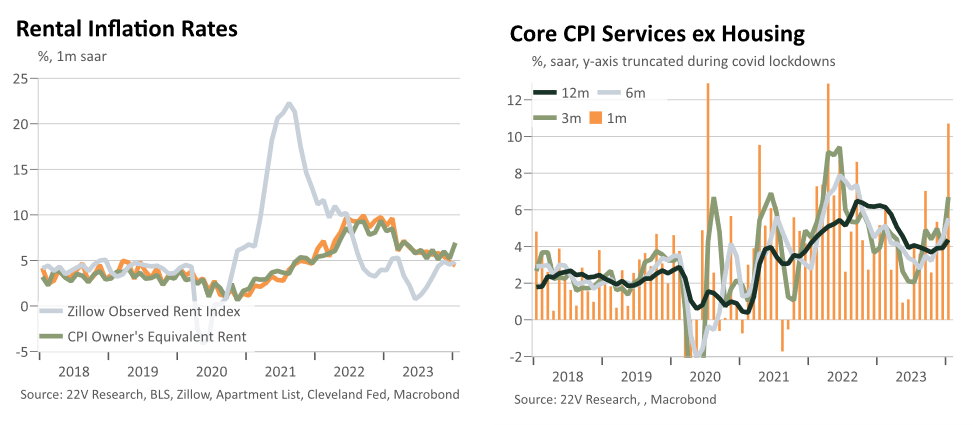
- Rental inflation also came in notably hotter. Rent of primary residences seems to be very gradually slowing in the CPI measure, reflecting the slower incorporation of the lower new multifamily rental increases, although the Zillow measure suggests that marginal rent growth has bounced some since 2023H2. Rents should continue decelerating across 2024 with the covid apartment construction boom finally seeing delivery.
- Owner’s equivalent rents (OER) bounced notably m/m. This is likely at least partially noise, but consensus here seems a bit too optimistic and driven by assumptions about multifamily pricing spillovers and too quick an incorporation of marginal rents data. The gap between rents and OER is unusual but the reasons for it seem solid enough and suggest that is likely to be at least somewhat persistent during 2024.
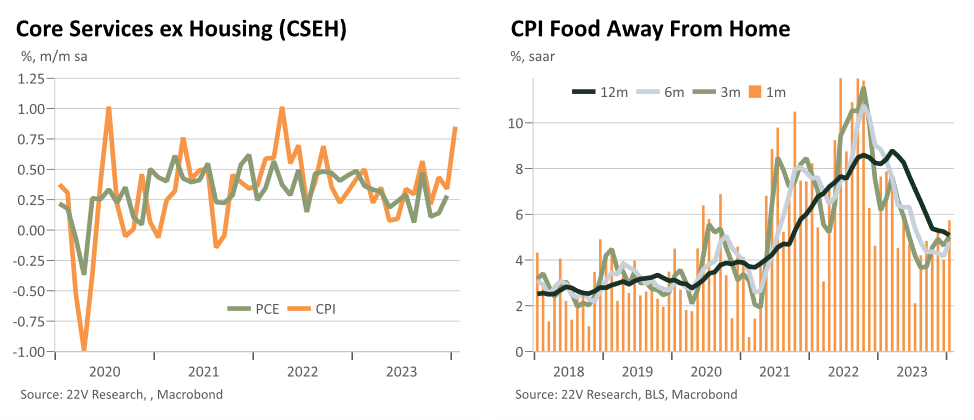
- Core services ex housing saw its sharpest m/m gain since April 2022. This is obviously hawkish on its own merits but deserves a bit of tempering for a few reasons. First off a number of categories saw unusually large jumps which might be where Jan effects popped up (medical care services, car insurance). Second, CPI CSEH has been notably hotter and more volatile than the PCE version, although we need to wait for the PPI data to get a better understanding of just how hot PCE CSEH might be in January.
- Food away from home, one of my favorite inflationary metrics given its discretionary nature and tight link to labor costs, came in a bit hotter m/m again and has been in a bouncy range around 5% saar for the past 6 months. This is a worrisome sign of potentially higher inflationary pressures being sticky and acceptable (in a price taking sense) for consumers.