

Bloomberg has a story on how some junior Fed officials are bemoaning that the recent steep disinflation in goods and services lacks “breadth.” That is sort of consistent with the argument I have been making, but there are a couple key differences.
The Bloomberg story HERE is a simple and quick enough read that I need not summarize it. Instead, I will run down where I would have a different take. Of course, what the Fed leadership thinks is more relevant than what I do. But the point of my challenge to the juniors is that they may not be speaking for the leadership, and even the leadership may be slightly cagey on this issue in their public communication.
First, the issue with the recent disinflation is not really that it lacks “breadth.” Central tendency inflation measures systematically overweight housing, whose coverage in the government data is severely lagging, as is now well documented and universally accepted. (And yet people still refer to central tendency.) But the larger issue is not so much that the disinflation is narrow as that it is concentrated in the part of the economy where it is least likely to persist at its recent pace: in goods. As I have been pointing out, goods inflation has less momentum than core services inflation, especially in the current environment in which supply chain pressures have been reversing.
It is not so much the narrowness, as that the deflation is predictably transitory
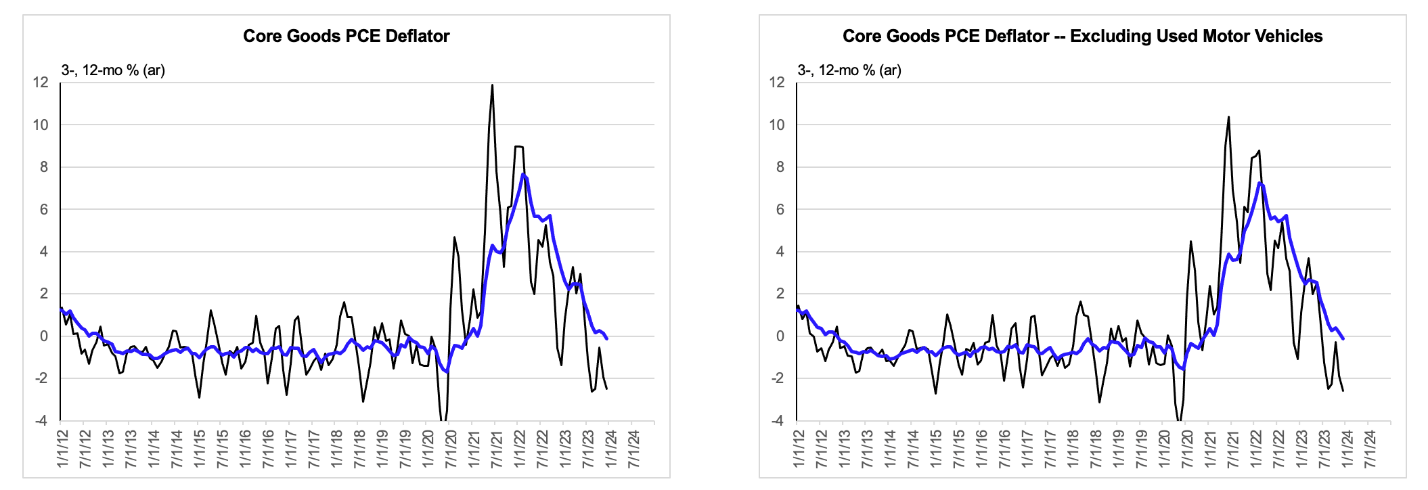
Data are actual to January.
The reversal may or may not persist in level terms but its delivery of deep deflation in goods is very likely transitory — and for reasons that do not require invoking Houthis. For example, at the last Press Conference Powell mooted the idea of goods price inflation moving to zero. That would actually be consistent with above-target inflation all else equal because the secular trend in goods prices with overall inflation at target has historically been downward at about ½ to ¾% a year. But you get the point.
If you absolutely insist on waiting for the inevitable, then fine
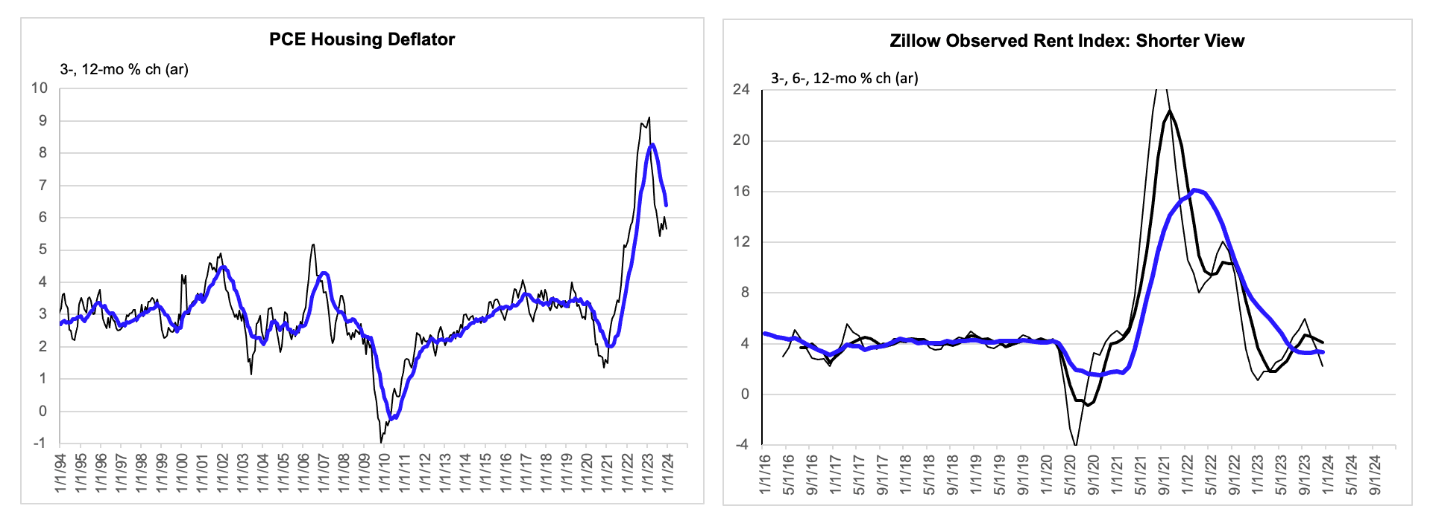
Data are actual to January.
The second point on which I disagree with them is on rents. Marginal rent growth has already disinflated to a pace that is easily consistent with the Fed hitting its inflation target over time. I think it is basically pointless to watch the government rent data, which are predictably lagged and seem fated to converge down to the pace of marginal rent growth. On the other hand, it is not entirely unreasonable for folks – perhaps playing a bit of the greater fool game – to want to see that “confirmed” in the government data. You know the issues here. There is no point in relitigating them. Even I would concede the Fed would probably prefer to see some confirmation in the government data.
Finally, there is the role of wages. We all seem to agree that the so-called Powell “Supercore” inflation rate looks somewhat too high for comfort. The debate is whether we should think of this as fully or just partly offset by the (arithmetically) compensating compression of core goods prices inflation. (I lean a bit hawkish on that, which is actually the main subject of this note.) But we disagree on the role of wages here. I am more impressed by the fact that wage growth remains high in absolute terms, and am less impressed by its recent deceleration, because that deceleration is arguably a reflection of the goods and services disinflation recently that has originated from outside the labor market. In my view, the fact that nominal wage growth has not fallen further may be evidence that the labor market is actually tight, which would fit into “supercore” inflation staying sticky going forward. My contention is that the Fed leadership agrees with me and that this is one reason for their hesitation in cutting rates. But I cannot point to them saying so. What they actually say is that wage disinflation will just continue. So, it takes a bit of reading in to get to my result, full disclosure.
This is relatively sticky, but what do wages say about the prospects here?

Data are actual to January.
I prefer the MPO version of the Powell Supercore to the standard, for reasons I have been over in earlier notes.
I often point out that my interpretation of the data is out of consensus, which means that it might not help with getting the immediate market reaction to this or that bit of news. If my interpretation is correct, it would be a guide to how things play out ultimately. And I will stick with that. But here is a wrinkle for tomorrow. I think market participants would be more likely inclined to celebrate a low core inflation print if it were concentrated in rents. I am the other way, because I view it as virtually impossible for the government rent data to be fundamental news. The government data mostly tell us how the government data are wrong this month. For a given change of the core CPI, then, I think it would be more dovish if the rent component were higher. But I will keep such thoughts to myself at 8:31.

