SUMMARY: Fed officials (Powell/Waller in particular) have noted that CPI revisions, which are released today, are an important factor in gaining confidence that core inflation is falling. Last year, the three-month annualized change in core PCE for December 2022 increased to 3.6% from 2.9% after the CPI revisions. That was a shock, so it makes sense Fed officials don’t want to be surprised again. It would be weird to make a firm commitment to cut rates based on recent dovish inflation data only to have that data revised away. Assuming CPI revisions are benign today (released AROUND 8:30), Cyclicals should continue to outperform Defensives, and the low Vol factor, which is lower WoW, will remain under pressure.
Benign CPI revisions combined with the headline decline in the Atlanta Fed wage tracker (we got that on Wednesday) would significantly decrease the risk that the Fed will need to tighten financial conditions again, which is something investors have been increasingly worried about. Benign CPI revisions won’t mean 6+ cuts will be priced again though. Investors should expect much higher confidence of 3-4 cuts. In a 2-2.5% real GDP growth backdrop, that is positive for risk assets. SMID cap names, ex financials, have had a strong 4 days as 10yr yields have stabilized and that should continue in the above scenario. Cyclicals would continue to outperform Defensives.
Hawkish CPI revisions would be a problem for small caps, highly levered names, etc.,
According to our survey of investors (HERE), Growth is the favorite factor in a stronger or weaker growth backdrop. Value in an in-line economic backdrop. Megas/large caps are best in a stronger or weaker growth backdrop. Small caps in an in-line backdrop. That makes sense, 2%ish GDP growth, which would be an “in-line” economic backdrop significantly reduces monetary policy and economic volatility. Investors can get more comfortable “pricing an economic cycle” in an in-line economic backdrop.
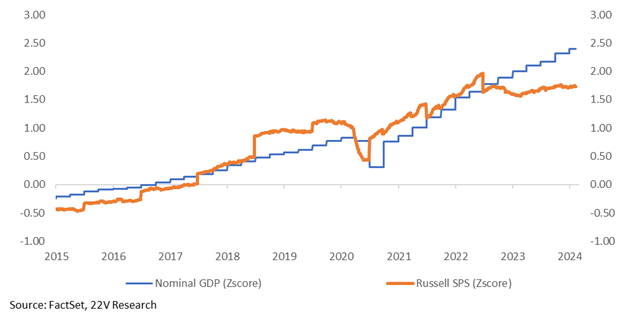
FYI: There is a gap between nominal GDP and Russell sales expectations. That is a very odd gap relative to history. If GDP growth continues around its current pace, a meaningful catch-up in Russell sales estimates should be expected. Some investors believe a more permanent shift to services vs goods is the driver of this divergence. We disagree, but monitoring Russell sales expectations vs Nominal GDP will be a way to track the validity of that thesis.

Full report below…
MARKET VIEWS: Fed Governor Waller focused the world on CPI revisions about a month ago when he noted the revisions were an important factor in gaining confidence that core inflation is falling. Powell mentioned revisions several times at the last FOMC press conference. Last year the three-month annualized change in core PCE for December 2022 increased to 3.6% from 2.9% after the CPI revisions. That was a bit shocking, so it makes sense Fed officials don’t want to be surprised again. It would be weird to commit firmly to rate cuts, based on the recent dovish inflation data, only to have that dovish data revised away. Assuming CPI revisions are benign today (released AROUND 8:30), Cyclicals should continue to outperform Defensives, and the low Vol factor, which is lower WoW, will remain under pressure.
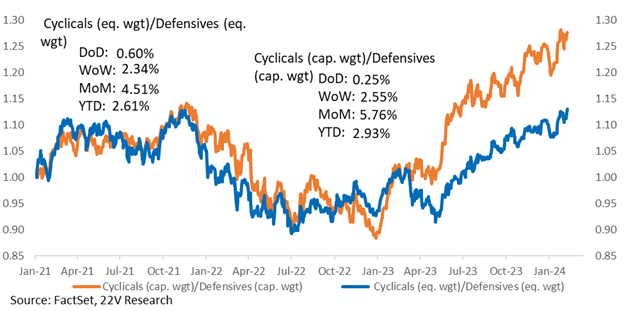
As Gerard noted in a report yesterday, the decline in the Atlanta Fed Wage Tracker “is fully consistent with the Fed claim that the trend and outlook for wage growth is moderating”. Gerard goes on to make the point that the way he looks at the data is not necessarily dovish, but that is a long-term theme. Benign CPI revisions and the headline decline in the Atlanta Fed wage tracker does increase the odds of a broadening out of winners. SMID cap names, ex financials, have had a strong 4 days as 10yr yields have stabilized.
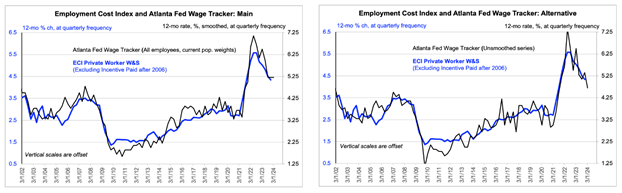
Source: Federal Reserve Banks of Atlanta and St. Louis (FRED), FH calculationsECI is actual to December. Wage Tracker is actual to January. All data are monthly but expressed (and in the case of the ECI reported) at a quarterly frequency.
According to our survey of investors (HERE), the Growth factor is the favorite factor to own in a stronger or weaker growth backdrop. Value in an in-line backdrop. Megas/large caps are best in a stronger or weaker growth backdrop. Small caps in an in-line backdrop. That makes sense, if economic growth is significantly above or below 2%, owning Mega caps/growth assets makes sense as longer-term recession risk increases. More Cyclical assets, like Small caps and Value underperform as investors have difficulty pricing in a longer economic Cycle.
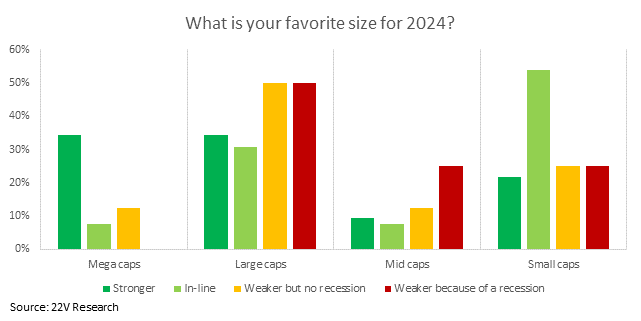
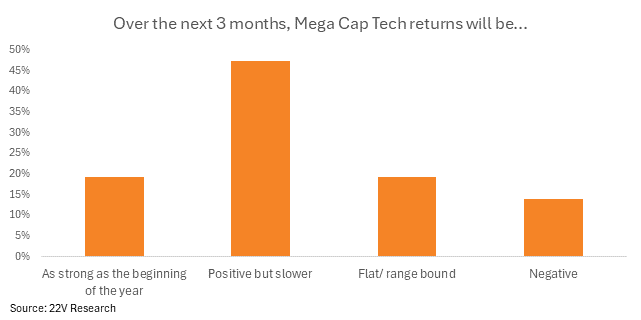
FYI: Broadly speaking, investors think mega cap tech returns will be positive but slower over the next 3 months.
FYI: There is a very odd gap between nominal GDP and Russell sales expectations. If GDP growth continues around its current pace, a meaningful catch-up in Rusell sales expectations should be expected. Some investors believe a more permanent shift to services vs goods is the driver of the divergence. We disagree, but monitoring Russell sales expectations vs Nominal GDP will be a way to track the validity of that thesis.