Back Economics

Consensus and differentiated take on Wage Tracker

Published on February 8, 2024

∙ Download the PDF Report

By

Gerard MacDonell

We can imagine two ways to interpret the softer wage signal from the Atlanta Fed’s Wage Tracker for January released yesterday.   The first would be through the consensus lens, which should be applied if you are trying to get the immediate reaction (if any) right.  And then there is my own lens, which would not guide the immediate reaction but might be relevant over time if there is something to it.  Through the first lens it is good news. And through the second, it remains somewhat troubling, although arguably less so.

Let’s start with the consensus interpretation, which I would by no means disparage.  The most obvious point to make in this context is that the downtick of most metrics within the tracker provides further confirmation of what we should already have expected.  The strength of average hourly earnings growth in the January jobs report was due to a weather-driven distortion in the average workweek.   On a 12-month basis, the Wage Tracker generally continues to slow, which is contrary to the (probably misleading) hook higher in average hourly earnings reported in the employment report.

Having said that, there is one minor anomaly here that I should mention even though it does not overturn the point raised immediately above.  People disagree on what the main metric within the Wage Tracker is. I prefer the series weighted to current population characteristics, for reasons I need not get into here, except to say that my preference there is itself out of consensus.  The 12-month rate there, which is reported at a 3-month moving average has been stuck at (a high) 5.2% for six months in a row now.  But most of the other 12-month rates, including an unsmoothed version of a metric that is definitionally close to what I follow, ticked down.  Indeed, the unsmoothed series fell from 5.4% in December to 4.7% in January, as indicated in the right panel of the chart below.  Be sure to read the notes before the chart though, because the data are for the most part quarter end.

On balance, the data from the Wage Tracker is fully consistent with the Fed claim that the trend and outlook for wage growth are uncomplicated. Wage growth is now slightly too high, but it has been moderating and will probably continue to do so. Let’s keep it simple, by extrapolating, says the Fed leadership — in their public communication at least. 

A reasonable observer with weak or no priors would say nominal wage growth is slowing

A graph of a person and person

Description automatically generated with medium confidence
Source: Federal Reserve Banks of Atlanta and St. Louis (FRED), FH calculations
ECI is actual to December.  Wage Tracker is actual to January. All data are monthly but expressed (and in the case of the ECI reported) at a quarterly frequency. 

Where I am out of consensus — and therefore irrelevant to scoring the immediate market reaction (if any) — is on the notion that we really ought not get too excited by the fact that wage growth is less extremely elevated than it was.  The run up of wage inflation earlier in this episode looks to have been primarily catch up to the surge of inflation, particularly in its most salient components, for reasons that originated almost entirely outside the labor market. And conversely on the way down.  My hypothesis is that the failure of wage inflation to decelerate even more steeply might be evidence that the labor market is tight.  Might be: I am not sure.  But one bit of evidence related to that is that real wage growth, defined as the Wage Tracker less salient inflation, has been accelerating. Full disclosure: in the chart I use the smoothed version, which flatters my case. But you can adjust as you see fit. 

I don’t know anybody else making this point. To a lot of folks it might seem like a rather pinheaded distinction. Dude, goods and services price inflation and wage growth are both decelerating. Don’t overthink it. On the other hand, the Fed is not easing. Maybe they are also overthinking it, which might be nice to know about.  One advantage of this approach is that it does not lead to shock surprise when the Fed hesitates here. If that is the right take, then the implication is not that hawkish. It just reinforces that the Fed would prefer not to see a further tightening of the labor market and might prefer a slight easing. Six months ago, things did look more concerning.

Final point as an aside. I noticed during the last Press Conference that Jay Pow had trouble swallowing when asked about the seasonals in the CPI.  Maybe that is also giving him some pause, pardon the pun. The news related to that will be interesting.
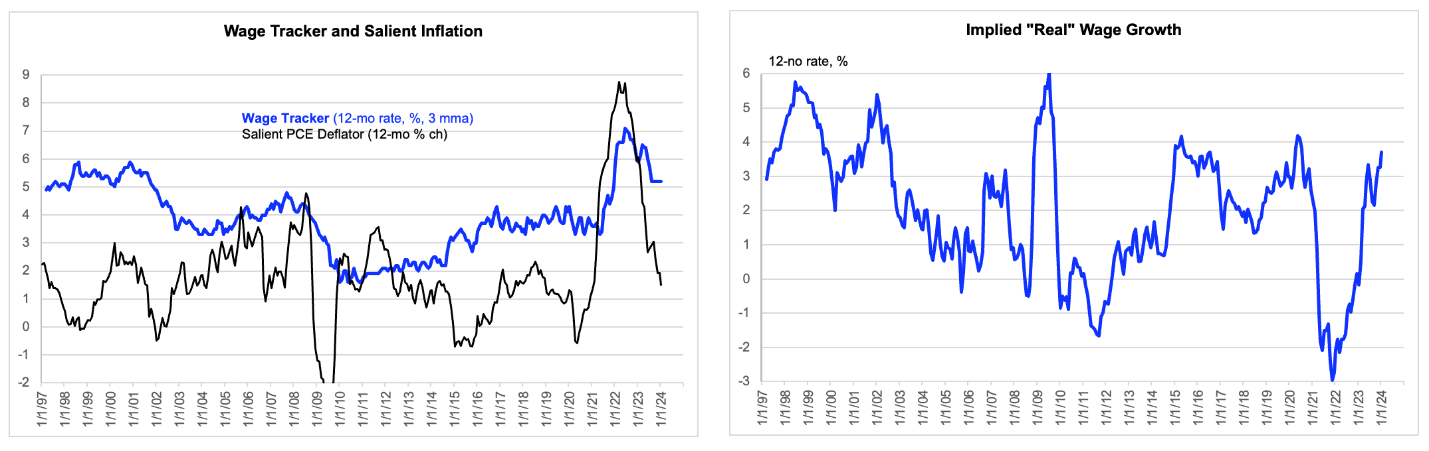
A graph of a stock market

Description automatically generated with medium confidence
Source: BEA, Federal Reserve Bank of Atlanta, FH calculations
Salient inflation is actual to December and estimated to January. The Wage Tracker is actual to January.


DISCLOSURES AND DISCLAIMERS

Analyst Certification

The analyst, 22V Research Group, primarily responsible for the preparation of this research report attests to the following: (1) that the views and opinions rendered in this research report reflect his or her personal views about the subject companies or issuers; and (2) that no part of the research analyst’s compensation was, is, or will be directly related to the specific recommendations or views in this research report.

Analyst Certifications and Independence of Research.

Each of the 22V Research analysts whose names appear on the front page of this report hereby certify that all the views expressed in this Report accurately reflect our personal views about any and all of the subject securities or issuers and that no part of our compensation was, is, or will be, directly or indirectly, related to the specific recommendations or views of in this Report.

22V Research (the “Company”) is an independent research provider. The Company is not a member of the FINRA or the SIPC and is not a registered broker dealer or investment adviser. 22V Research has no other regulated or unregulated business activities which conflict with its provision of independent research.

22V Research, LLC is a professional services and independent publication organization. 22V Research, LLC is not a securities broker-dealer, not a member of the Financial Industry Regulatory Authority (FINRA), not a registered investment advisor (RIA) and not a member of SIPC.

Securities transactions, when offered, are offered by 22V Securities, LLC through LPS Capital, LLC. Certain employees of 22V Securities, LLC are dually registered as securities representatives of LPS Capital, LLC or Analyst Hub Securities, LLC. 22V Securities, LPS Capital and Analyst Hub Securities are members FINRA, SIPC.

https://brokercheck.finra.org/

Current Ratings Definition.

SECTOR OUTPERFORM: An “outperform” rating anticipates the company will outperform the S&P Regional Banking Index (peer group).

SECTOR PERFORM: A “market perform” rating anticipates the company will perform in line with the S&P Regional Banking Index (peer group).

SECTOR UNDERPERFORM: An “underperform” rating anticipates the company will underperform the S&P Regional Banking Index (peer group).

Limitation Of Research And Information.

This Report has been prepared for distribution to only qualified institutional or professional clients of 22V Research Group. The contents of this Report represent the views, opinions, and analyses of its authors. The information contained herein does not constitute financial, legal, tax or any other advice. All third-party data presented herein were obtained from publicly available sources which are believed to be reliable; however, the Company makes no warranty, express or implied, concerning the accuracy or completeness of such information. In no event shall the Company be responsible or liable for the correctness of, or update to, any such material or for any damage or lost opportunities resulting from use of this data. Nothing contained in this Report or any distribution by the Company should be construed as any offer to sell, or any solicitation of an offer to buy, any security or investment. Any research or other material received should not be construed as individualized investment advice. Investment decisions should be made as part of an overall portfolio strategy and you should consult with a professional financial advisor, legal and tax advisor prior to making any investment decision. 22V Research Group shall not be liable for any direct or indirect, incidental or consequential loss or damage (including loss of profits, revenue or goodwill) arising from any investment decisions based on information or research obtained from 22V Research Group.

Reproduction And Distribution Strictly Prohibited.

No user of this Report may reproduce, modify, copy, distribute, sell, resell, transmit, transfer, license, assign or publish the Report itself or any information contained therein. Notwithstanding the foregoing, clients with access to working models are permitted to alter or modify the information contained therein, provided that it is solely for such client’s own use. This Report is not intended to be available or distributed for any purpose that would be deemed unlawful or otherwise prohibited by any local, state, national or international laws or regulations or would otherwise subject the Company to registration or regulation of any kind within such jurisdiction.

Copyrights, Trademarks, Intellectual Property.

22V Research Group, and any logos or marks included in this Report are proprietary materials. The use of such terms and logos and marks without the express written consent of 22V Research Group is strictly prohibited. The copyright in the pages or in the screens of the Report, and in the information and material therein, is proprietary material owned by 22V Research Group unless otherwise indicated. The unauthorized use of any material on this Report may violate numerous statutes, regulations and laws, including, but not limited to, copyright, trademark, trade secret or patent laws.