Back Economics

Jay Powell now so smart he can also do fiscal policy too, and an aside on services ISM

Published on February 6, 2024

∙ Download the PDF Report

By

Gerard MacDonell

The Fed’s adoption of Average Inflation Targeting (AIT) in August 2020 might have been benign to pointless.  As former Fed Vice Chair Richard Clarida formally modeled the actual implications in real time, the Fed would have been stopped out of the need to average just two months into the subsequent inflation spike. The real problem was the reaction function announced at the September FOMC meeting, which committed the Fed to getting well behind on both sides of their mandate, thereby tossing time consistency.  In the wake of some admittedly bad luck, it looks like that unforced error caused a bit of reality denial on the FOMC followed by some unseemly scrambling to renege belatedly without admitting to doing so. In hindsight especially, it was a striking policy error, even by the Fed’s own lights.

The recent steep – and surprising to me – decline of core inflation in the goods and services markets has probably made Fed Chair Powell start to feel a bit more confident that he can get that mistake into the past, where it will be averaged against some legitimate successes.  We could tell from the tone of the Press Conference last week, if not the rates commentary itself, that Powell is indeed feeling better. And then on the weekend, he really showed that his confidence has returned by starting to lecture the politicians on how they should do fiscal policy. Apparently, the debt/GDP ratio is on an unsustainable path, and it is time to have an “adult conversation” about the burdens we are placing on “future generations.”  Surely, that is “uncontroversial.”  Apparently, Jamie Dimon is part of this fake centrist campaign, inevitably.

I am in favor of an adult conversation and would like to weigh in on that basis.  Whether the US has even enough public debt — or the prospect for same – is a function of the future path of r* relative to g*, for reasons that people seemed to understand as recently as a year ago.[1]Right now, forward r* is above estimated g*, although it looks to be a near call, and forward rates may be slightly inflated by a term premium.  

Market now hints that r* is possibly expected to rise above conventional estimates of g*

A graph of growth and growth

Description automatically generated with medium confidence
Source: CBO, Federal Reserve Banks of New York and Philadelphia
Forward rate is actual to Friday and roughly estimated to today, as I am on low tech right now.

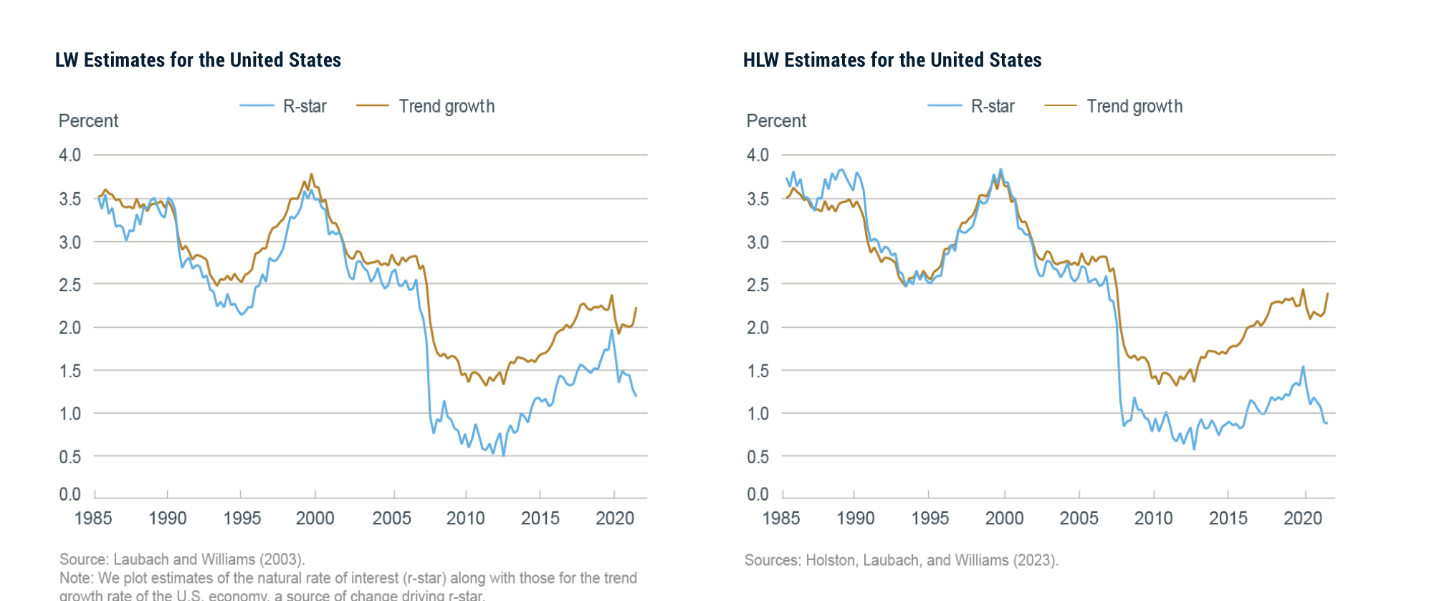
The conventional way of measuring spot r* vs g* suggests that there is still a huge gap there and that we may need significantly more federal debt. This is not my unique opinion. It is just a straightforward application of the logic of Ponzi Public Finance, not disparagement implied by the term.

New York Fed hosted approach suggests there is not nearly enough public debt
A close-up of a graph

Description automatically generated
Source: Federal Reserve Bank of New York

So, I disagree with Jay Powell. His comment about fiscal sustainability is indeed controversial, and not just because the conventional take is uncertain.  With fiscal sustainability analysis, his view is not even conventional, certainly not in the categorical terms he expresses it.  Powell is again winging it based on a gut feel, and he should know better. 

True, with a continued rise of the federal debt, there is a good chance that the forward path of r* will rise meaningfully above g*, which would be a signal that fiscal consolidation is in fact required.  If fiscal consolidation is not delivered in a timely way, which I concede is a risk, then trouble could arise in one of three ways.

  • The Fed might find itself in a position where it is pressured to inflate away the debt. I don’t think that risk is high, but sensible people disagree.
  • Bond holders, overrepresented by the higher end, might decide that the risk of inflation or formal default had risen in which case, they would force real yields up in a way that would be unhelpful on efficiency and cyclical grounds.
  •  There might be the need for a sudden fiscal contraction, which would most likely be most damaging to the most vulnerable members of society.

But the correct political lens through which to look at those three prospects involves class conflict, not intergenerational warfare, whose invocation is almost inevitably designed to obscure class issues. Sorry, to sound Marxist, but they started it. The burdening of future generations stuff is pablum, and certainly not part of an “adult conversation.”

This is not to say that fiscal policy is a non-issue.  The case for letting the debt rip is now more ambiguous than it was, as the top chart above suggests. Fiscal tightening might be helpful on cyclical grounds here. And the long odds against it imply upward pressure on the term premium in the yield curve, due to portfolio balance, not fiscal sustainability, considerations.  But Powell speaks with far more confidence than is appropriate here and the tell is the lazy bromide about “future generations.”

An aside on the Non Manufacturing ISM prices index

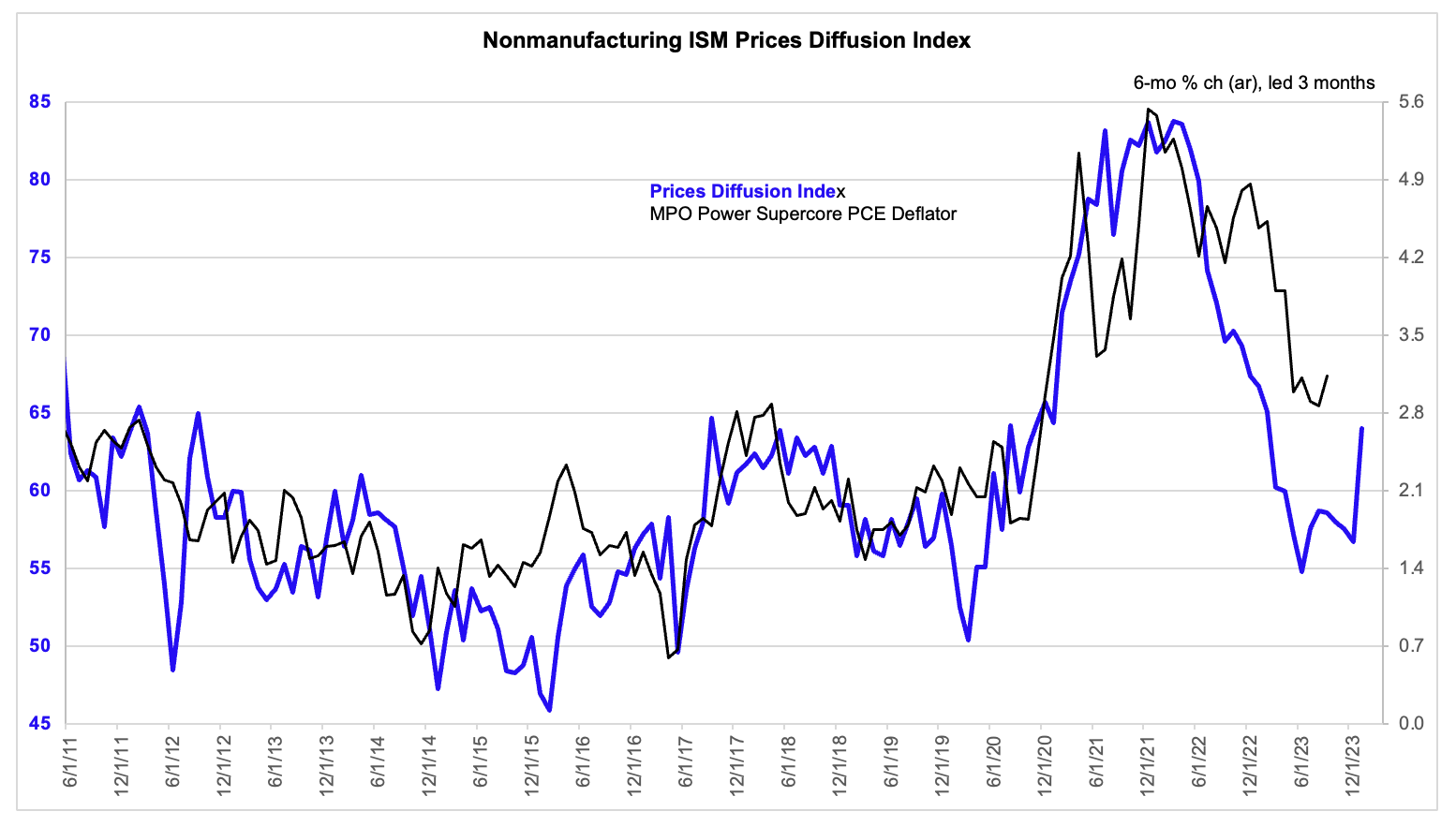
I fully admit to cutting off the time scale to show only the period during which it very roughly “works.” But there is an imperfect correlation between that diffusion index and what I have called the MPO version of the “Powell Supercore,” as it is sometimes called, with some people taking some liberties in the labeling there.  There is no need for a lot of words. The chart tells you roughly what I know. 

 Very tentative support for the arguably still kicking 2 Stage Disinflation Take
A graph with blue lines and numbers

Description automatically generated
 Source: Bloomberg, ISM, BEA, FH calculations
“Supercore” inflation is actual to December and led three months. The price diffusion index is actual to February.

[1] My complaint here has nothing to do with MMT, which I view as fraudulent.

DISCLOSURES AND DISCLAIMERS

Analyst Certification

The analyst, 22V Research Group, primarily responsible for the preparation of this research report attests to the following: (1) that the views and opinions rendered in this research report reflect his or her personal views about the subject companies or issuers; and (2) that no part of the research analyst’s compensation was, is, or will be directly related to the specific recommendations or views in this research report.

Analyst Certifications and Independence of Research.

Each of the 22V Research analysts whose names appear on the front page of this report hereby certify that all the views expressed in this Report accurately reflect our personal views about any and all of the subject securities or issuers and that no part of our compensation was, is, or will be, directly or indirectly, related to the specific recommendations or views of in this Report.

22V Research (the “Company”) is an independent research provider. The Company is not a member of the FINRA or the SIPC and is not a registered broker dealer or investment adviser. 22V Research has no other regulated or unregulated business activities which conflict with its provision of independent research.

22V Research, LLC is a professional services and independent publication organization. 22V Research, LLC is not a securities broker-dealer, not a member of the Financial Industry Regulatory Authority (FINRA), not a registered investment advisor (RIA) and not a member of SIPC.

Securities transactions, when offered, are offered by 22V Securities, LLC through LPS Capital, LLC. Certain employees of 22V Securities, LLC are dually registered as securities representatives of LPS Capital, LLC or Analyst Hub Securities, LLC. 22V Securities, LPS Capital and Analyst Hub Securities are members FINRA, SIPC.

https://brokercheck.finra.org/

Current Ratings Definition.

SECTOR OUTPERFORM: An “outperform” rating anticipates the company will outperform the S&P Regional Banking Index (peer group).

SECTOR PERFORM: A “market perform” rating anticipates the company will perform in line with the S&P Regional Banking Index (peer group).

SECTOR UNDERPERFORM: An “underperform” rating anticipates the company will underperform the S&P Regional Banking Index (peer group).

Limitation Of Research And Information.

This Report has been prepared for distribution to only qualified institutional or professional clients of 22V Research Group. The contents of this Report represent the views, opinions, and analyses of its authors. The information contained herein does not constitute financial, legal, tax or any other advice. All third-party data presented herein were obtained from publicly available sources which are believed to be reliable; however, the Company makes no warranty, express or implied, concerning the accuracy or completeness of such information. In no event shall the Company be responsible or liable for the correctness of, or update to, any such material or for any damage or lost opportunities resulting from use of this data. Nothing contained in this Report or any distribution by the Company should be construed as any offer to sell, or any solicitation of an offer to buy, any security or investment. Any research or other material received should not be construed as individualized investment advice. Investment decisions should be made as part of an overall portfolio strategy and you should consult with a professional financial advisor, legal and tax advisor prior to making any investment decision. 22V Research Group shall not be liable for any direct or indirect, incidental or consequential loss or damage (including loss of profits, revenue or goodwill) arising from any investment decisions based on information or research obtained from 22V Research Group.

Reproduction And Distribution Strictly Prohibited.

No user of this Report may reproduce, modify, copy, distribute, sell, resell, transmit, transfer, license, assign or publish the Report itself or any information contained therein. Notwithstanding the foregoing, clients with access to working models are permitted to alter or modify the information contained therein, provided that it is solely for such client’s own use. This Report is not intended to be available or distributed for any purpose that would be deemed unlawful or otherwise prohibited by any local, state, national or international laws or regulations or would otherwise subject the Company to registration or regulation of any kind within such jurisdiction.

Copyrights, Trademarks, Intellectual Property.

22V Research Group, and any logos or marks included in this Report are proprietary materials. The use of such terms and logos and marks without the express written consent of 22V Research Group is strictly prohibited. The copyright in the pages or in the screens of the Report, and in the information and material therein, is proprietary material owned by 22V Research Group unless otherwise indicated. The unauthorized use of any material on this Report may violate numerous statutes, regulations and laws, including, but not limited to, copyright, trademark, trade secret or patent laws.
