On Jan 12, 2024, in a note entitled, “Paul Tudor Jones Please Forgive Me” I invoked PTJ as follows:
My favorite PTJ line of all time is, “Price turns and then a narrative follows.” But I think in this environment his elegant turn-of-phrase should be amended to, “Price turns and then a narrative follows until the next day’s trading.” And I think PTJ’s bon mot should be amended because, it seems to me, that a particular narrative spun yesterday to account for or explain the market’s price action is all too quickly reversed the next day to account for or explain that day’s price action.”
“Intense and consistent flip-flopping of narratives is evident with respect to the number of potential Fed rate cuts (3 in ’24 or is it 6 in ‘24?) and when potential rate cuts might begin (Mar ’24?). I believe that the narrative inconsistency is directly tied to a Fed that would be referred to as a chiacchierone – a chatterbox, a loudmouth, a windbag – in my old neighborhood. Remember on December 13, 2023, when, during a presser, Jay Powell shifted from comments he made weeks earlier (“would be premature” to talk about policy easing) to what was interpreted as a full-fledged pivot (rate cuts are “beginning to come into view.”).”
Heading into yesterday the S&P had been up in 12 of 13 weeks, so it might be said that investors have been anticipating Fed rate cuts for some time now. In fact, Dennis DeBusschere’s Strategy Team conducted a survey just this week that revealed “Most Optimism about the FOMC We’ve Recorded” so, again, it might be said investors were anticipating rate cuts. And then, in a note from last night by 22V’s own Peter Williams, “The most newsworthy line was Chair Powell saying, ‘I don’t think it’s likely that the committee will reach a level of confidence by the time of the March meeting to identify March as the time to [cut], but that’s to be seen.’ There were strong reasons for Powell not to pre-signal a March cut, even if it had been his baseline, but this was a much more definitive statement than I expected.”
I continue to contend the Fed would be a more effective communicator if they did less communicating (I’ll bet you a lunch ol’ motormouth Austan Goolsbee will be on CNBC before this week is out to provide more “color” on the Fed’s communique.). The Fed would do well to remember the following quote from French mathematician and physicist Blaise Pascal, “All of humanity’s problems, stem from man’s inability to sit quietly in a room alone.” But they won’t.
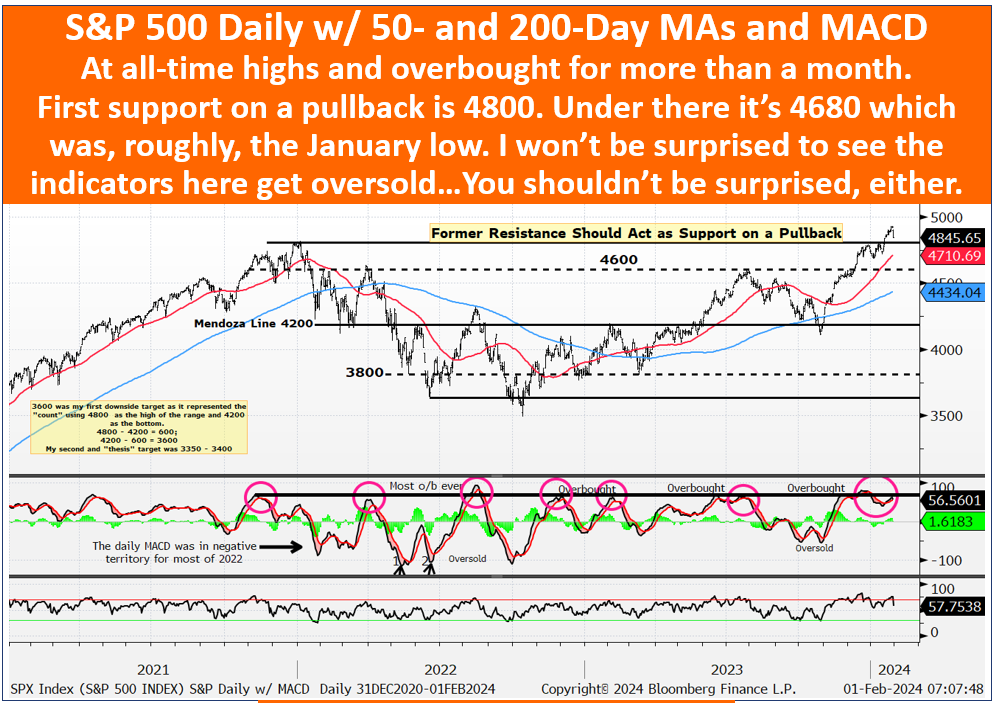
None of us should be surprised that the market was in sharply yesterday nor if yesterday’s sharp move lower was the beginning of a more than one-day corrective phase. Major indexes in the US have been overbought for more than 1 month and, as noted above, the S&P has gained in 12 of the last 13 weeks so – to use an unoriginal line – even God rested… If you were to cue a song sung in a Broadway play…let’s say, “Evita” that was also sung by Madonna in the movie of the same name it would be the updated version of “Don’t Cry for Me, Argentina” to “Don’t Cry for Me, Equity Investors.”
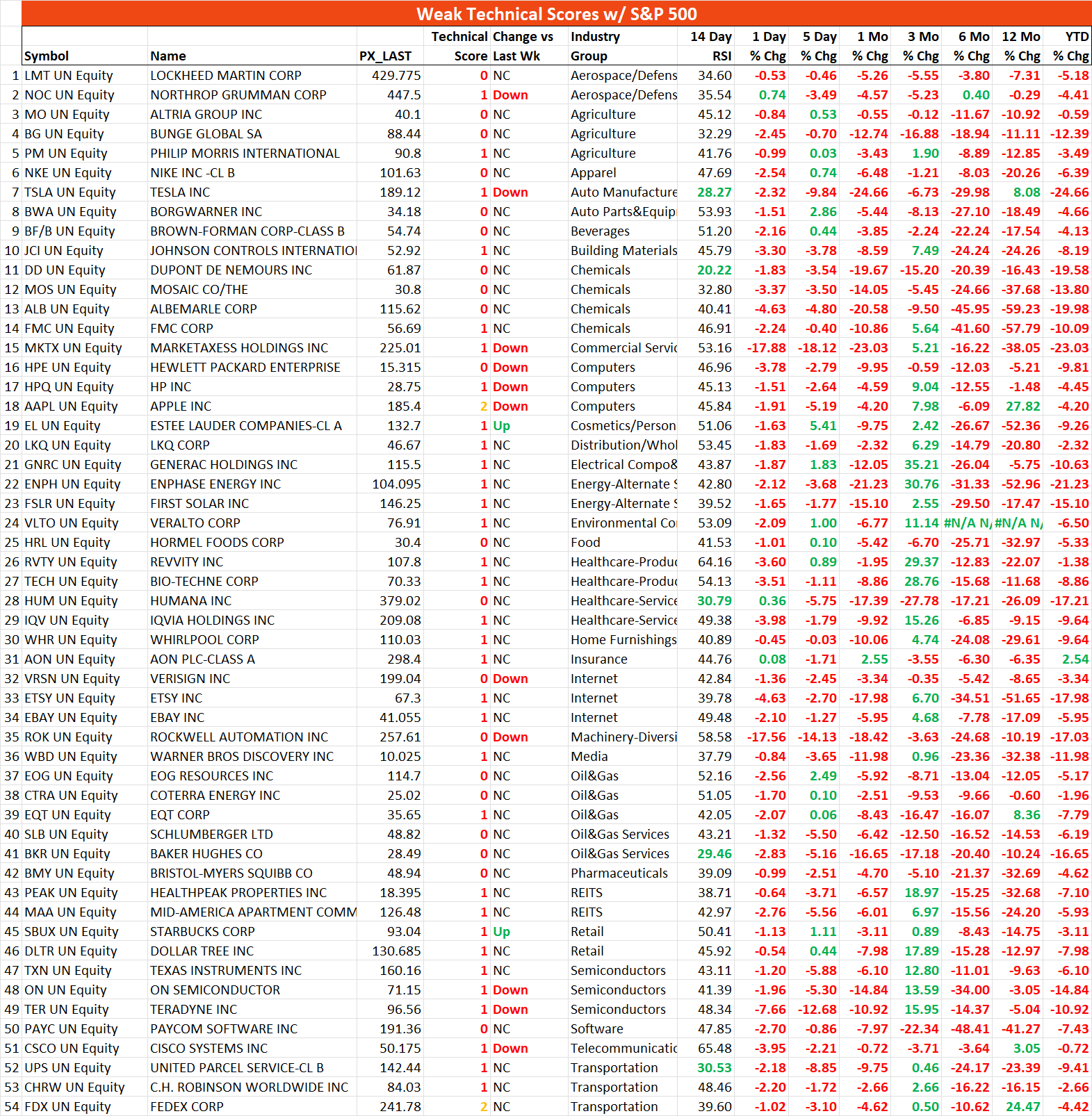
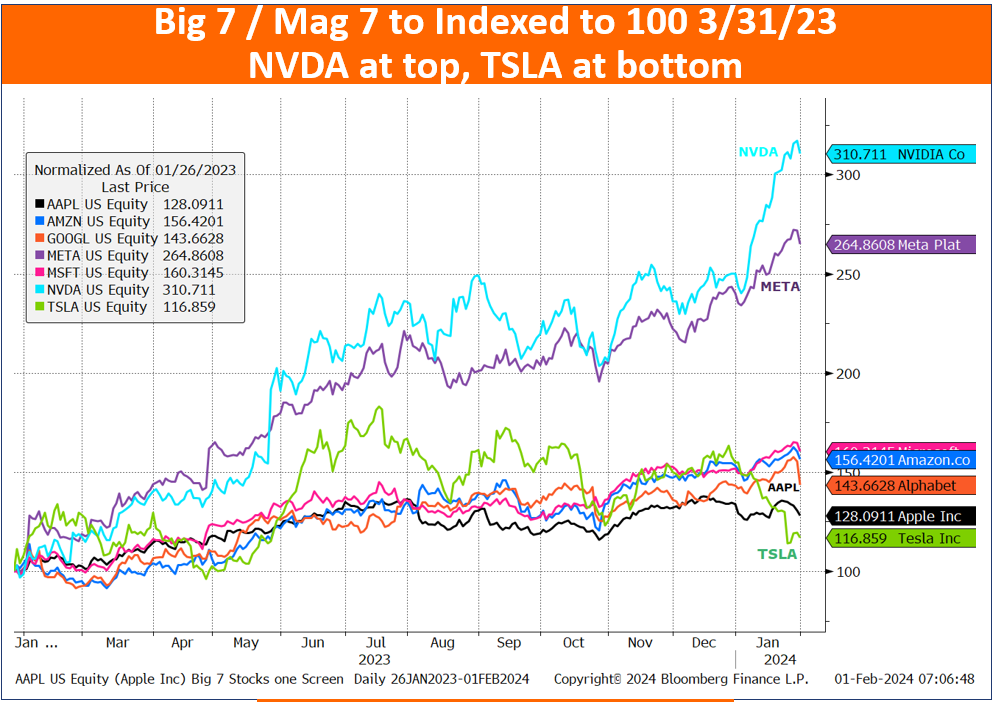
Most hedge fund types I speak with regularly are more interested in shorting the major indexes via futures or ETFs. I think, however, that the following list of S&P stocks that are worse off than the S&P is a better place to start if you’re looking to add shorts or, if you’re a long-only investor, to reduce these underperformers. The list is sorted by Industry Group. Apple, FedEx, and Tesla – three stocks I’ve highlighted in particular – are on the list. Another, Abercrombie & Fitch, is not on the list but is still EXCESSIVELY overbought, is a good sale here, too.