Q4 ECI Data – Dovish Good News
There is little in today’s release of the 23Q4 employment cost index which leans hawkish on the margin. Almost every major category showed a deceleration in q/q growth when compared to the notably punchier Q3 and q/q saar paces below their y/y rates.
With so many cross currents impacting the labor market at the same time, pointing to a single series or release as the single best barometer of labor market slack seems somewhat foolhardy (the intra-indicator dispersion is exceptionally wide with different measures suggesting wildly different levels of slack as discussed in yesterday’s JOLTS write-up).
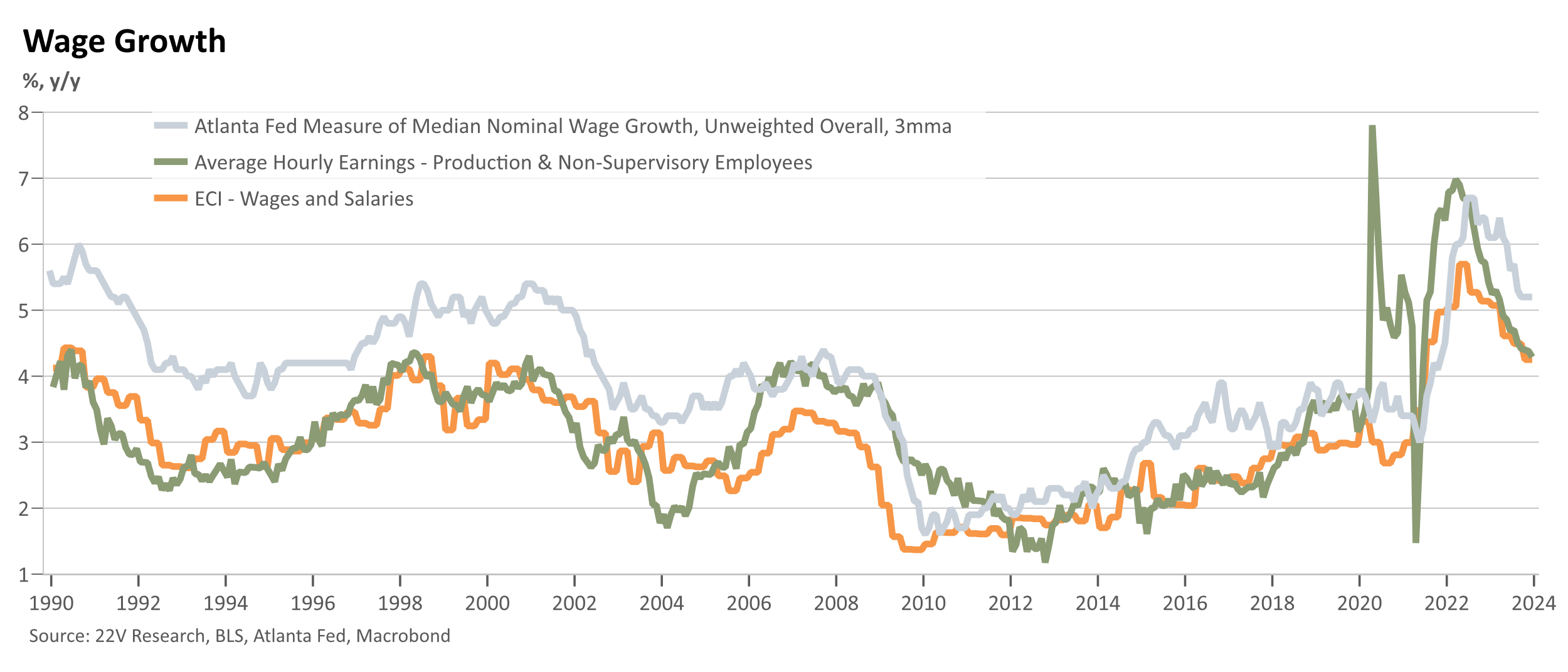
Rates of wage growth remain a bit too hot for the Fed overall but with labor markets still fairly tight, although at much healthier seeming levels now, and wage negotiations happening at a lower frequency than consumer facing pricing, some trailing momentum is reasonable and does not seem obviously inconsistent with a soft-landing. Of course, other measures tell somewhat different stories with the ECI being the most recently dovish but highest quality of them (AHE bit hotter towards the end of the year and the Atlanta Fed’s wage growth tracker is running in the mid-5s y/y, a hot level but a fairly standard spread to the ECI and AHE). For the Fed, with rates up here, that should probably be enough so long as the inflation data remain relatively well behaved.
One issue in leaning too aggressively on wage growth as a signal of underlying inflationary pressures is that the wage growth is highly multi-causal and could be driven by a myriad of other forces in the short-term to medium-term. This should reinforce the cautious but not necessarily hawkish view when interpreting wage growth, as long as inflation remains at or near target. Too hot wage growth could be a sign of (in rough order of how I, and not necessarily the Fed, currently view them): lagging impacts of the various inflation shocks, continued marginal tightness in the labor market, elevated productivity growth, worker’s regaining some income share from firms, and/or too high of underlying wage and inflation dynamics. The Fed will likely acknowledge that wage growth remains a bit too hot overall, given its assumptions about underlying productivity growth, but the impact on actual policy rate shifts of wage growth remaining ‘too hot’ is highly inflation context dependent and wages are not likely to push policy in a substantially hawkish a direction entirely on their own.
I think this multi-causal issue, along with the decline in inflation pressures and general trends towards a soft-landing in the data, explains why we have heard the Fed leaning less on wage growth in recent months. Yes, wage growth still comes up but with less frequency and hawkish worry than before. Fed officials have been quite willing to rapidly switch across data inputs into their reaction function this cycle and, for now at least, the primary one is simply overall core inflation, with others mattering most in framing individual policy makers’ risk management preferences.
Over the medium-term (i.e. summer-24 and onwards), I continue to think that inflationary pressures are currently being somewhat flattered by one-off factors in the data and that wage growth is likely to remain a bit high for the Fed’s liking. This, and my broader macro optimism relative to consensus, are a key part of why I think the Fed is likely to underdeliver relative to current market pricing, and more dovish base case forecasts, over the course of 2024 as a whole despite a tentatively held view that cuts likely begin in March.
With the ECI being only quarterly though, we have to return monitoring the noisier average hourly earnings data and the Atlanta Fed wage growth tracker.
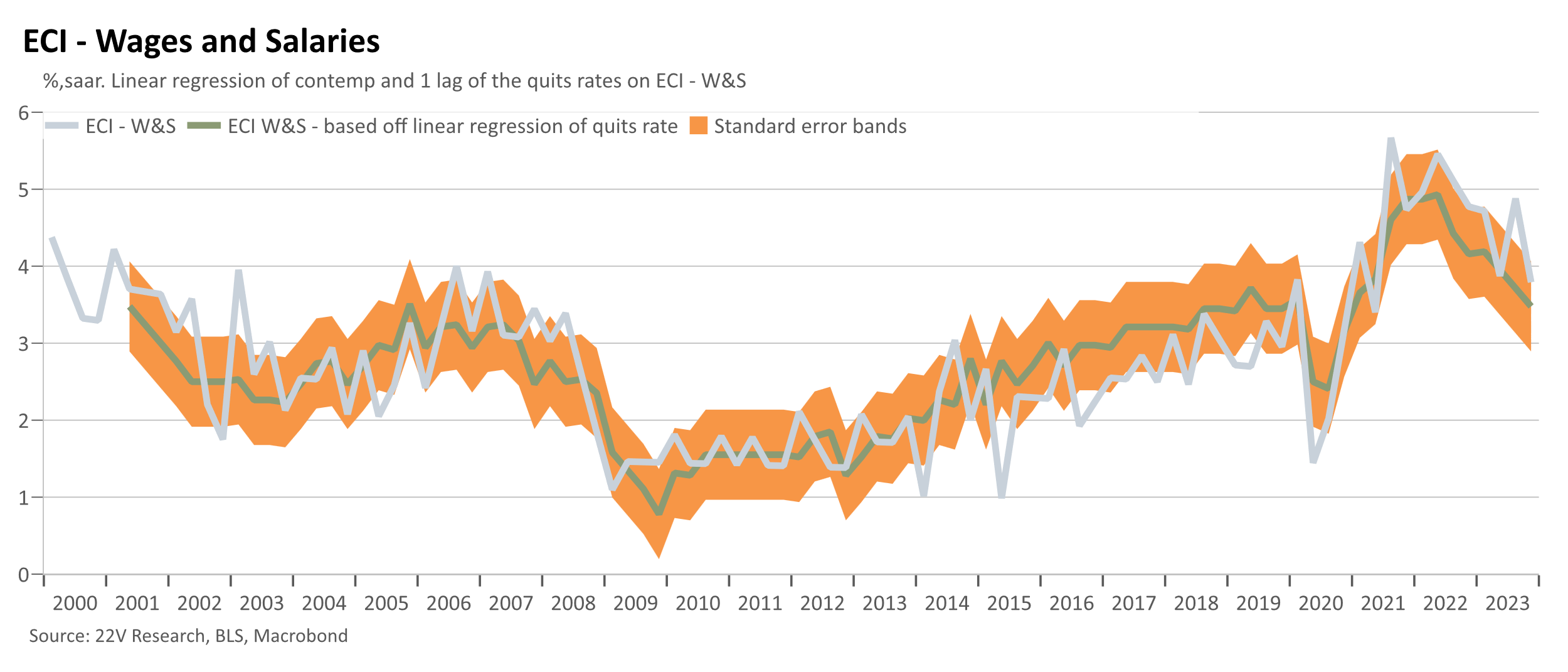
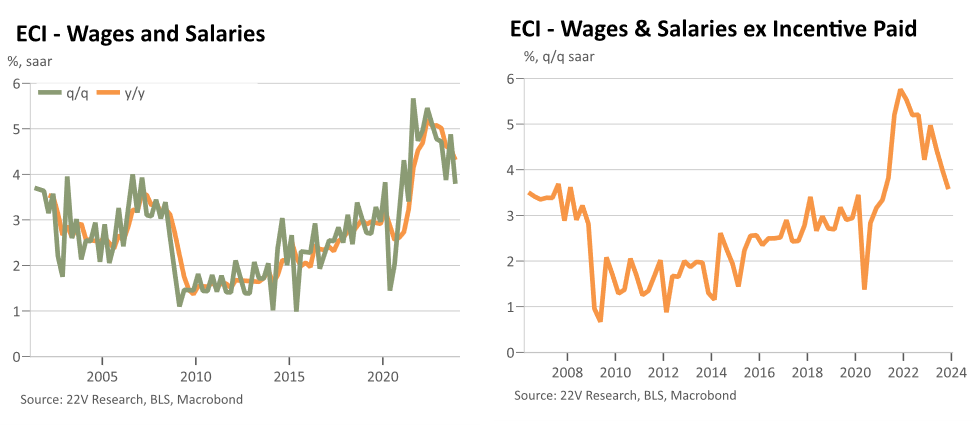
After a punchy Q3, q/q wages and salaries growth decelerated from 4.9% to 3.8%. year-on-year growth is running at 4.3%. This is likely to slowly trend down over time, although the q/q path will be somewhat bouncy and I don’t wage growth to decelerate, if at all this cycle, back to 2018-19 levels as quickly as inflation has.
ECI wages and salaries ex incentive paid occupations which is analogous to core wage growth, stripping out more volatile compensation patterns around benefits and bonuses, came in at ~3.6% q/q saar and 4.3% y/y.