

It is not the main focus for today, obviously, but while waiting for the Fed I thought I would take account of Jason Furman’s recent point that real wages are 5% below trend, which apparently is making the rounds (HERE). If that is true, then real wage growth could run well above presumed trend productivity for a while with no implications for inflation, but with somewhat negative implications for margins.
This would be a huge deal if representative

But it doesn’t seem to be true, and in this note I explain why, trying to be as transparent as possible so that you can follow along and judge for yourself. Let’s start with Furman’s main bit of evidence, which I copy above. The ratio of ECI wages to the headline CPI is 5% below trend, as shown in the chart above. It seems simple enough.
The straightforward implication of that claim is that the labor share is somehow also 5% below some sense of normal. Sorry to put words in Dr. Furman’s mouth, but if that is not the implied claim then he does not have a relevant one. And that is provocative because I have a direct measure of the labor share that is 0% below normal, at least if we take the pred-Covid level, rather than say the postwar average, as our benchmark of “normal.”
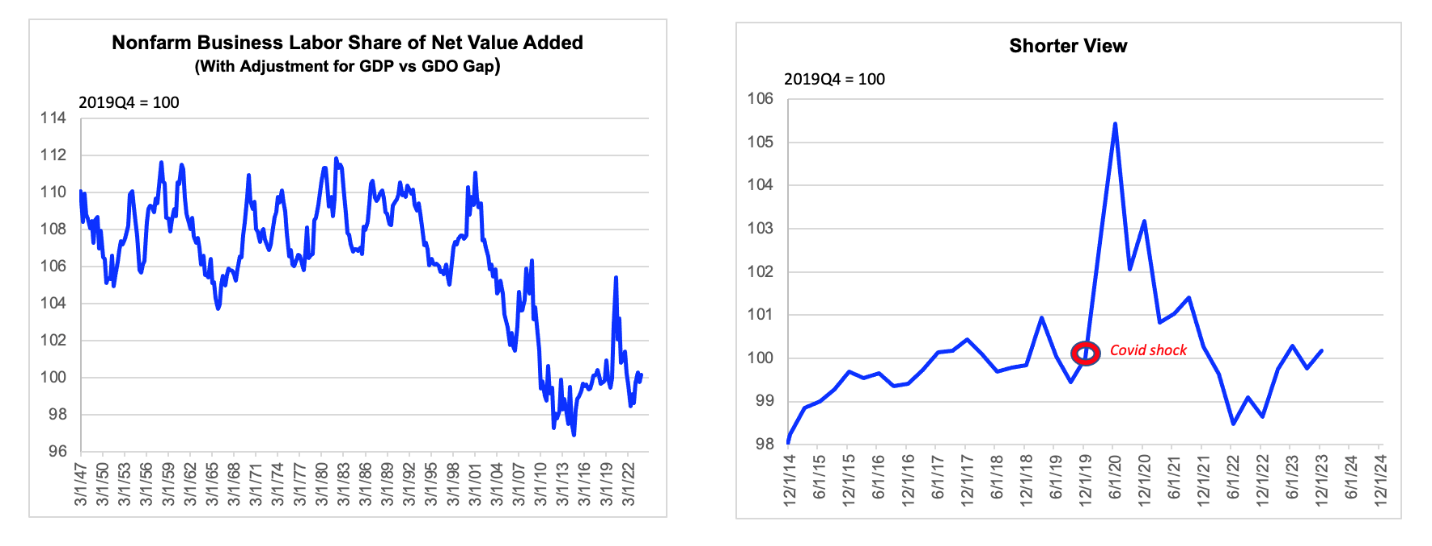
Data are actual to Q3 and consensus estimates for Q4. I am showing levels, so the consensus being slightly off on the growth rates will not matter much.
What is going on here? Well, that is actually an answerable question, using arithmetic. We can quibble about the meaning of the accounting, but the accounting itself is unavoidable. So, let’s do the numbers.
First, my measure of the labor share makes an adjustment for the statistical discrepancy in the National Accounts. Most people would not do that, preferring to take the implied labor share from the Productivity and Cost report at face value. So, in the interest of transparency, let’s reverse out that adjustment. That gets me to a labor share that is 1.1% below its immediate pre-Covid level (not shown). There is no way that such a tiny gap could rationalize a catchup effect in real wages, particularly one that seems to be accelerating. In other words, my more hawkish take here does not really lean much on the adjustment for the statistical discrepancy. I just figure the adjustment is appropriate.
But what of the remaining four percentage points? Unavoidable accounting identities dictate that it has to be some combination of the following three items:
· Nonfarm business sector productivity growth has been weaker than is implied by extrapolating the period immediately pre-Covid.
· Average hourly compensation has been faster than the core ECI.
· The output price deflator for the business sector has risen less quickly than the headline CPI.
In fact, all three of these factors have contributed. Cumulative productivity growth since Covid has been around its structural of 1.1%, even though it grew at 2% (ar) during Furman’s trend period. Average hourly compensation is up a cumulative 23% vs the 18% rise of the ECI wages and salaries. And the CPI has risen 19% cumulatively vs the 17.4% rise in the business sector’s output price deflator. It is not surprising that the deflator has not risen as much as the CPI because the CPI is heavily overweight rents, as you know. Away from that, I have not actually looked into how the relative price of consumer prices and business sector output prices has evolved. But I do know – with as much certainty as macro allows – the deflator is the relevant price index here.
Let me conclude by addressing what might seem to be a cheat here? If average hourly compensation is the better measure of wages, then why do we all look at the ECI? Can’t have it both ways. Actually, we can. For the purposes of assessing the underlying rate of wage growth, we watch the ECI. For the purposes of watching the level of the labor share, we have to take account of all labor costs, even if doing so introduces volatility in the reported quarterly growth rates. Such volatility is not a worry when assessing the level.
To repeat, this is not the main thing for today. But it is something on which I have a relatively informed (by my own standards) view.

