

One aspect of the current macro debate that seems peculiar to the current cycle is the presence of analysts who expect the data to be revised to confirm their view that the economy has recently been weak. Perhaps the best example of this is the Bloomberg economist who believes we have “more likely than not” been in recession, despite the 4% GDP growth reported for the second half of last year.[1] I suspect you are aware of the pattern, so I can leave it there.
On Friday, the BLS will revise (even NSA) employment levels to December and employment growth rates to last March, largely on the basis of already known results from the Quarterly Census of Employment and Wages (QCEW). The revisions will be moderately downward and may renew concerns that the employment data in particular are biased. This is especially the case, given that there has recently been a strong tendency for the data to get revised during the two months immediately after their release for reasons that are separate from — and thus incremental to — the signal from the QCEW.
For now, I tentatively pencil in that data issues internal to the employment report imply that private (and thus total) employment growth is running at about 40 to 50k a month below what the current data show. That’s false precision and subject to its own updating. But to paraphrase one of Tim Geithner’s aphorisms: number beats no number. We should have some sense of why we are even talking about this. Accordingly, private employment growth over the past two months recorded at 160k on average might map to a best guess of the true gain near 115k.
The purpose of this note is not to explain why I am using a fudge factor of 40 to 50k. Nor is it to try to resolve the issue fully. It is good to stay persuadable on these issues. But I present here three considerations that, taken in isolation, point away from the idea that the labor market has been sneakily weakening dramatically. Whether the actual labor market will abruptly turn south as part of a “landslide,” as Larry Summers calls it, is entirely separate. I am looking into how the recent data depict the recent reality and coming up with some partial results:
- The historical data do not suggest a strong tendency to downward revision when contemporaneously reported employment growth is running at a moderate pace. The big initial overstatements happen in recession. And this point is not largely circular. The initial prints themselves shed light on the recession risk.
- The ADP National Employment Report can be used as a consistency check of the private employment figures produced by BLS. This is particularly the case now that the purpose of the ADP release is to capture likely BLS revisions, rather than to try to beat the contemporaneous release by a couple days. This makes tomorrow’s ADP release slightly more interesting than it would be under its old formulation.
- Much more importantly, the Fed staff have worked up estimates of private employment growth that are based on ADP source data but are probably more reliable than the ADP release itself. I wish they would publish those data, especially given the repeated pious bromides about “openness.” What I have noticed is that the Fed has recently stopped highlighting these secret inputs as a worry. This point is admittedly highly speculative on my behalf. And if, say, Governor Waller were to come out and highlight that the Fed staff’s reading of the ADP figures finds weakness, then I would pay close attention to that.

Data are actual to December.
BLS first look contains information
The picture above illustrates a point I have made before, but I have tweaked the approach to focus on 3-month rates of change and to incorporate what I think (without having confirmed) might be a slight tweak in how the St. Louis Fred presents their historical vintage data. As usual, I censor the data from the initial Covid period to avoid the distraction created by the wild volatility there.
Note that for the period before the Covid shock, which is sufficiently distant to allow the revisions to have come in, there is a tight correlation between what the initial prints show and what the subsequently revised data show. On the other hand, there is a tendency for the initial data to overstate employment growth – or more to the point, to understate employment loss – when a recession has begun.
I will focus on the experience around Covid in my discussion of the Fed’s work below but will ignore it here because we did not really need the employment data to tell us that was a disaster. But let’s focus on the GFC, when having the revised data would actually have helped a lot of us in real time. And let’s focus on the 1-month changes in the interest of greater granularity, even though the chart shows 3-month changes which are appropriate in a more serene environment.
The prior expansion peaked in December 2007. Somewhat ironically, the contemporaneous vintage data understated employment growth at that time and were roughly correct for the first three months of the recession. It was only when the actual collapse set in that the first looks missed it. You can see that in the chart. But to complete the thought, the current data show a 19 bps decline of private employment for April, vs just 3 bps in the contemporaneous data. And that huge gap persisted for roughly the next year.
So based on the historical performance alone, we have pretty good reason to suspect that the contemporaneous employment data will severely understate employment weakness during a collapse. But during such collapses, the contemporaneous figures are themselves quite weak, just not weak enough. So based on history at least, we ought not guess that employment is significantly overstated when the contemporaneous employment figures are running at a trend or above-trend rate. I choose my words carefully here because the historical record is not the only issue that bears on this debate. Collapsing survey response rates are novel and the effect of them cannot be assessed by a resort to the historical record, which is better suited to assess, for example, the role of the much maligned birth-death model.
ADP report is now actually relevant
The ADP employment report can be used as a cross check of what the contemporaneous vintage private employment figures are showing. This has been the case since the report was last reformulated to get a lead on the QCEW five months hence, rather than the first look at employment two days hence. I am not sure it does a great job of that because not enough time has passed to test its reliability in real time application. And for now, at least, I would be short the required data anyway, because the history gets revised, which is newly not a scandal. (The old formulation was borderline fraudulent.)

Source: ADP technical appendix on their methodology, as linked above
But here is what I can say. During the nine months between March and December, the ADP measure of private employment growth has been substantially stronger than the current vintage of private employment growth as measured in the headline BLS data imply. I worry, though, about the current vintage of ADP data describing the Covid shock. It is a huge miss.
Would you mind just sending over your data?
But the above is mostly by way of introducing what I take to be the proper way to use the underlying ADP payroll processing data. You may recall this paper (and earlier versions of it) published by Fed types during the very early days of the Covid shock, the abstract’s money passage of which is captured below.
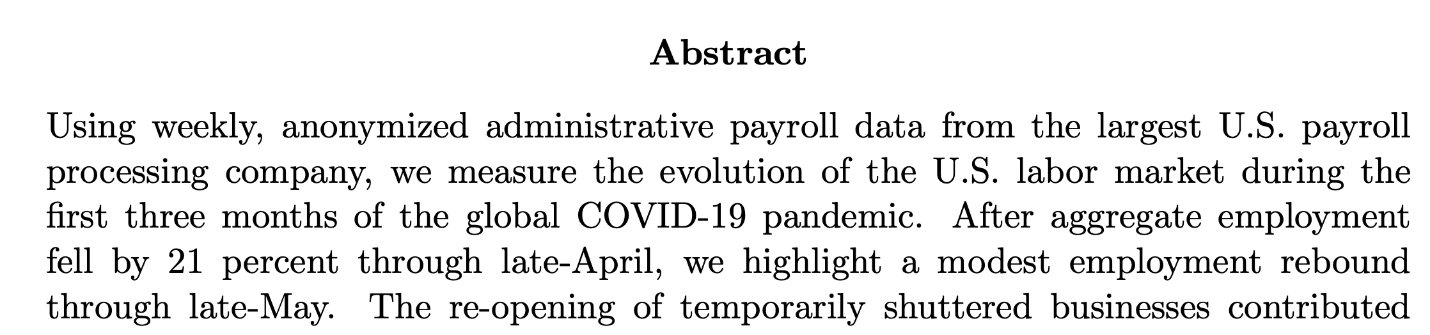
Whereas the authors of what we call the ADP “report” use an empirical approach to extracting the information from the underlying payroll data, the Fed types take an analytical approach, whose focus is on proper benchmarking and scaling, rather than statistical inference. Sorry, I cannot retrieve the reference just now, but I saw a paper by them or associates recently in which they were bragging that their approach worked. Their success was not so much in getting the scaling right during the March disaster (we don’t yet know), so much as having a reporting lead (relative to BLS) in February and March and in showing employment losses for February that were (correctly) larger than the BLS reported in real time.
The thing is, some of what I call here “Fed types” are now actually on the staff of the Federal Reserve Board and apparently, they have kept the effort going. Governor Chris Waller mentions that effort in this speech to the NY forecasters in late 2021. And in the minutes to the June 2023 FOMC meeting, we can find this passage:
Some participants pointed out that payroll gains had remained robust but noted that some other measures of employment—such as those based on the Bureau of Labor Statistics’ household survey, the Quarterly Census of Employment and Wages, or the Board staff’s measure of private employment using data from the payroll processing firm ADP—suggested that job growth may have been weaker than indicated by payroll employment.
I got to tell you that you folks are lucky to have me surfacing this stuff for you, because nobody else seems to be onto it. It would be great if the Fed would just report out what their model, which I suspect might be updated weekly in real time, shows. After all, they make such a big point of being “open,” to the point of laying it on in a cringe inducing way. If being open is so valuable, then why don’t they share with the public where they actually do have an information advantage.
Here is my suspicion, they don’t want to insult their friends at their BLS or their new friends at ADP. When one of my clients says, Gerard, could you just send the data over, I can get my back up. And separately, I love when economists try so hard to confirm the public’s suspicion of them that they are not normal humans. Being human, the Fed staffers are probably showing grace.
Where am I going with this? To another speculation. I have not noticed senior Fed officials referring to those secret employment data, which are probably quite high value added. For now, I assume – brazenly – that this does not mean they are showing weakness. But if that were to change. Or if you, dear reader, were to correct a misperception here, then I would pay a lot of attention to that.
[1] The statistical discrepancy in the National Accounts does suggest that the GDP for the current period is likely to be revised lower. And separate from the revision, the GDP may simply continue to overstate aggregate demand growth in the current period even after revision. Sometimes, the data just stay misleading, as hinted at in this report on the issue from the Cleveland Fed. My best effort to manage that issue is to monitor Gross Domestic Output (the average of GDP and Gross Domestic Income). It is moderately strong and has recently been accelerating. But there is admittedly uncertainty here.

