

Bottom Line: We have met with a significant number of investors over the past few weeks. They are worried that economic growth will be weak enough in 1Q24 to raise recession risks in 2H24. That outcome would drive yields lower and markets could trade more “recessionary” even if an actual recession never unfolds. That would favor risk-off factors (low Vol, Higher Quality, and Defensives). That is not an unfair assumption and helps explain why investors thought the payroll report today would miss slightly to the downside and be risk-off (according to our institutional investor survey work).
Relevant News: Headline Payrolls were higher than consensus and average hourly earnings were in line via a revision lower to the previous reading. The data meaningfully challenge the view that the Fed is on the cusp of cutting rates. It has cleared the decks to do so if needed. However, these data point away from the need.
Things to Watch: (12/12) CPI, (12/13) FOMC, (12/14) Retail Sales (12/22) PCE.
Economics:
Wages and Reviewing this Cycle’s Cutting Criteria:
Wage and aggregate income growth was notably punchier in November. Combined with falling gas prices this suggests strong real income growth in the month. This comes after a few weaker months. The 3-6 trends still seem healthy, but this is a nice reminder that the data is likely to be somewhat volatile and assessing underlying wage growth and inflation data amidst the various bullwhips and supply shocks remains challenging.
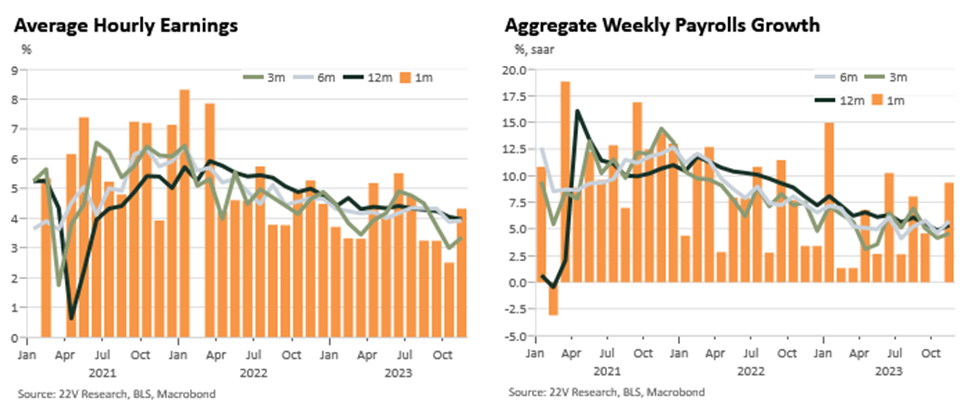
The most important point is that the data and evolving forward-looking risk management concerns around durably achieving 2% inflation will drive the process. 22V’s macro economist’s strong suspicion remains that the cutting cycle is unlikely to be a smooth process. With current nominal rates far above reasonable estimates of neutral it’s wildly challenging to imagine the Fed returning to current levels after cutting. However, if the economy reaccelerates after cuts, especially a larger number of them, the future rate path may become increasingly symmetric, or upside skewed.

Portfolio Strategy:
Mean Reversion Continues to be a Portfolio Risk – Broadly Speaking:
Our industry group mean reversal portfolio, which goes long the prior month’s worst three performing Industry groups and short the 3 best performing industry groups, WORKED AGAIN in November. Since January, the mean reversion strategy has returned +30%.
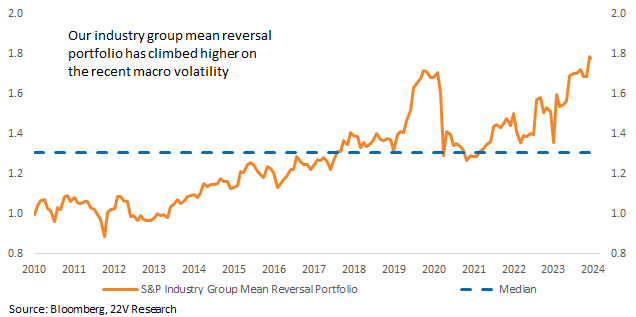
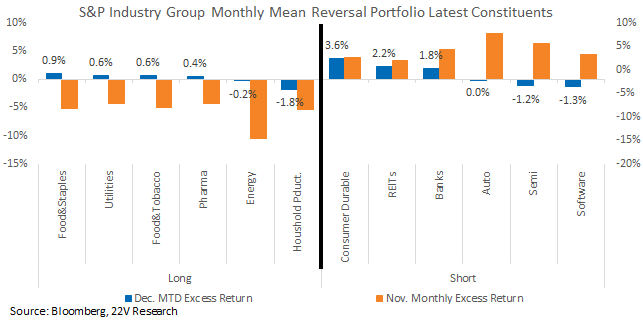
We are not suggesting investors blindly trade a mean reversion portfolio at all. The strong mean reversion tendency in markets is something to be aware of in a period of still relatively high macro volatility backdrop. Macro volatility is declining, but still high. The portfolio for December goes Long Food & Staples, Utilities, Food & Tobacco, Pharma, Energy, and Household Products, and short Consumer Durables, REITs, Banks, Autos, Semis, and Software. Month to date, there has been a mild reversal in the Defensives and Early Cyclical industry groups.
China Strategy:
The Politburo’s Tone is Modestly Supportive Heading into Economic Work Conference (CEWC):
China’s Politburo held its meeting to preview the upcoming Central Economic Work Conference (CEWC), which lays out the economic policy agenda for the following year. There is a focus on supporting growth next year, including phrases such as “increase macro-control efforts” and “strengthen counter-cyclical and inter-cyclical adjustment of macroeconomic policies.” However, the tone of the meeting did not suggest a critical urgency in this regard, saying that “the economy has rebounded and is developing with high quality” and not betraying deep concern over employment, for example. There was little to suggest a major departure from current policy settings.
On macro policies, key phrases include pledges to:
- “Continue to implement proactive fiscal policies and prudent monetary policies.” Message: overall continuity.
- “Proactive fiscal policy must be moderately strengthened, improve quality and efficiency.” This is consistent with other recent signals of stepped up central government support for infrastructure and other spending, but moderate in scale.
- “Prudent monetary policy must be flexible, appropriate, precise and effective.” This suggests monetary policy will stay supportive but with limited room for major easing, particularly when it comes to broad measures such as rate cuts.
- “It is necessary to enhance the consistency of macro policy orientation and strengthen economic propaganda and public opinion guidance.” It is hard to tell exactly with this means, but to me it sounds like: “We need to stay the course and do a better job explaining to people why they should be happy with it” – that is, not entirely encouraging in terms of a shift in approach.
- The meeting pledges support for consumption but nothing new. As expected, there is no indication that we will see direct fiscal stimulus to Chinese households.
- Property is not mentioned directly. Clearly there will be significant support for property, especially through affordable housing programs, but China’s leadership does not view real estate as a key stimulus tool and is not willing to reflate the sector to achieve short-term growth goals.
Other Things at 22V:
- 22V’s European analyst (HERE) gives his latest update and gives a preview of the ECB meeting next week.
- A replay of our weekly webinar where 22V’s analysts give their latest thoughts (Replay HERE)
Weekend Reading:
Several of 22V analysts have flagged this Economist article (HERE) on how the pandemic has affected sentiment in surveys.
An interesting thread by Jason Furman on howe he is thinking about the inflation outlook (HERE)

