Economic data has indicated high odds of a soft landing for several months, and the dovish shift in Fed rhetoric over the past week has reduced the risks of a near-term re-tightening of financial conditions. Investors, as per our latest survey (HERE), still put ~50% odds on there being a recession in 2024, so unless data deteriorates, there is still a sentiment arbitrage opportunity.
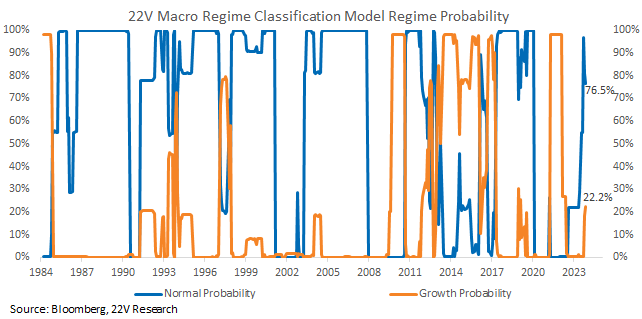
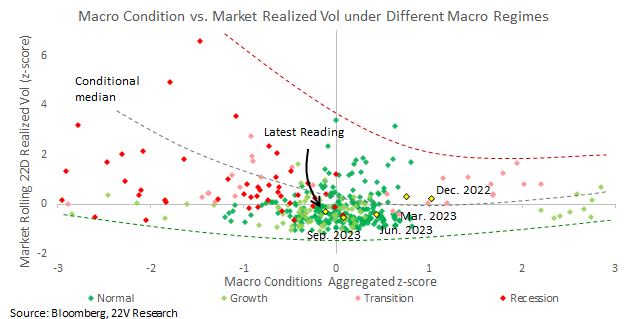
Broad measures of recession risk, like our Macro Regime Model, have been signaling lower recession risk since ~July this year. We break macro regimes into two broad categories – contracting or expanding – with two sub-groups:
- Recessions/Transition: periods where market internals act as they do in recessions. Those periods see higher vol, higher correlations, more mean reversal, and Defensive/Risk-off leadership.
- Normal/Growth: When internals are generally more risk-on. In those periods, pure Defensive groups and risk-off factors tend to lag, micro themes play a larger role, and return trends are less binary.
Over the past few months, the odds of the economy being in a Recession/Transition period have fallen to 0% and the probability of being in a Growth period has increased. A recession could, of course, still happen, but the burden of proof has shifted. Until hard data deteriorates significantly (more on what that means below) or the Fed signals its intent to tighten financial conditions materially (which could force a deterioration in hard data) rotations are more likely to occur within Cyclicals than between Cyclicals and Defensives, and factor rotations are more likely between style and momentum than between risk-on/off.

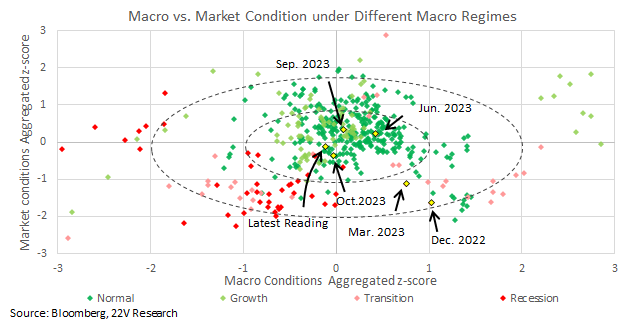
Market conditions improved in November as risk assets moved higher, supported by easing financial conditions. Macro conditions continued deteriorating, which is necessary to move data toward a non-recession distribution. Market volatility has moved as expected given the above. The VIX is near its lows for the year and aggregated cross-asset volatility is below the average.
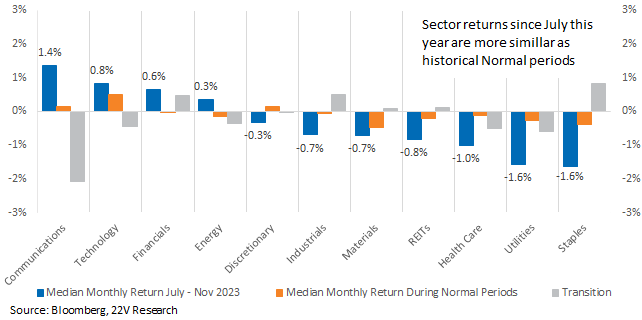
Sector returns during the current Normal regime are consistent with historical Normal periods, led by Early Cyclicals, including Communications and Technology. Defensives have underperformed, especially Utilities and Staples. With the Normal regime looking increasingly sticky, we expect Early Cyclicals will continue to lead internals at the expense of Defensives.
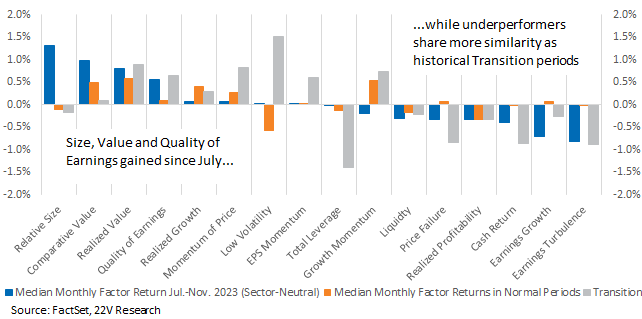
Factor returns have diverged some with Earnings Turbulence and Earnings Growth acting more like we would expect in a Transition period. Given how the rest of macro and market data is behaving, we expect to see a rebound in higher earnings risk and earnings growth names into year-end. In addition, small caps are likely to rebound, leading to some retraction from Relative Size, which has continued to perform unusually well for a Normal regime.
Macro Regime About as Normal as It Gets: Recent inflation readings are moving in the right direction (lower) and Fed policy, as per Powell earlier today “…is moving forward carefully as the risks of under and over tightening are becoming more balance.” The Fed allowing the for the easing of financial conditions was an important hurdle to clear. With that risk reduced (it won’t be eliminated until core inflation is clearly on a trend to ~2%), we can focus on the continued improvement in macro trends. Our Macro Regime Model has signaled reduced recession risk since July and the probability of moving into a Growth regime has moved higher over the past two months. What that means is 1) near-term recession risk is VERY low, and 2) investors should expect and position for persistently lower vol, and a rebound in low-recession laggards.
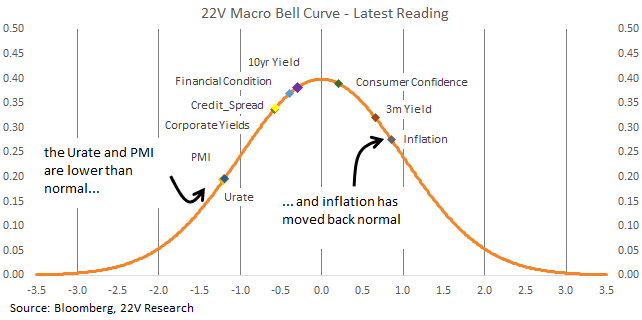
First, focusing on macro factors, most data is back within its typical range (distros back to ’83, the pre-’83 distributions are entirely different and have not been helpful this cycle, more HERE). Importantly, inflation has dropped back into the high end of its normal range, WITHOUT collapsing. A collapse in inflation would have increased recession risks. The all-clear is closer but there are a few outliers. Notably, the PMI reading is still low (most recent data was flat) as is the unemployment rate. Unemployment has increased, which moved the economy CLOSER to normal. If the Urate spikes, that would be a negative for the macro regime.
On to markets… internals improved in November, bringing the combined macro + market vector back to a very normal distribution. Financial conditions easing together with the equity market recovery of both large and small cap names confirm the reductions in vol and expansion of PEs over the past month.
Market volatility has been stable, especially in the late half of this year. VIX has moved to the lowest range of the year. Aggregate volatility is now lower than the average, suggesting some upside risk. That being noted, lower vol is a hallmark of moves AWAY from economic uncertainty.
Sector returns since July have been similar to historical Normal periods, with Early Cyclicals including Communications and Technology leading. Defensives, especially Utilities and Staples, have lagged. During Normal periods rotations are typically between types of Cyclicals (early vs deep vs rate sensitive) rather than between Cyclicals and Defensives.
Factor returns since July have been led by Relative Size, Value, and Quality, while Earnings Turbulence, Earnings Growth and Cash Return dropped. Factor returns, especially for the underperformers, are still more like Transition periods. As the market and macro trends are both suggesting a more Normal regime, we expect to see catchup by Turbulence, Growth, and Cash Return into and through year-end. Small cap names are likely to rebound (they are up huge today), leading to some retraction from Relative Size.