

SUMMARY
- China’s end-July Politburo meeting will be a key watchpoint for policy support in the second half, but it may underwhelm as a comprehensive stimulus package; we continue to expect targeted stimulus measures to be rolled out incrementally before and after the meeting.
- Coming measures will include an acceleration of already planned infrastructure investment in Q3, modest monetary easing, and local-level support to try to buoy property demand; Beijing’s aim is to secure the 5% GDP growth target for this year while staying disciplined in avoiding financial risks and pursuing key industrial/innovation initiatives.
- Q2 GDP and June activity data, to be released Sunday 10pm ET, will be a key watchpoint ahead of the Politburo meeting but there is a very high bar before Beijing’s reaches for the “bazooka” of broad and aggressive easing measures.
At the end of July, the Politburo (the 24-member senior body of the Communist Party) will hold its quarterly meeting on the economy, laying out policies for the second half. Given the lagging growth recovery and middling performance of Chinese assets in recent months, markets are understandably focused on the prospects for stimulus measures. In this note we update views on what – and what not – to expect from the Politburo meeting and from policies in Q3.
Upcoming Politburo meeting will set the tone but not the details
The specific date for the Politburo meeting has not yet been set. In recent years the meeting has concluded close to the end of the month and on a weekday. Based on that pattern, the most likely dates are 7/27 (Thursday), 7/28 (Friday) and 7/31 (Monday) but one should not be shocked if it comes earlier (in 2017 the meeting was held on Monday, 7/24).
The key output of the meeting is the statement released at its conclusion. That statement sets out the economic priorities for the second half, including not only macro policies but also industrial policy and broader development goals. It outlines support measures but does not go into details. In 2022, for example, it pledged to “make good use of new credit from policy banks and investment funds for infrastructure construction,” leaving it to the PBOC to announce specifics of policy tools to support local government investment projects.
Without getting bogged down in semantics, we would caution against expecting the Politburo meeting to produce a comprehensive “stimulus package”:
- “Stimulus” (boosting demand) is just one aspect of Beijing’s priorities. China’s leadership is also focused on boosting longer-term confidence in the economy, particularly among domestic private firms as well as (secondarily) the foreign business community. This week, for example, Premier Li Qiang met with executives at major e-commerce firms to offer a qualified show of support for the sector. And at the level of Xi Jinping, advancing industrial policy initiatives such as China’s clean tech dominance is the highest priority.
- “Package” implies a comprehensive and coordinated set of measures. More likely is a series of policies that come out from the State Council (cabinet) and individual agencies before and especially after the Politburo meeting. Indeed, our impression from recent political discourse is that Xi sees China’s current policy direction as correct but is allowing the economic team (headed by Premier Li) to undertake specific measures within their purview to boost growth and confidence. That adds to the likelihood that policies will come out incrementally and somewhat scattershot rather than a major “show of force” from the very top leadership.
Beijing aims to secure the growth target while maintaining discipline
What is Beijing’s current mindset? Since mid-June, senior officials have moved from a passive stance to active support mode. A June 16 State Council meeting pledged “more forceful” measures to support the economy (see our write up HERE), and some incremental measures have since come out, including a recent extension of financial regulatory policies to support property developers.
But “restraint” and “discipline” are still guiding Beijing’s reaction function. China’s leadership is focused on securing the 5% GDP growth target for the year in a way consistent with Xi Jinping’s directive of pursuing “high-quality” growth: guarding against financial risks (particularly local government debt) and pursuing new growth drivers (such as investment in clean tech supply chains) rather than old growth drivers (especially property investment).
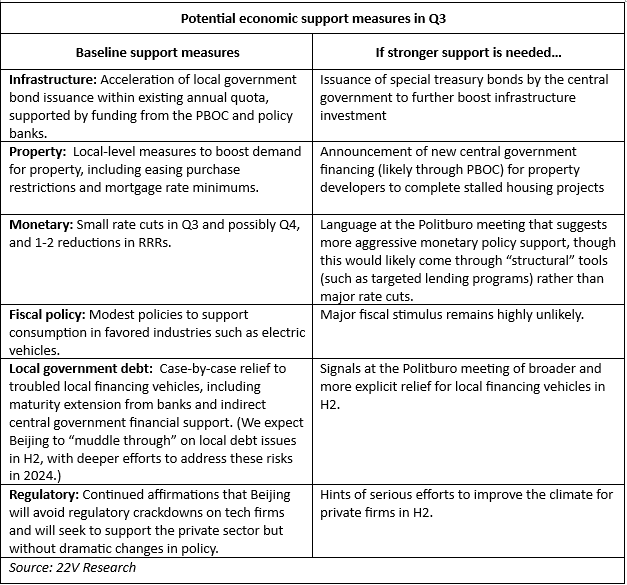
The table below summarizes our views on the baseline (minimum) stimulus policies to expect in Q3, as well as stronger measures that could also be part of Beijing’s toolkit, especially if forthcoming data imply that the 5% GDP growth target is in jeopardy.
Where do things stand as the Politburo meeting approaches? Incremental economic data for June show that demand remains weak but probably not so dire as to threaten the growth target:
- Trade data released on Thursday showed both export growth (-12.4% y/y) and import growth (-6.8% y/y) missing expectations and slowing sharply compared to y/y growth in May. Weak exports will continue to weigh on manufacturing activity and investment confidence. The slowdown in import growth reflects weak demand but is also due to falling global commodity prices; in volume terms, imports of key commodities were reasonably resilient. Commodity demand in China isn’t falling off a cliff, it just hasn’t matched the very bullish expectations from some investors earlier this year.
- June PMI data were weak but with less deterioration than in April/May. The official manufacturing PMI index stayed in contraction (49) but showed its first improvement in three months. Employment sub-indices in both manufacturing and services remain quite subdued, which is not helpful for the job and wage gains necessary to boost household income and consumption growth (see our discussion of the “missing middle” below).
- June credit growth surprised to the upside, particularly in terms of bank lending. However, this is likely more an indication of policy support, especially loans for infrastructure projects, than a sign of robust private demand.
- Low inflation is yet another sign of soft demand, though concerns of a major threat of deflation are overstated. Core CPI slowed from 0.6% y/y in May to 0.4% y/y in June, and PPI fell by -5.4% y/y (from -4.6% in May) heavily influenced by falling commodity prices. Consumer disinflation and industrial deflation provide PBOC with additional room to ease, but the central bank will be wary of major rate cuts that add to pressure on the currency and worsen margins for the banking sector.
- Property data continues to disappoint, with real estate data provider CRIC showing sales of the 100 largest developers down 28% y/y. Weakness in sales is weighing on land acquisition and in turn local government revenue from land sales, worsening local government debt woes and hampering infrastructure investment. Policymakers are intent to avoid reflating the property sector as a form of stimulus but will be eager to avoid a further deterioration in sentiment and activity; direct central government assistance for developers to complete stalled projects seemed unlikely a few months ago but is now at least plausible.
The critical watchpoint before the Politburo meeting is the release of Q2 GDP and June activity data, which will come out Monday morning (July 18) in Beijing (Sunday 10pm EST). There is not one single number to watch but certainly the Q2 GDP number will be important. The Bloomberg consensus forecasts for Q2 and for full year 2023 are 7.4% y/y and 5.5%, respectively; a bad miss in Q2 would suggest that the 5% annual target is not safe and could compel Beijing to reach deeper into the basket of support measures outlined in our table. However, we continue to see a very high bar before Beijing reaches for a “bazooka” in terms of broad and aggressive easing measures (such as big interest rate cuts, a major expansion of support for property developers, or expanding fiscal and infrastructure spending beyond the current envelope).
Implications for growth and markets
China’s growth this year has been driven by services (from post-Covid reopening) and infrastructure stimulus, with a large “missing middle” of household spending on goods (not just services) and private investment, especially in property. The result is a subdued and relatively narrow recovery, with fewer sectors benefiting than in an environment of broad-based demand.
If our expectations of coming stimulus measures are correct, the “missing middle” will be slow to fill in. While there are loud calls in domestic policy circles for Beijing to use fiscal policy to directly stimulate consumption, the leadership remains reluctant to embrace this tool. Infrastructure spending will be a key stimulus tool in H2 but isn’t particularly effective in boosting employment or private investment. Monetary policy is also operating under significant constraints. All of this suggests that the recovery will remain gradual, requiring a steady grind of employment growth and income gains in coming quarters for household consumption and private sector confidence to firm up.
A further note to put infrastructure stimulus in context: after a strong start to the year, in recent months growth in infrastructure spending has slowed. A key factor has been the slowdown in issuance of special bonds by local governments (see chart below), as Beijing has scrutinized their spending. In Q3, Beijing will direct local governments to accelerate their bond issuance and very likely provide additional support through the PBOC and policy banks as it did in H2 2022. The coming pick up in bond issuance in Q3 will (with some lag) offset the recent slowdown but is necessary just to avoid a “fiscal cliff” in infrastructure spending in H2. Moreover, continued weakness in land sales revenue will limit local government spending capacity. One should not expect a major boom in Chinese commodity demand, particularly with the property sector still in malaise.
When it comes to politics and geopolitics, there have been some positive signs but the structural issues hanging over investment and business confidence in China remain in place:
- The economic team is eager to reassure the private sector, seen in Premier Li’s recent meeting with e-commerce companies and the resolution of the fintech crackdown centered on Ant Financial. But private firms, especially the e-commerce companies, will continue to operate in a relatively tight regulatory and political “new normal.”
- In geopolitics, US Treasury Secretary Janet Yellen’s recent visit was positive but aimed at restarting dialogue rather than producing concrete outcomes (see our preview note HERE). The “thaw” underway between the two sides is quite fragile and narrow in scope. It will do little to alleviate tech-related tensions, including a forthcoming executive order from the Biden administration to limit/scrutinize US corporate and private equity/VC investment in certain strategic sectors in China.
Still, one needs to put the headwinds for China’s outlook in perspective. A gradual and relatively subdued recovery was, in our view, always in the cards for this year. We don’t see any near-term catalysts that are likely to shift that view, so those picking up exposure should just be prepared to stay patient.


