

My 2-Stage Disinflation (hypo) thesis is both tentative and kludgy. The kludge is that it arbitrarily distinguishes between the main driver of disinflation to date and what is required to achieve tolerably low inflation going forward. The disinflation to date has been driven by getting nominal demand growth back in line and has not been well described by the conventional macro model which assigns a large role to labor market conditions. However, to get inflation back to a tolerably low pace, the employment overshoot will have to be reversed, in line with what the conventional model, which emphasizes levels, shows. I concede it would be better if I could remove this inconsistency, but we are dealing with macro here, so let’s not let perfection or even good be the enemy of less bad. Somewhat related, I don’t actually know that my template is valid. It just seems plausible — and worth pressing when the consensus is too confident in its competing view.
The consensus seems to believe that the recent disinflation, particularly in wages, reflects “easing” labor market conditions, even though the unemployment rate is stuck at a half century low. The reason they advance is that reported job vacancies have fallen, which has allowed the ratio of vacancies to unemployment, v/u, – or even more dubiously the “jobs-workers gap”[1] to come off its highs. On this view, and I am being polemical to make a point, the decline of the v/u ratio depicted in the right panel of the chart above has allowed the 3-month rate of nominal wage growth to slow 400 basis points. That is possible, but surely not the only possible interpretation.

Source: Bloomberg, Federal Reserve Bank of St. Louis (FRED), FH calculations and estimates.
JOLTS data are actual to May. However, I estimate the value for June (extrapolating the 12-month change) to allow for an estimate of v/u in June, as in the right panel.
I do not take the vacancies data seriously, for reasons I have been over, and I am open minded about the possibility that the direction of causation during the recent inflation surge and reversal ran from inflation to wages, and not mostly vice versa. I sound a bit like the Fed leadership in this regard, if you will forgive the appeal to authority.[2] Closely related, I am very skeptical of the “finding” in that recent Bernanke-Blanchard paper that there is little evidence of a catch-up effect in nominal wage growth.[3] I think a more likely outcome is that the recent wage surge and moderation was mostly about inflation pressures originally largely -but not entirely – outside the labor market.
If this is the right template, then it does not mean that the recent decline of goods and services prices should be dismissed. It has been quite an achievement and has been duly celebrated in the equity market, to the extent it has allowed the inflation situation to evolve from crisis to mere problem. Rather, it is simply important not to double count the goodness.
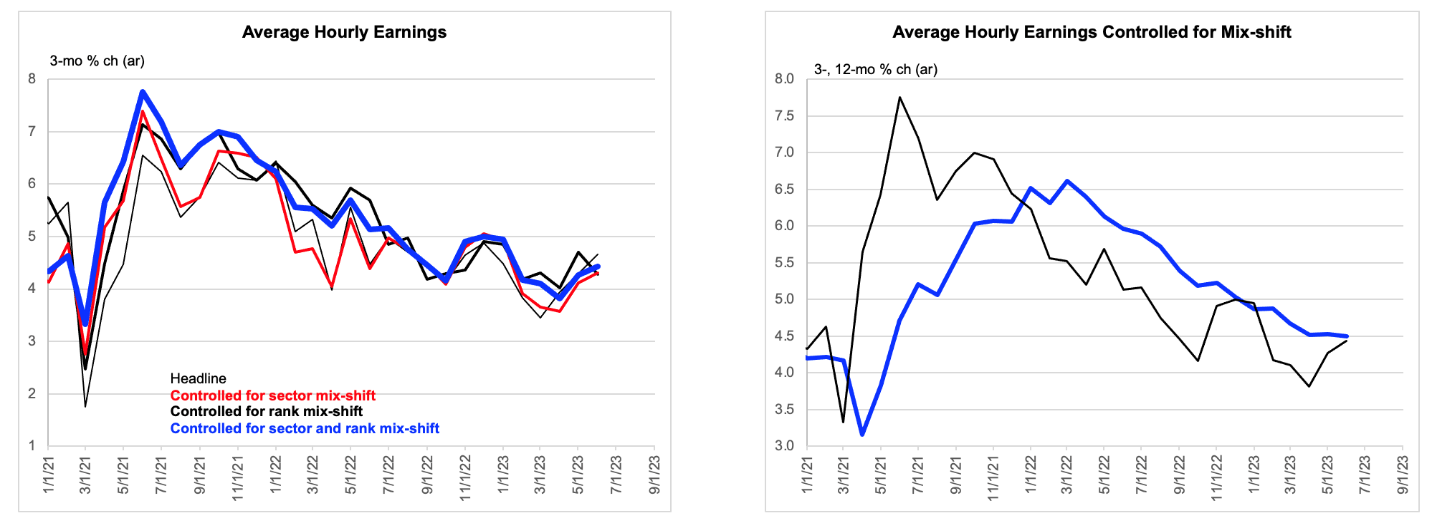
Despite what I would characterize as the catch-up effect from earlier rapid salient inflation moderating, along with the salient inflation itself, nominal wage growth has recently shown signs of stabilizing. I have noticed some claiming that wage growth among production and non-supervisory (PNS) workers has recently been lower than headline, and I think that is a relevant point to make, given that the broader wage measures were flattered by “rank” mix-shift this past month. But rather than cherry picking PNS workers this month, why not look at measures that control for sector and rank mix shift? (Honest answer: they are a bloody horror to calculate!) Whether you use headline whichever controls you like, the AHE data look to be stabilizing at too strong a growth rate. And alternative measures are higher still, which is partly why Goldman’s Wage Tracker, expressed at a quarterly frequency, is now up two quarters in a row. Celebrating ongoing wage disinflation might be missing the plot here.
So, does this mean you should put on duration shorts this week? Maybe not, as there has been quite a repricing that would seem to have more to do with Fed rhetoric (which is exaggerated) and evidence of growth resilience. Of course, the pricing can change. It always does. For now, my point would – as often – be more limited. We are a long way from the Fed declaring victory and suggesting that victory is theirs and that they can stop taking the medium-term recession risk by targeting below trend growth. They will continue to target below trend growth and not reverse course on the first sign of weakness (including if my note yesterday made a relevant point.)
Source: BEA, FH calculations
Data are actual to June. The black line in the right panel replicates the blue line in the left panel, but the right panel shows also the 12-month change.
[1] Even if we were to accept that the relationship between vacancy and unemployment is the main driver here, the “jobs-employment gap” would seem to make little sense as an expression of that idea. For example, if unemployment and vacancies were both to fall by 2.5 mm, taking vacancies back to their immediate pre-Covid level, then the “jobs-employment” gap would be unchanged by definition. But the v/u ratio would go to a fresh record high as the unemployment rate went to 2.1%. Reductio ad absurdum is hard on that metric, then.
[2] When it suits, I have no trouble claiming the Fed are wrong or even fibbing.
[3] See their discussion on page 17 here. Goods and services inflation is meant to affect wage growth, but only via inflation expectations. There is no tendency for the real wage to revert towards what they call its aspirational value, from which they conclude that there is no wage catch up effect. I suspect that this has to do with the fact that the model is estimated during the price stability period through 2019, during which inflation never rose high enough to become salient, as Fed staffer Jeremy Rudd, see for example here, might argue.

