SUMMARY: Housing data was a significant drag on the economy last year and the stabilization and slight improvement in housing data suggests most of the impact from Fed rate hikes (which impacts the economy through financial conditions) are already in the economy. That means the lagged impacts of monetary policy are much less likely to drive the economy into recession in the near term. Unless Financial conditions tighten more, expect housing data to remain fine. The above helps explain the significant outperformance (97th%tile) of Cyclicals over Defensives yesterday (housing data was firm). We expect the average stock, destocking losers, deep cyclicals, and small caps to continue to do well over the coming weeks as hard landing risk is reduced.

The main recession risk remains the Fed and the potential need to keep rates higher for a VERY long time, or tighten financial conditions further. To tighten financial conditions more, the Fed would need to signal that they are going to raise rates further than what is currently priced (5.25%-5.5% peak rate).
As Gerard has pointed out (HERE), the easy part of disinflation (rents and goods prices normalizing) is behind us. The harder part (getting core PCE below 3%) is ahead. Wages are still too high even though demand growth has normalized at a slightly below trend pace (trend is estimated to be 1.8%, the WEI is at 1%). That suggests unemployment needs to move higher for core PCE to move below 3%. This doesn’t have to be the case. Wages could come down without much disruption in the labor market. We had a similar urate in 2019 with much lower wages. So, the outlook is still uncertain, and we shouldn’t assume the Fed will need to tighten further. Macro uncertainty is VERY high, so conviction on macro outcomes needs to remain low.
FYI: The PE spread between Nasdaq and Russell is extreme and the NDX PE, currently at 25.9 (88th%tile historically) is driving that spread. If the Fed needs to tighten financial conditions more (stocks are part of financial conditions), higher PE stocks are likely to suffer the most. Something to keep in mind longer term.
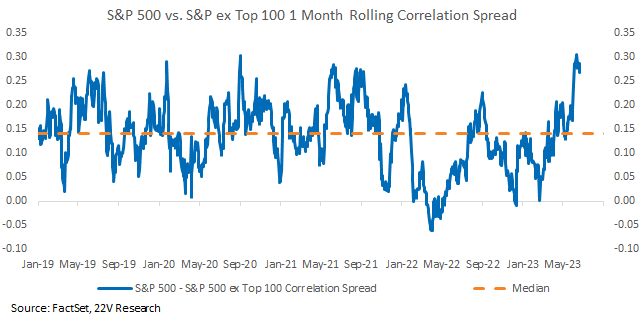
Generating alpha in mega caps is really hard now. Correlations are too high. Correlations for the rest of the S&P, ex-mega caps, are much lower. Plenty of stock picking alpha opportunities exist in the rest of the index and lower correlations favor micro themes. Our favorite micro theme currently is a rebound in destocking losers (retail/transports).
Full note below…
MARKET VIEWS: Economic data was firmer across the board yesterday and Cyclicals had significant (97th%tile) d/d outperformance relative to Defensive. Housing data was the most impactful as housing is the most interest rate sensitive sector. Housing data was a significant drag on the economy last year and the stabilization and slight improvement recently suggests most of the impact from Fed rate hikes, which impact the economy through the financial conditions, are already in the economy. That means the lagged impacts of monetary policy are much less likely to drive the economy into recession in the near term. Near term recession risk is lower as a result. Unless Financial conditions tighten more, expect housing data to remain fine.
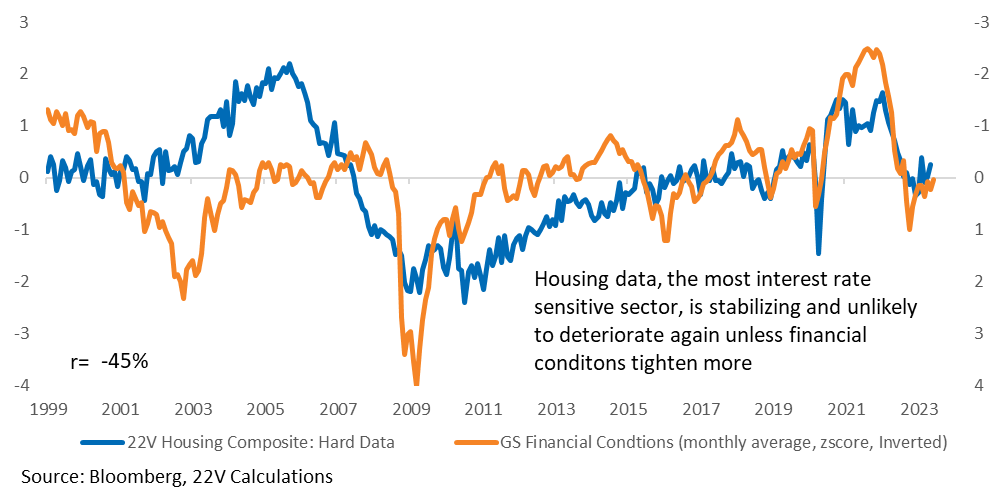
There is a risk that financial conditions need to tighten more, which is something Gerard has highlighted (HERE). The easy part of disinflation (rents and goods prices normalizing) is past. The harder part of getting core PCE below 3% is ahead of us. Wages are still too high even as demand growth has normalized to a slightly below trend pace. That suggests the unemployment rate needs to move higher to get core PCE below 3%. This doesn’t have to be the case. Wages could come down without much labor market disruption. There was a similar urate in 2019 with much lower wages. Macro uncertainty is VERY high, so conviction on macro outcomes needs to remain low.
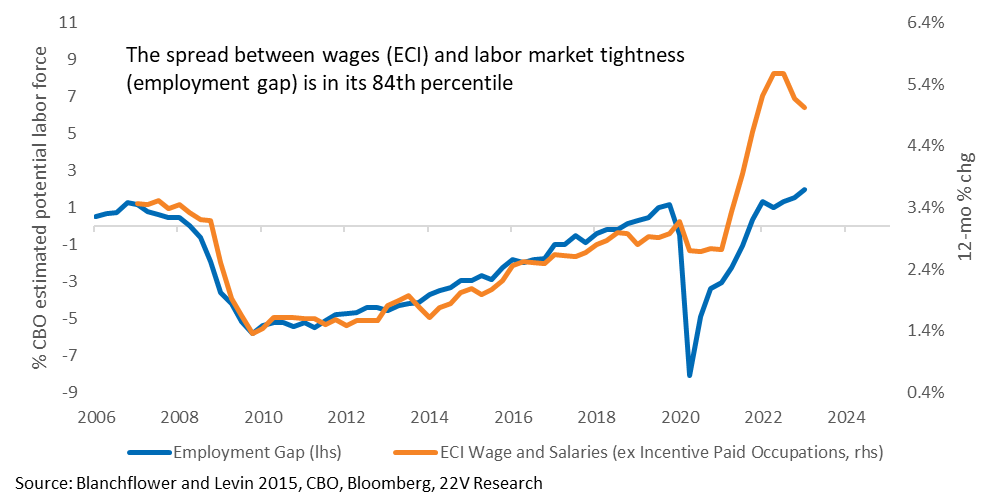
Longer term, recession risk remains elevated (50/50 call in our view) while wages remain strong. Strong wages mean the Fed needs to keep demand growth below trend for longer. Near term though, housing data is better, wages are elevated, and rates are likely to stay higher for longer. That should favor small caps relative to large caps all things equal. The PE spread between Nasdaq and Russell is extreme and the NDX PE, currently at 25.9 (88th%tile historically) is the main driver of that spread. If the Fed needs to tighten financial conditions more (stocks are part of financial conditions), higher PE stocks are likely to suffer the most.

Correlations – Mega Caps vs The Rest: Correlations of the S&P ex Megas are MUCH lower than for the overall index.
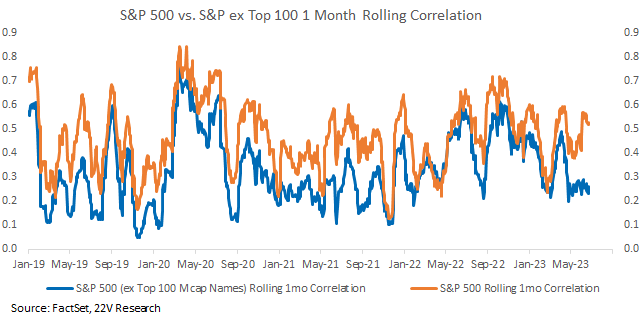
The correlation spread between the groups is one of the highest on record. That means there is much more dispersion in the non-mega large cap space. The implications being, 1) differentiating between the mega caps is hard, so it is better to own/not own the whole group, and 2) the low correlations ex mega caps indicate stock picking is attractive.