SUMMARY: Multiple ECB officials, including Lagarde, are delivering a hawkish message. The ECB is concerned about wage inflation now, similar to the two-stage disinflation Gerard has discussed in the US (HERE). Of note, rates in the EU are little changed this morning, giving us more conviction that the hawkish messaging is priced in. Data will have a larger impact on rates and currencies going forward.
The Dallas Fed Banking Conditions Survey (released yesterday, HERE) painted a dour picture of loan growth. The Dallas Fed Banking Conditions Survey is a diffusion index (net improving – deteriorating, relative to the prior reference period) like most other widely followed surveys (PMIs, Senior Loan Officer Opinion Survey). They are all susceptible to problems with different base effects.
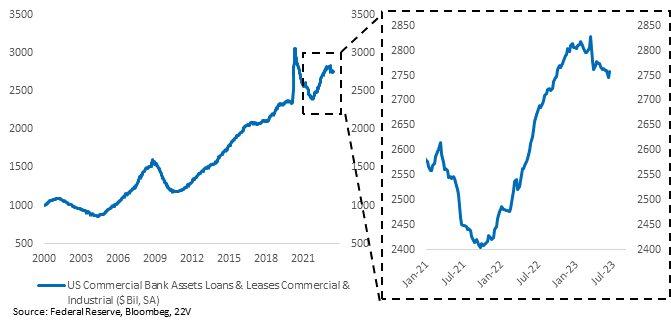
Hard data on actual lending levels matter more right now. Those data show that 1) credit conditions are marginally tighter, which is consistent with the below-trend growth rate and the Fed’s goals. 2) that the most economically sensitive lending – broad loans to small and medium-sized businesses – remain strong. In previous recessions, C&I loans have dipped more than -20%. Loans are currently down -2.5%. Firm loan growth means inflation is likely to remain sticky high, supporting our call that the Fed will keep rates higher for longer.
How much tighter lending is impacting demand is difficult to measure in real-time. What we know is that Liquidity sentiment, measured using the Amenity natural language processing tool, of S&P ex-Banks remains around its median level. Liquidity sentiment measures what management is saying (positive or negative) about the availability of cash/credit. Like C&I loans, liquidity ex-financials is weaker, but there is no sign of collapse.
KRE HEADWINDS: The modest decline in C&I loans and liquidity ex-Banks is not a macro concern, but it may l be a headwind to Bank equities. We track the banks with the worst p/b ratios, eps growth estimates, liquidity sentiment, and equity returns since 3/3. More Banks are red on our screen than at the beginning of June. All in, 25% of the KRE (by weight) flashes red on our monitors. In early June, it was 13% (HERE). Loan growth is not an economic problem, but Bank profitability and returns will remain under pressure.
SHORT UK: Last week the BOE surprised by raising rates +50bps (40% odds pre-decision). In our weekly update (replay HERE), Jacob Kirkegaard- 22V’s Europe Analyst, highlighted raising rates without an articulated strategy was an error and potentially weakens the BOE’s credibility. This breakdown in communication by the BOE has left Jacob bearish on the UK. Coincidentally, 22V’s head of Technical analysis, John Roque, thinks UK equities are in a weak position. Details in the full report below…
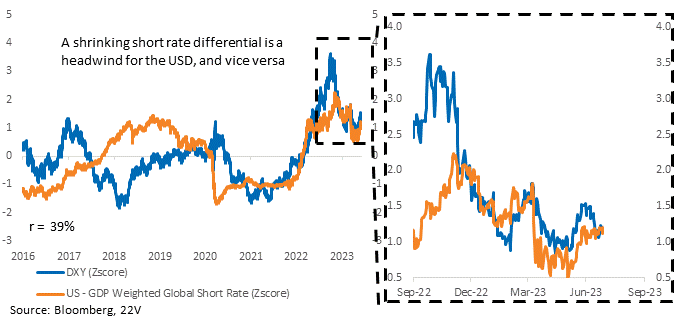
MARKET VIEWS: ECB officials are out in droves delivering a hawkish message. Lagarde, Wunsch, Simkus, and Kazaks all discussed higher inflation and more rate hikes. The ECB is concerned about wage inflation now, similar to the two-stage disinflation Gerard has discussed in the US (HERE). Of note, rates in the EU are little changed this morning, giving us more conviction that the hawkish messaging is priced in. Data will have a larger impact. That also means the changes in global rate differentials are having a marginal impact on the USD, and are unlikely to drive the currency to breaking out here.
UGLY, FLAWED SURVEY DATA: The Dallas Fed Banking Conditions Survey (released yesterday, HERE) paints a dour picture of loan growth and the outlook of loan growth. Loan volume and loan demand deteriorated, credit standards tightened, and the 6-month outlook got worse.
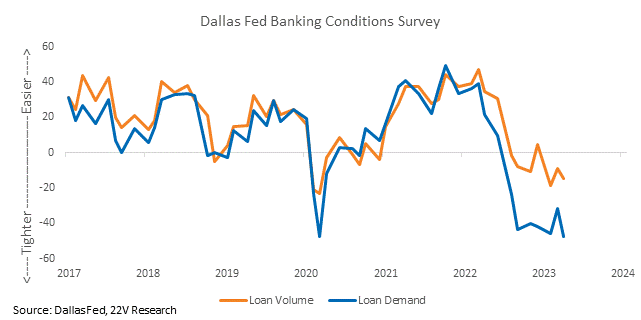
It is important to keep in mind how that survey is constructed and what it is trying to measure. The Dallas Fed Banking Conditions Survey is a diffusion index (net improving – deteriorating, relative to the prior reference period) like most other widely followed surveys (PMIs, Senior Loan Officer Opinion Survey). They are all susceptible to problems with different base effects (details below). Hard data, which are actual levels, matter more right now. C&I loans, which dipped over 20% in the prior three recessions, are currently down -2.5%. Broad loan activity remaining firm means the SMB crunch that could have caused a rapid decline in growth is not playing out.

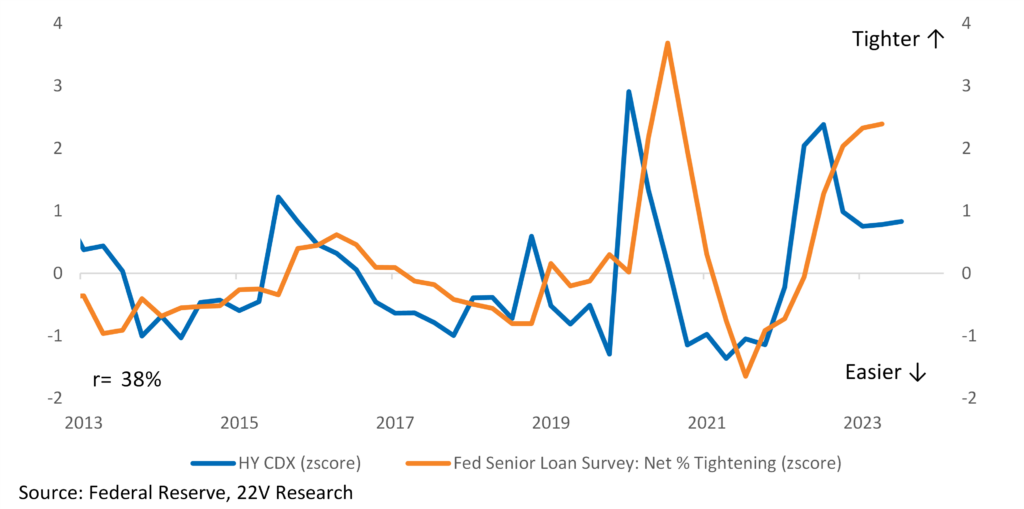
The Dallas Fed Banking Conditions Survey and Senior Loan Officer Opinion Survey are both at scary levels. However, the Covid shock and recovery led to ultra-easy credit conditions, so the “level” from which tightening of credit conditions began was very easy. We can’t be sure about the level to which banks have tightened their lending standards, only that those standards are tighter than the extremely easy level following an unprecedented shock. HY CDX tend to track the survey, but they have diverged recently. The credit market isn’t pricing the same recession risk that would be implied by survey data. The result of the above is that growth is slowing, not collapsing, and that means the Fed is likely to keep rates higher for longer.
Another metric we use to track changes in credit is Liquidity sentiment of the S&P ex-Banks, measured using the Amenity natural language processing tool. Liquidity sentiment measures what managers are saying (positive or negative) about the availability of cash/credit. Like C&I loans, liquidity ex-financials have deteriorated, but not to a concerning level. Some pullback is desirable given the need for below trend growth to slow inflation. What company management is NOT signaling is a large decline in the availability of cash/credit.
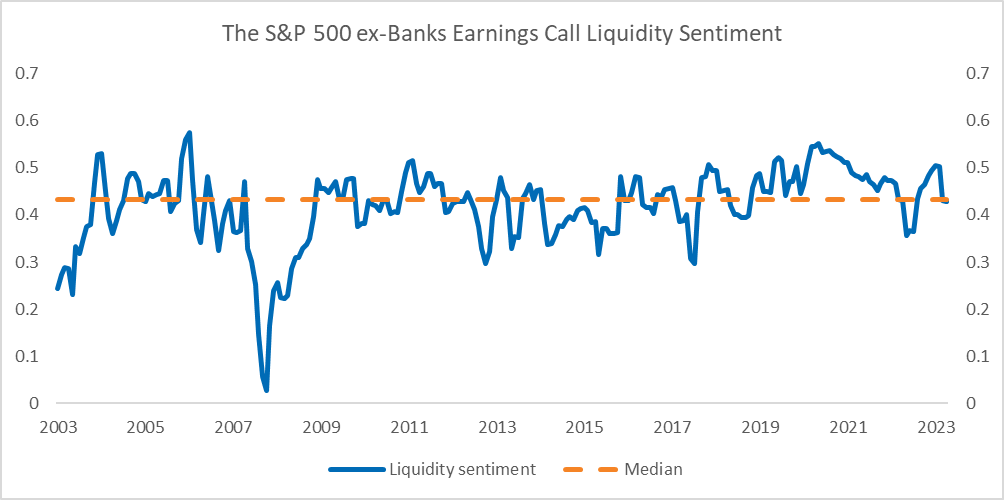
Source: Amenity Analytics, 22V Research
KRE HEADWINDS: The modest decline in C&I loans and liquidity ex-Banks is not a macro concern, but it may still be a headwind to Bank equities. KRE fell almost -10% last week, so we are refreshing our KRE monitor. We track the banks with the worst p/b ratios, eps growth estimates, liquidity sentiment, and equity returns since 3/3. More Banks are red on our screen than at the beginning of June. All in, 25% of the KRE (by weight) flashes on our monitors. In early June, it was 13% (HERE).
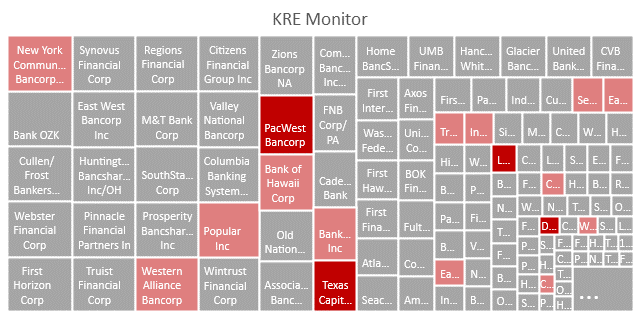
Source: Bloomberg, 22V Research
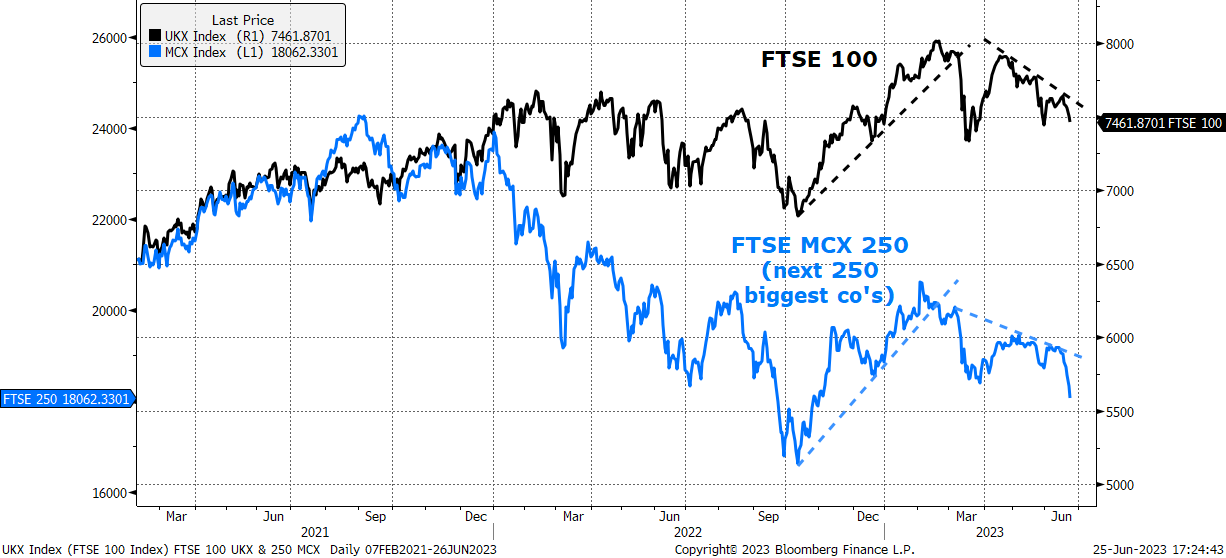
SHORT UK: Last week the BOE surprised by raising rates +50bps (40% odds pre-decision). In our weekly update (replay HERE), Jacob Kirkegaard- 22V’s Europe Analyst, highlighted raising rates without an articulated strategy was an error and potentially weakens the BOE’s credibility. This breakdown in communication by the BOE has left Jacob bearish on the UK. Coincidentally, 22V’s John Roque, head technician, highlighted that the FTSE 250 (the next 250 largest companies in the UK) price action is deteriorating quickly, and he would be surprised if the FTSE 100 remained immune from what’s ailing the FTSE 250.
FTSE 250 – Weekly w/ 40-Week MA, MACD, and Rel. to FTSE 100
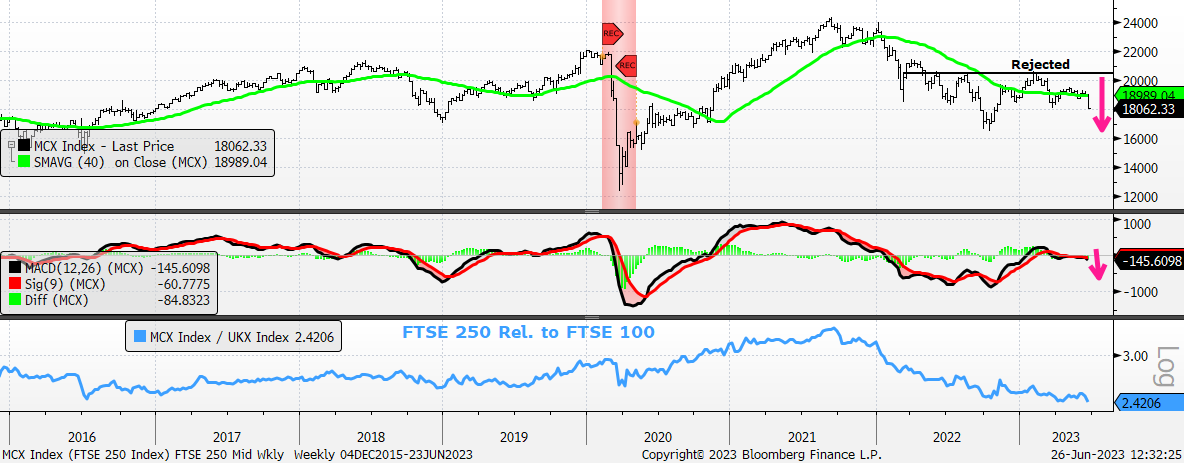
Perhaps more importantly, however, is that there is weakness developing for the FTSE 100, too, which, to be sure, is a natural. You can see in the next chart that the FTSE 250 has weakened ahead of the FTSE 100 but there’s almost no way the FTSE 100 is going to be or remain immune from what’s ailing the FTSE 250 (“price turns and then a narrative follows”).