Back Portfolio Strategy

Less Patient Central Banks and Recession Risk Complicating the Risk-On Trade + Longer Term Defensive Headwinds

Published on June 23, 2023

∙ Download the PDF Report

By

Dennis DeBusschere

Brian Herlihy

Kevin Brocks

Sophia Wang

SUMMARY: Low Volatility names have outperformed Earnings Turbulence names by 2.1% WoW. Our risk-on factor call for the month of June is based on lower near-term recession odds and more patient central banks. Central banks appear less patient now (this could change quickly as data changes), working against the risk-on factor call for now. The odds of a recession happening in the next 3-4 months have declined significantly. That helps Cyclical and risk-on factors. At the same time, the Fed IS probing for a soft landing, and the valuation spread between Cyclicals and Defensives remains unusually wide historically. So, we are not abandoning the trade and think it will still work into July.

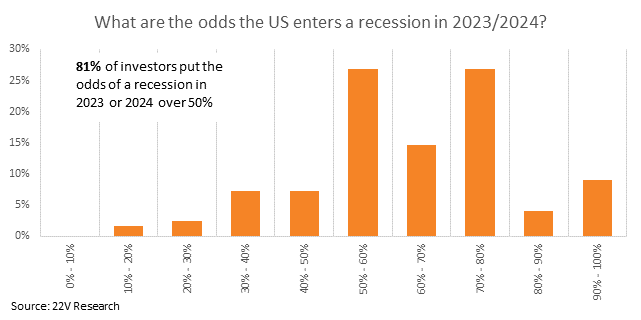
The above being noted, the Fed needs to keep economic growth at a below-trend pace for a long time to get core PCE inflation back toward 2%. That makes playing for an enduring (12 mo+) move higher in risk-on factors tough. Especially when most investors still think a recession is highly likely. 81% of the investors we polled (HERE) put the odds of a recession in 2023 or 2024 above 50%. That’s roughly consistent with the percent that expected a 2023 recession when we asked in January (81%), during our post-SVB survey (83%), and in our May survey (72%). The main source of recession risk is the Fed. For the 81% recession odds to come down and for an enduring move higher in risk-on factors to emerge, central banks need to become less hawkish and labor markets need to ease gradually.

We recommend selling calls on the S&P now (HERE).

Longer Term Thought: A higher estimate of r*, meaning a 4-5% fed funds rate drives core PCE below 3% without crushing for economic growth, is how higher for longer doesn’t lead to a risk-off reversal. Defensive headwinds increase in a higher r* backdrop because 1) earnings growth will be strong if the economy can tolerate higher interest rates. 2) Defensives have poor earnings growth expectations. 3) Higher interest rates make Defensive yields relatively less attractive. Currently, dividend yields for Utilities, Staples, Health Care, and REITs are all below the 2yr and near their lowest relative levels. Given our forecast for higher, but not too high, inflation and higher r* over the next Cycle, Defensives are particularly unattractive longer term. Short term they need much weaker economic growth to work.

Full report below…

MARKET VIEWS: Over the past few days several central banks have either resumed/stepped up the pace of tightening, or warned that more rate hikes may be needed due to stickier inflation. Combined with disappointing flash PMIs overnight and China’s lack of follow through on stimulus, the outlook for risk-on factors ha deteriorated short term. Low Volatility names outperformed high Earnings Turbulence stocks by 2.1% WoW. Our risk-on factor call for the month of June is based on lower near-term recession odds and more patient central banks. Central banks appear less patient now (this could change quickly as the data changes), which has worked against the risk-on factor call for now.
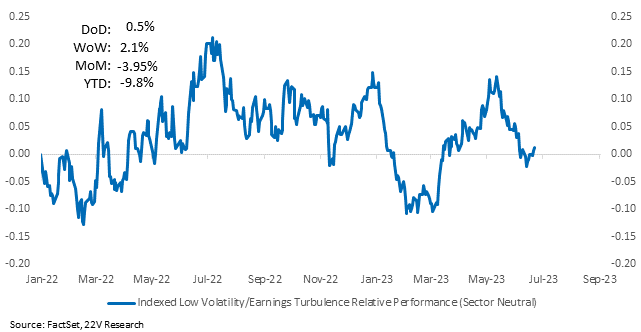
Image preview

It is understandable why investors are quick to fade risk-on factors or Cyclical sectors. 81% of the investors we polled (HERE) put the odds of a recession in 2023 or 2024 above 50%. That’s roughly consistent with the percent that expected a recession this year in January (81%), in our post-SVB survey (83%), and in our May survey (72%). The main source of recession risk is the Fed. For the 81% recession odds to come down, central banks need to become less hawkish.
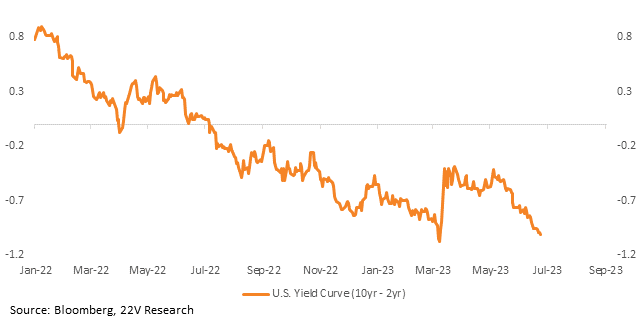
The main source of recession and market risk is tighter financial conditions, which helps explain why 10yr yields have been volatile, but in a tight range for the last few weeks. The curve has inverted more, reflecting increased risk of slower economic growth, as short rates have moved higher. The 10s-2s Yield curve has moved back to its March pre-SVB lows.
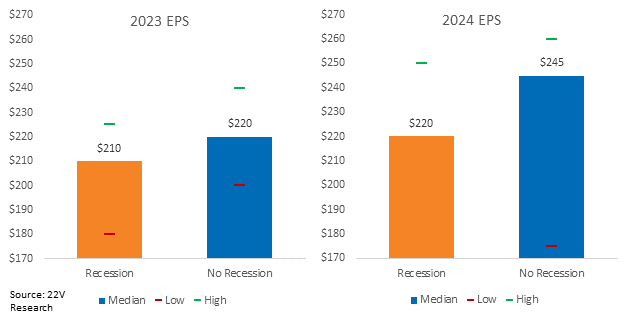
Also in our Investor survey, investors who do not expect a recession have eps estimates of $220 and $245 for 2023 and 2024, respectively. With a recession, the estimates drop to $210 and $220. That is a very wide EPS spread. Since we don’t have clarity on a soft landing, $245 is still uncertain for 2024 and why the market has little upside (we recommend selling calls on the S&P, more HERE). Since 81% of investors think a recession will happen, the base case for earnings appears to be $210 and $220. That implies downside risk for the market, but not a sharp selloff.
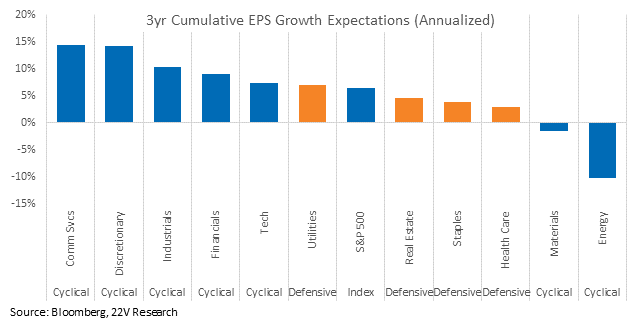
R* and Defensives – A Longer Term Thought: We’ve been talking about higher estimates of the neutral rate (r*) as the market prices in higher rates for longer. A higher estimate of r* (so a 4-5% fed funds rate is not crushing for economic growth but is required just to keep core PCE below 3%) is how higher for longer doesn’t lead to a risk-off reversal. A couple of reasons it’s a headwind to Defensives… earnings growth will still be solid if the economy can tolerate higher interest rates. Defensives have poor earnings growth expectations.
A picture containing text, screenshot, font, number
Description automatically generated

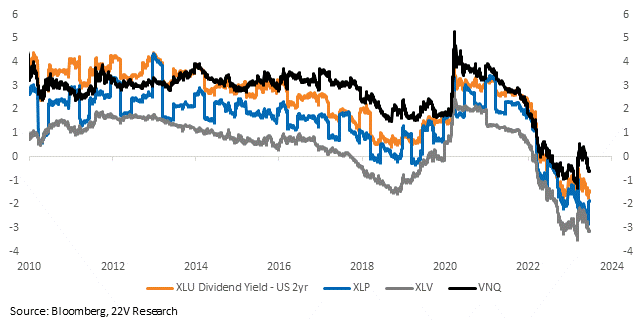
Higher interest rates make Defensive yields relatively less attractive. Dividend yields for Utilities, Staples, Health Care, and REITs are all below the 2yr and near their lowest relative levels. Defensives work when a higher 2yr yield implies a more aggressive Fed and higher recession risk. That does not appear to be the case right now. Given our forecast for higher, but not to high, inflation and higher R* over the next Cycle, Defensives are particularly unattractive longer term. Short term they need much weaker economic growth to work.
A picture containing screenshot, text, plot, line

Description automatically generated

DISCLOSURES AND DISCLAIMERS

Analyst Certification

The analyst, 22V Research Group, primarily responsible for the preparation of this research report attests to the following: (1) that the views and opinions rendered in this research report reflect his or her personal views about the subject companies or issuers; and (2) that no part of the research analyst’s compensation was, is, or will be directly related to the specific recommendations or views in this research report.

Analyst Certifications and Independence of Research.

Each of the 22V Research analysts whose names appear on the front page of this report hereby certify that all the views expressed in this Report accurately reflect our personal views about any and all of the subject securities or issuers and that no part of our compensation was, is, or will be, directly or indirectly, related to the specific recommendations or views of in this Report.

22V Research (the “Company”) is an independent research provider. The Company is not a member of the FINRA or the SIPC and is not a registered broker dealer or investment adviser. 22V Research has no other regulated or unregulated business activities which conflict with its provision of independent research.

22V Research, LLC is a professional services and independent publication organization. 22V Research, LLC is not a securities broker-dealer, not a member of the Financial Industry Regulatory Authority (FINRA), not a registered investment advisor (RIA) and not a member of SIPC.

Securities transactions, when offered, are offered by 22V Securities, LLC through LPS Capital, LLC. Certain employees of 22V Securities, LLC are dually registered as securities representatives of LPS Capital, LLC or Analyst Hub Securities, LLC. 22V Securities, LPS Capital and Analyst Hub Securities are members FINRA, SIPC.

https://brokercheck.finra.org/

Current Ratings Definition.

SECTOR OUTPERFORM: An “outperform” rating anticipates the company will outperform the S&P Regional Banking Index (peer group).

SECTOR PERFORM: A “market perform” rating anticipates the company will perform in line with the S&P Regional Banking Index (peer group).

SECTOR UNDERPERFORM: An “underperform” rating anticipates the company will underperform the S&P Regional Banking Index (peer group).

Limitation Of Research And Information.

This Report has been prepared for distribution to only qualified institutional or professional clients of 22V Research Group. The contents of this Report represent the views, opinions, and analyses of its authors. The information contained herein does not constitute financial, legal, tax or any other advice. All third-party data presented herein were obtained from publicly available sources which are believed to be reliable; however, the Company makes no warranty, express or implied, concerning the accuracy or completeness of such information. In no event shall the Company be responsible or liable for the correctness of, or update to, any such material or for any damage or lost opportunities resulting from use of this data. Nothing contained in this Report or any distribution by the Company should be construed as any offer to sell, or any solicitation of an offer to buy, any security or investment. Any research or other material received should not be construed as individualized investment advice. Investment decisions should be made as part of an overall portfolio strategy and you should consult with a professional financial advisor, legal and tax advisor prior to making any investment decision. 22V Research Group shall not be liable for any direct or indirect, incidental or consequential loss or damage (including loss of profits, revenue or goodwill) arising from any investment decisions based on information or research obtained from 22V Research Group.

Reproduction And Distribution Strictly Prohibited.

No user of this Report may reproduce, modify, copy, distribute, sell, resell, transmit, transfer, license, assign or publish the Report itself or any information contained therein. Notwithstanding the foregoing, clients with access to working models are permitted to alter or modify the information contained therein, provided that it is solely for such client’s own use. This Report is not intended to be available or distributed for any purpose that would be deemed unlawful or otherwise prohibited by any local, state, national or international laws or regulations or would otherwise subject the Company to registration or regulation of any kind within such jurisdiction.

Copyrights, Trademarks, Intellectual Property.

22V Research Group, and any logos or marks included in this Report are proprietary materials. The use of such terms and logos and marks without the express written consent of 22V Research Group is strictly prohibited. The copyright in the pages or in the screens of the Report, and in the information and material therein, is proprietary material owned by 22V Research Group unless otherwise indicated. The unauthorized use of any material on this Report may violate numerous statutes, regulations and laws, including, but not limited to, copyright, trademark, trade secret or patent laws.
