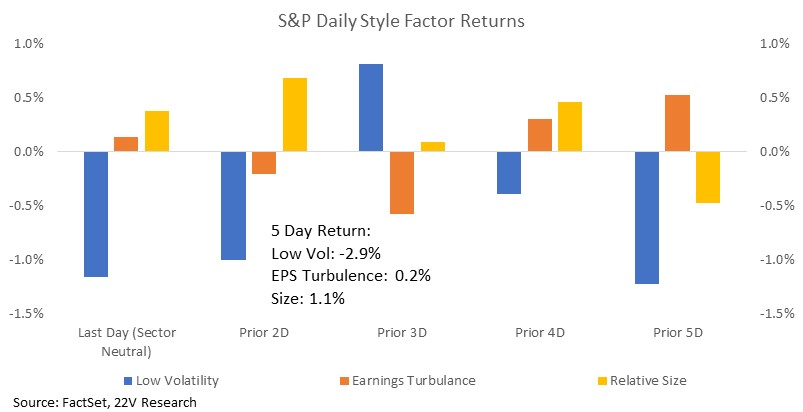
SUMMARY: As we look toward the end of the quarter and ahead to 3Q, we don’t see any reason for the risk-on factor and Cyclical sector rally to change. Credit crunch risk has faded, 1Q earnings season results were strong, and positive commentary by management indicates lower recession risk. U.S. default risk also looks to have been resolved. At the margin, the skew for risk-on factors is better. FYI, the driving force of the risk rally so far has been a collapse in risk-off (Low Vol). The two best factors are Liquidity (measures trading spreads and volume), and Size, which tend to have little correlation. That suggests investors are selling smaller Low Vol names, but they are not heavily buying risk-on. Early Cyclicals (Tech, Communications, discretionary) continue to trounce Deep Cyclicasl (Energy, Industrials, Materials).
The all-clear remains elusive and we caution against extrapolating a stronger economy and LONGER-TERM outperformance of lower Quality Cyclicals. Inflation is still too high, necessitating persistently restrictive central bank policy and elevated recession risk (6 months out). That is why the yield curve remains inverted and we shouldn’t expect Cyclical PEs to expand relative to Defensive while that is true. If a soft landing achieved through a modest easing of labor markets can be achieved, Deep Cyclicals will become more attractive. Until then, macro uncertainty will remain high, mean reversion will be a dominant theme, and equities will remain range bound.

There will be a period of labor market pain, and subsequent higher near-term recession risk, before a soft landing (if one happens) is clear. Labor market loosening seems like a given as wages are still WELL ABOVE underlying demand trends (see the NY Fed’s Weekly Economic index vs wages I the full report). Expect recession risk to increase, limiting gains in lower quality names, as wage growth slows. We think the labor market loosening will become more obvious in 3Q or 4Q and as that happens, another round of internal mean reversion (yields lower, Cyclicals give back some gains, etc.,) should be expected.
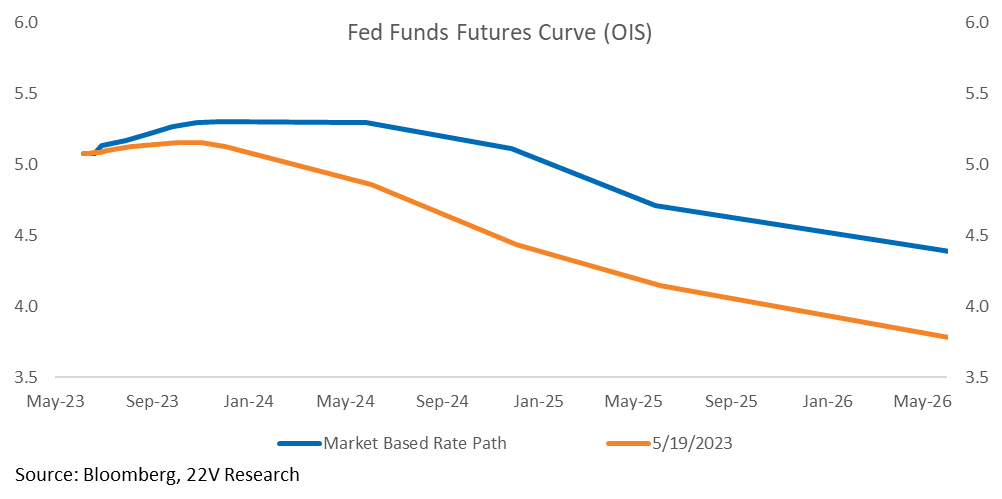
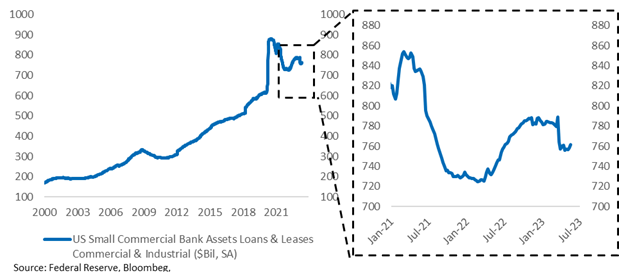
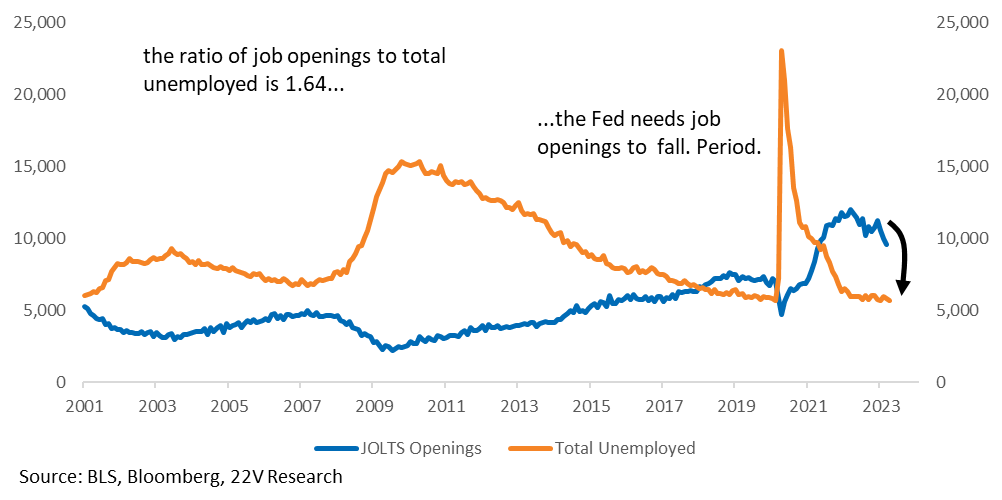
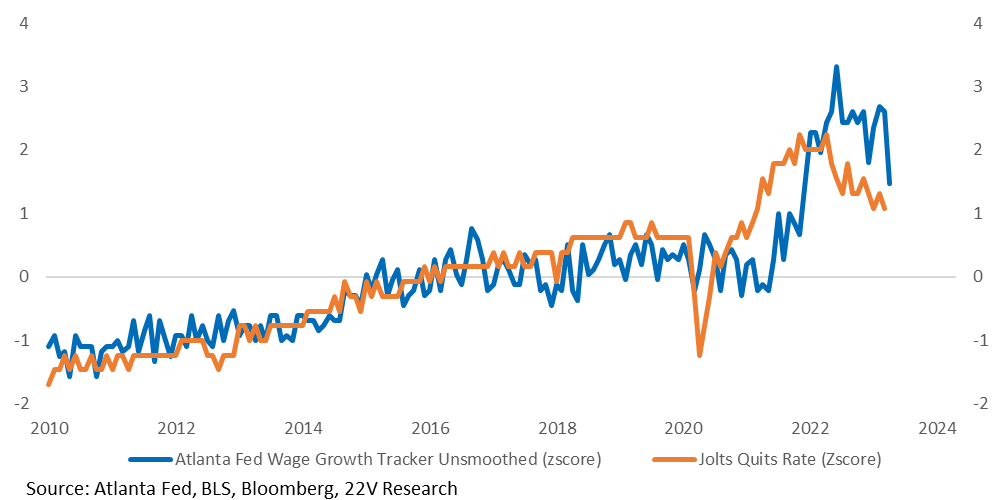
For the Week: Fed futures are pricing in much higher rate hike odds (57%) than Powell signaled at the last FOMC MEETING. C&I loans to small and medium businesses increased, so the lack of credit tightening impact on the economy only encourages more hikes. Labor market data remains the most important indicator though. JOLTS tomorrow and Payrolls on Friday will be the major swing factors on rate hike odds. The JOLTS “quits” rate and Job Openings (mentioned by Powell and Bernanke a few times in the past two weeks) need to decline for hike odds to be reduced.
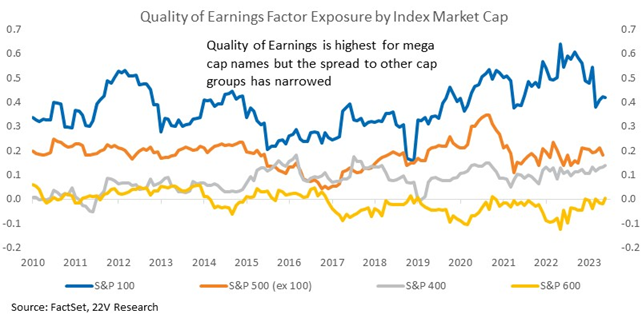
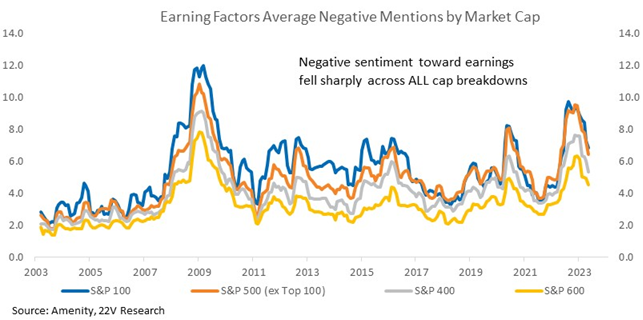
Quality Focus: Mega caps are overexposed to quality relative to other market size segments and have seen earnings sentiment stabilize. Keep that in mind when thinking about their relative performance.
Full report below…
MARKET VIEWS: Most risk-on factors outperformed last week, but Value continues to lag relative to Growth. Early Cyclicas (Tech, Discretionary, Communications) outperformed Deep Cyclicals (Energy, Materials, Industrials), and as we look into the end of the quarter and ahead to 3Q, we don’t see any reason for that to change. Credit crunch risk has faded, strong earnings season results and positive commentary by management indicate lower recession risks, and the debt ceiling looks to have been resolved. At the margin, the skew for risk-on factors is better. FYI, the driving force of risk-on gains has been a collapse in risk-off (Low Vol). The two best factors are Liquidity (measures of trading liquidity – spreads, volume) and Size, which tend to have little correlation. That suggests investors are selling small Low Vol names, not heavily buying risk-on.
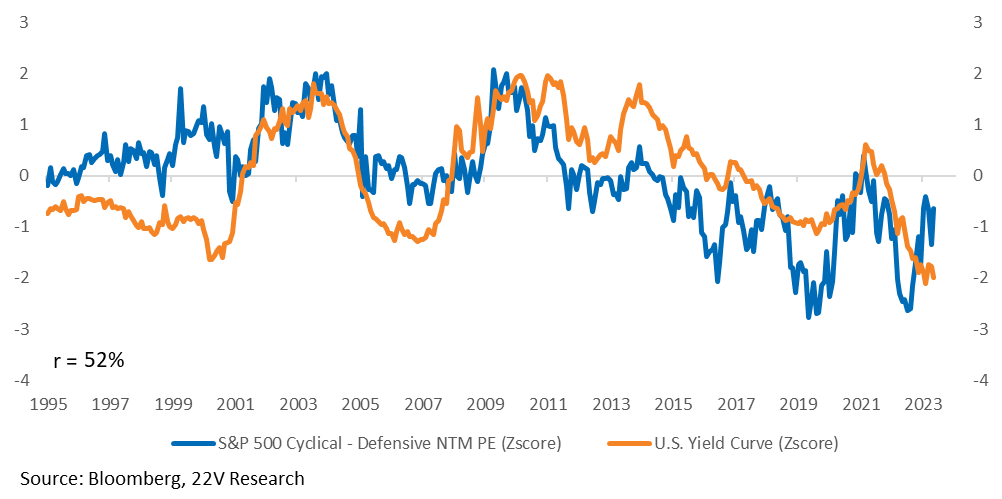
The all-clear remains elusive and we caution against extrapolating a much stronger economy and LONGER TERM outperformance of lower Quality stocks and Cyclicals. Inflation is still too high, necessitating persistently restrictive central bank policy and elevated recession risk (6 months out). That is why the yield curve remains inverted and we shouldn’t expect Cyclical PEs to expand much more relative to Defensives. FYI…the inverted yield curve reflects a high recession risk it does not mean a recession is guaranteed.
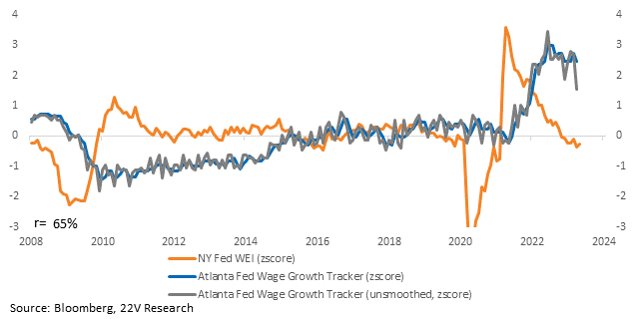
Labor market demand is set to ease and although economic data has been better than feared, we are still looking at 1%ish in underlying economic demand. As the labor market loosens in the coming months, which seems a given as wages are still WELL ABOVE underlying demand trends (below is the NY Fed’s Weekly Economic index vs wages), expect recession risk to go back up again and limit gains in lower quality names. We think the labor market loosening will become more obvious over the summer and as that happens, another round of internal market mean reversion (yields lower, Cyclicals give back some gains) should be expected.
Fed Futures: As our good friend Karim Basta pointed out yesterday, markets continued to attach more weight to hawkish Fed officials than the more dovish signals from leadership (Powell and Jefferson) regarding a June hike. Odds of a June hike went from 16% after Powell’s comments on May 19 to 57% at the end of last week. Some investors are worried about the Fed signaling that tighter financial conditions are necessary…
…on the one hand, they have a good case. C&I loans for small and medium-sized businesses increased last week and have had a minor move off the pre-SVB highs. The sharp tightening in lending standards, that was supposed to lead to much weaker economic activity, is not showing up. That would favor more rate hikes all things equal.
On the other hand, the labor market data is by far the most important signal for the Fed. Fed leadership has made that clear on multiple occasions. Tomorrow, we get JOLTS data and Powell has mentioned Job openings a few times. If Job openings continue to move lower…
…and the Quits rates continue to fall, it would suggest less wage pressure. Less wage pressure SHOULD lead to lower core services inflation. JOLTS will be important tomorrow and of course payrolls on Friday in determining how firmly investors will price more hikes.
Index Earnings Outlook & Mega Caps: Mega caps tend to have the highest Quality scores of nay market cap size segment. However, Quality of Earnings ratings for mega caps plunged in 2022, narrowing their spread relative to other indices. That is a result of deteriorating profitability ratings of mega cap Tech. They remain highly profitable and more so than the rest of the index, but the spread did narrow. If the worst of the earnings hit is behind the mega caps, then the still wide spread between mega cap Quality and other market segments means a support for lager stocks. A no landing needs to be more obvious for mega caps to suffer on a relative basis.
Earnings sentiment readings for mega caps deteriorated sharply last year. There have been some recovery in earnings sentiment this year, leading to similar earning sentiment across indices. On an absolute basis, small caps still have the weakest sentiment scores.
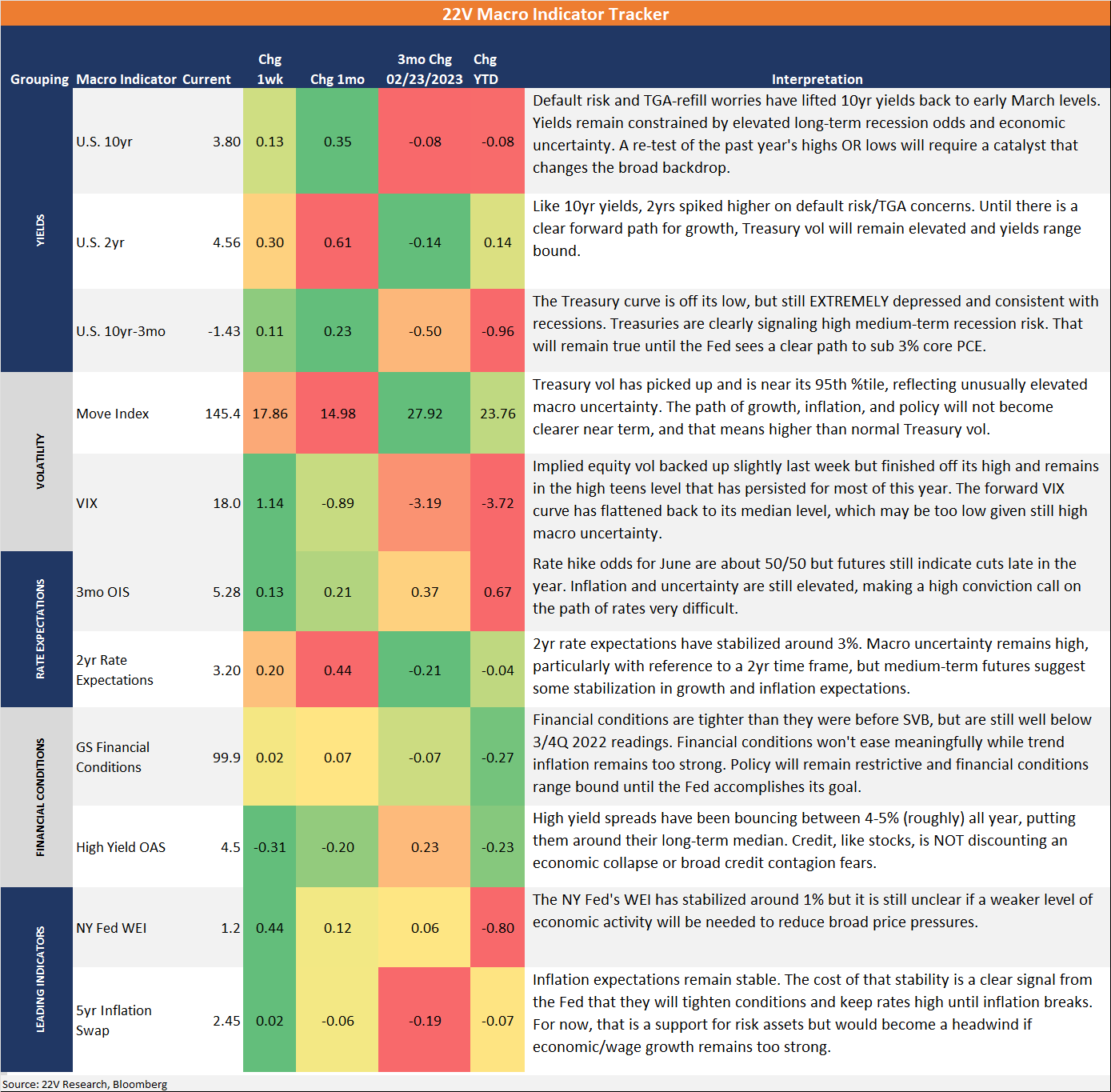
Macro Tracker: Market gains in the first quarter of 2023 were almost entirely the result of PE expansion that offset declining sales/EPS expectations. In aggregate, 2Q23’s ~2% gain was a result of better fundamentals while macro uncertainty kept PEs contained. But the aggregate can be misleading. Market gains were a result of mega caps rising and risk-off internals. Bank failures, debt ceiling concerns, and general recession risk all contributed to the concentration of gains. Looking into the end of the quarter and ahead to 3Q, credit crunch risk has faded, strong earnings season results and positive commentary by management indicate lower recession risk, and the debt ceiling looks to have been resolved. At the margin, the skew on the market is better and will be helped by an easing of Treasury yields now that a near-term default has likely been averted. Risk-on factors and a broader set of stocks should lead for a time. The all-clear remains elusive though. Inflation is still too high, necessitating persistently restrictive central bank policy and elevated recession risk. That will remain the backdrop until labor market demand eases. If a soft landing through an easing, not collapse, of labor demand can be achieved, Deep Cyclicals will become more attractive. Until then, macro uncertainty will remain high, mean reversion will be a dominant theme, and equities will remain range bound.