SUMMARY: Better earnings, lower recession risk, and more data supporting the bank walk versus bank run theory (isolated failures rather than a systemic issue) have all helped lift equities over the past few weeks. Cyclicals have led Defensives by 4.4% over the past month, and Early Cyclicals have led Deep Cyclicals by 4.7%. There is still a wide disconnect between the breadth of economic data and the level of investor sentiment, which suggests the Cyclical/risk-on rally has further room to run. That doesn’t mean a sharp break above 4200, we are talking about internals.
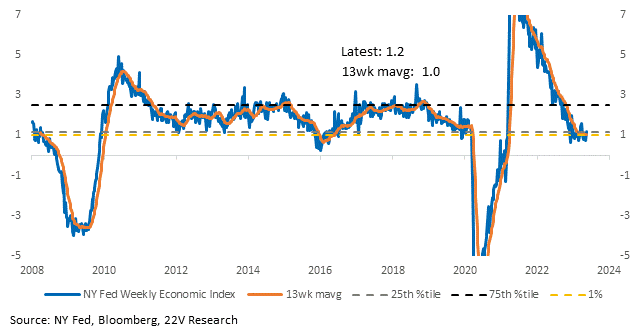
Growth has stabilized, easing concerns of an imminent slide into recession. It is important to keep in mind though that growth is below trend. It is just not recessionary. The NY Fed weekly economic index (WEI), a high-frequency measure of broad economic demand, has been holding steady at ~1%. That is enough to avoid a recession but is still weak. To reduce inflation, the Fed needs to keep economic activity below trend (at the current pace) for an extended period.
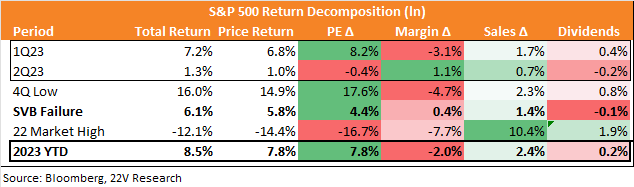
Weak growth is part of the reason the S&P remains range bound. The headline S&P is up about 2% over the past month, trailing the moves in internals (Cyclicals, risk-on factors). Gains from the October low and in 1Q were a result of PE expansion as deep recession fears eased. 2Q returns have been a result of stronger fundamentals while PEs have come down slightly. Reduced negativity toward earnings was enough to notch gains in 2Q. To break out of the 3800-4200 range, economic uncertainty/volatility needs to move lower.
Gerard noted margins are weak and contracting, possibly quickly (HERE). Consensus estimates still assume an unlikely rapid expansion of margins in 2H23. “Nominal profits earned on the global operations of US corporations dropped 5.1% (not annualized) during the first quarter… Strikingly, this steep profit decline was delivered despite a decline of the share of gross value added being taken by net interest charges… The inference I draw is that underlying profit performance may be even weaker than the headline figures suggest, even though they are themselves quite weak.” Increased profitability is anathema to the Fed’s goals. 2023 estimates are more likely to be revised lower than higher.
The market swing factor is the ERP, and short-term, that is a function of sentiment shifts. While economic volatility remains elevated, a high conviction call on a consistently lower ERP is tough. That is why the market is unlikely to break out to new highs. Longer-term, we expect the ERP to move lower as a deep recession is taken off the table. But that will not be clear for at least several months.

MARKET VIEWS: Better earnings, lower recession risk, and more data supporting the bank walk versus bank run theory (isolated failures rather than a systemic issue) have all helped lift equities over the past few weeks. Cyclicals have led Defensives by 4.4% over the past month, and Early Cyclicals have led Deep Cyclicals by 4.7%. There is still a wide disconnect between the breadth of economic data and the level of investor sentiment, which suggests the Cyclical/risk-on rally has further room to run.
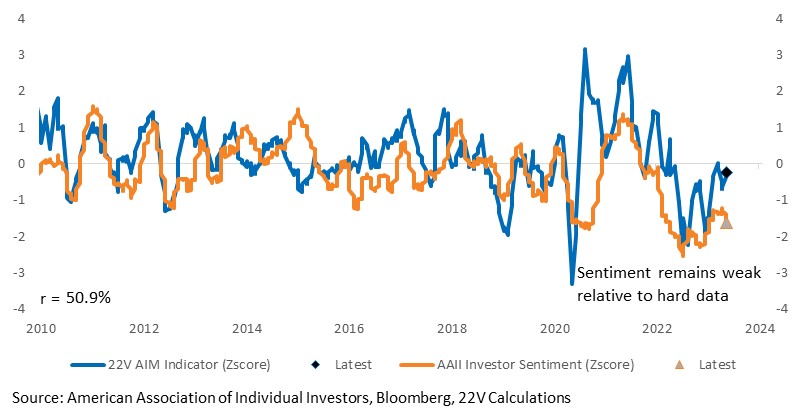
Growth has stabilized, easing concerns that a slide into recession is imminent. It is important to keep in mind though that growth is SLOW. The NY Fed weekly economic index (WEI), a high-frequency measure of broad economic demand, has been holding steady at ~1%. That is enough to avoid a recession but is still weak. To reduce inflation, the Fed needs to keep economic activity below trend for an extended period. Growth is not likely to accelerate meaningfully from here, and it is still unclear where the bottom will be. Deep Cyclicals will struggle until the bottom in economic growth become clearer.
Weak growth is part of the reason the S&P remains range bound. The headline S&P is up about 2% over the past month, trailing the moves in internals (Cyclicals, risk-on factors). Gains from the October low and in 1Q were a result of PE expansion as deep recession fears eased. 2Q returns have been a result of stronger fundamentals while PEs have come down slightly. Reduced negativity toward earnings was enough to notch gains in 2Q. To break out of the 3800-4200 range, economic uncertainty/volatility needs to move lower.
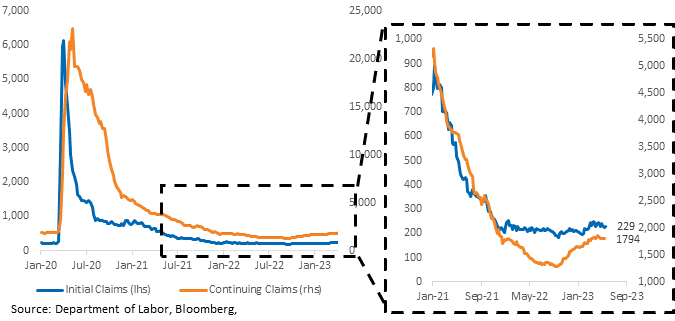
One path toward less economic uncertainty is through loosening labor markets. Easing labor demand would, hopefully, take pressure off wage growth, and give central bankers a clearer path toward sub-3% PCE. Over the past two months, claims haven’t moved higher. So far, labor markets are not sending the signal the Fed is looking for, which indicates rates will remain higher for longer.
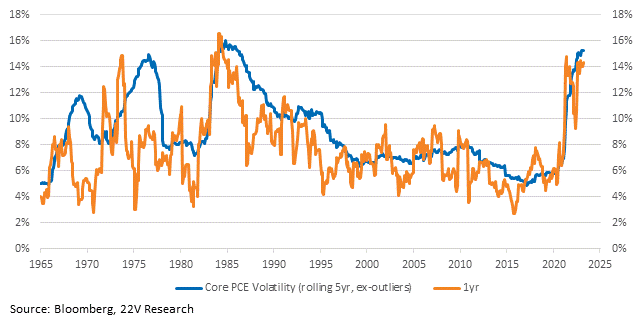
On the Profit Path: The Fed minutes (HERE) highlighted that nearby recession odds are lower, but medium-term deep recession vs. soft landing odds remain tied to the unpredictable path of inflation. From Gerard, “The high conviction point is that they are comfortable taking a high recession risk because they view inflation as too high and unlikely to fall sufficiently without higher unemployment and reduced demand in goods and services markets.” The Fed is willing to take recession risk, and economic volatility is extremely high.
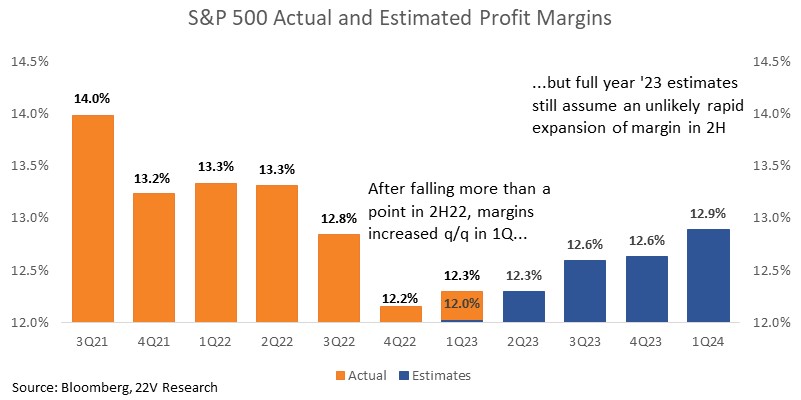
Gerard noted margins are weak and contracting, possibly quickly (HERE). Consensus estimates still assume an unlikely expansion of margins in 2H23. “Nominal profits earned on the global operations of US corporations dropped 5.1% (not annualized) during the first quarter on a pre-tax basis and 6.8% on an after-tax basis. This brought the 4-quarter change of both measures of profits down to -3% vs +2-3% in Q4. Strikingly, this steep profit decline was delivered despite a decline of the share of gross value added being taken by net interest charges. That admittedly surprised me and would seem not to be sustainable. The inference I draw is that underlying profit performance may be even weaker than the headline figures suggest, even though they are themselves quite weak.” The 2H path of consensus estimates assumes a steady increase in profitability that is anathema to the Fed’s goals. 2023 estimates are more likely to be revised lower than higher.
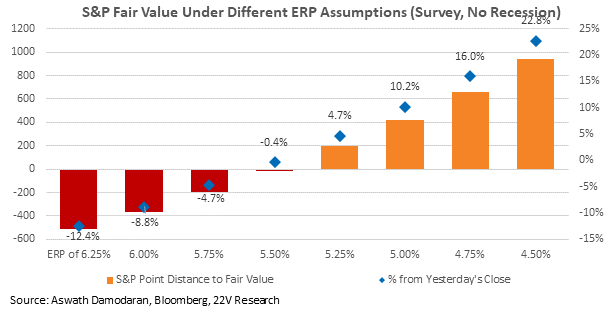
FAIR VALUE SHIFTING HIGHER STILL RANGE BOUND: We re-ran our S&P fair value estimates based on updated investor earnings expectations from our latest survey (HERE). The fair value range has shifted slightly higher to ~3850-4350. The assumptions are as follows: In a recession, we raise the equity risk premium and lower the 10yr yield and cash return ratio. FYI, we do not apply an earnings rebound after the recession, which is the norm outside of very deep recessions. An EPS rebound would increase fair value.
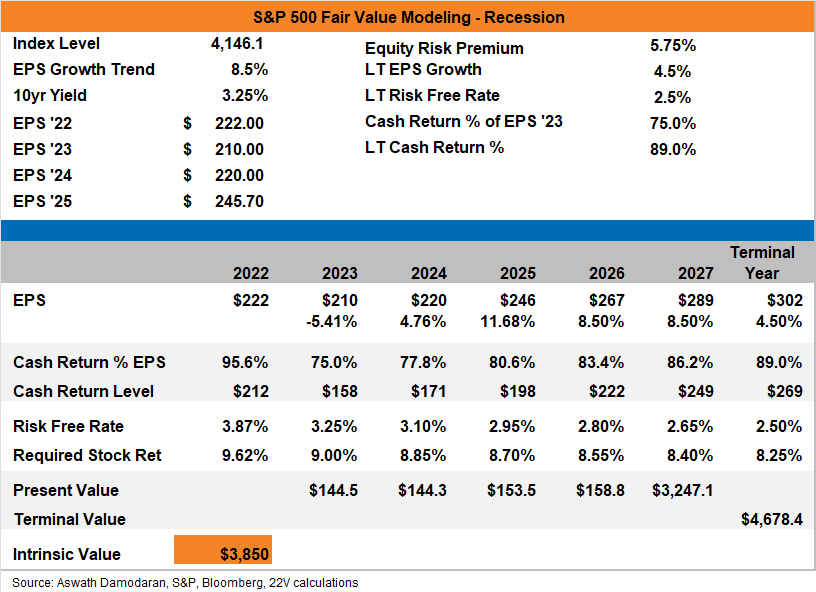
Under a no recession scenario, we have the ERP at its 75th percentile. Still elevated and only down modestly from current readings. Cash return will be better but given buyback and dividend sentiment have rolled over, cash return shouldn’t be assumed to be as strong as in recent years. That combination leaves non-recession fair value around 4,300.
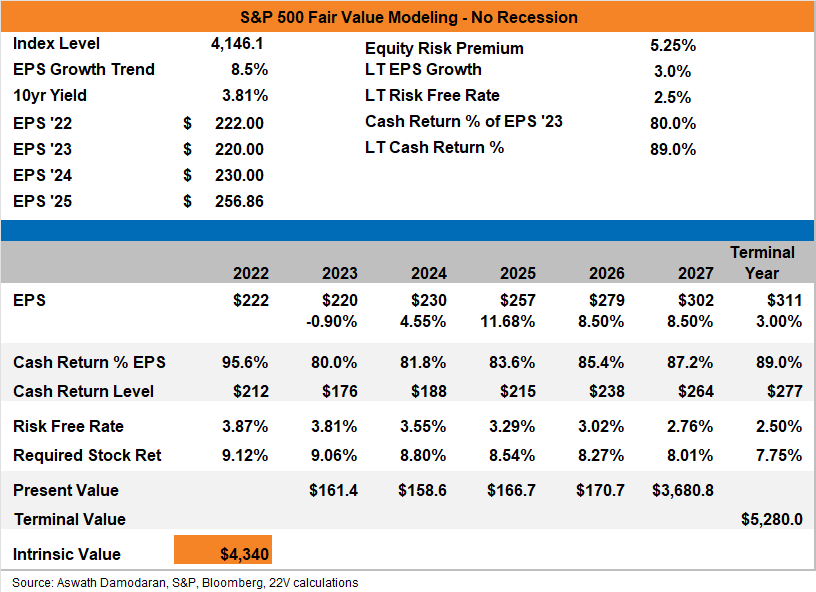
The swing factor is the ERP, and short-term, that is a function of sentiment shifts. While economic volatility remains as elevated as it is today, a high conviction call on a consistently lower ERP is tough. That is why the market is more likely to remain range bound than to break out to new highs. Longer-term, we expect the ERP to ease as a deep recession is taken off the table. But that will not be clear for at least several months.