SUMMARY: Manufacturing readings have weakened, illustrated by the miss in the Empire manufacturing survey this week. However, that weakness remains largely survey-based. Activity levels have weakened, but not nearly as far as surveys suggested they would. As Gerard noted following the industrial production report (HERE), “harder data here do not look alarming by historical standards.” People are worried about the economy but are not acting in a way consistent with a rapid slowdown.
Case in point, retail sales beat expectations and according to Gerard “…underlying real PCE growth appears — just eyeballing the historical data, with no overlay of priors — to be growing at about 1 1/2%.” How consumer spending evolves will remain critical for setting soft vs. hard landing odds, and trends so far suggest a slow decline in consumption and inflation. To be clear, rates will remain restrictive as policymakers believe they need to maintain below-trend growth to keep inflation slowing, but the cumulative impact of rate hikes, bank failures, etc., so far, is not leading to the kind of collapse in economic activity consistent with a hard landing.
RETAIL MACRO OK, RETAIL MICRO WORSE: Goods demand is under pressure. Services demand remains firm. It’s important to separate the macro from the micro here; service strength is helping the economy avoid a collapse in activity, but XRT is underweight services. We’ve highlighted over the past few days we expect XRT to continue to underperform, but that shouldn’t be extrapolated to a macro call on the consumer. XRT was down over -2.5% yesterday.
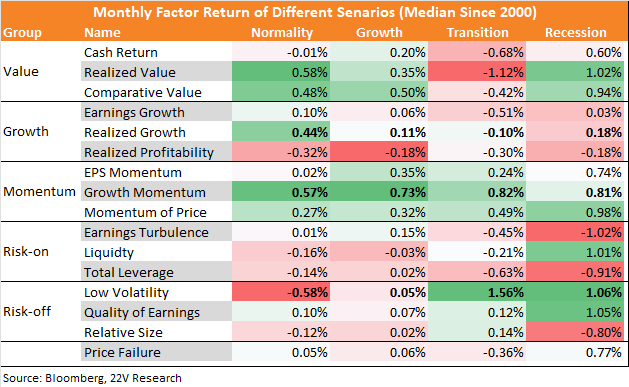
The above is consistent with our macro regime model, which puts the U.S. economy in a Transition period, with increasing odds of moving back to Normal growth (HERE). The big takeaways are 1) macro data is inconsistent with a recession, so current trends need to deteriorate for recession odds to increase (easiest is a rapid increase in the urate), and 2) risk-off factors, which posted extreme gains since the bank failures, usually struggle outside of Transition/Recession periods. The bottom line is lower hard landing odds make the medium-term outlook for Low Vol stocks less attractive, and favors those with strong fundamental momentum.

Of note, on a day the XRT fell over -2.5%, Early Cyclicals still outperformed Deep Cyclicals (all equal weight, so not just mega-caps). S&P Discretionary, eq wgt, fell -25bps yesterday, emphasizing the difference between it and the XRT.
Factor performance during different macro regimes are highlighted in the full report below…
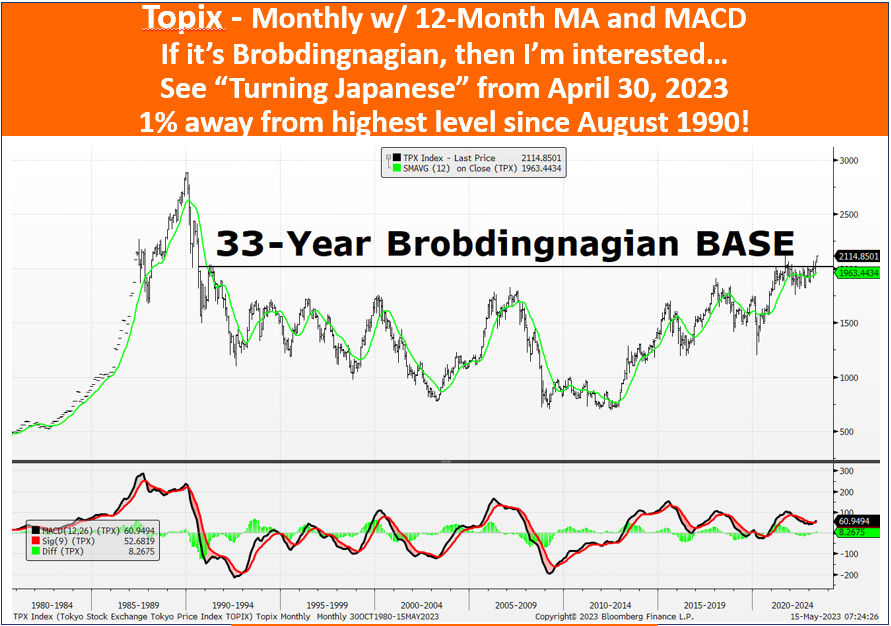
MARKET VIEWS: GDP and industrial production data in Japan beat expectations, and Japanese equities continue to perform well. GDP increased +1.6% SA QoQ AR vs 0.8% estimated, and IP increased 1.1% m/m vs 0.8% estimated. John Roque has been all over this theme and thinks there is more strength in the Topix (even in USD terms).
Manufacturing readings have weakened, illustrated by the miss in the Empire manufacturing survey this week. But, that weakness is largely survey-based rather than activity focused. As Gerard noted following the industrial production report (HERE), “harder data here do not look alarming by historical standards. The economy has taken this particular hit and dynamics internal to the manufacturing sector itself do not look very threatening.” People are worried about the economy but are not acting in a way consistent with a rapid slowdown.
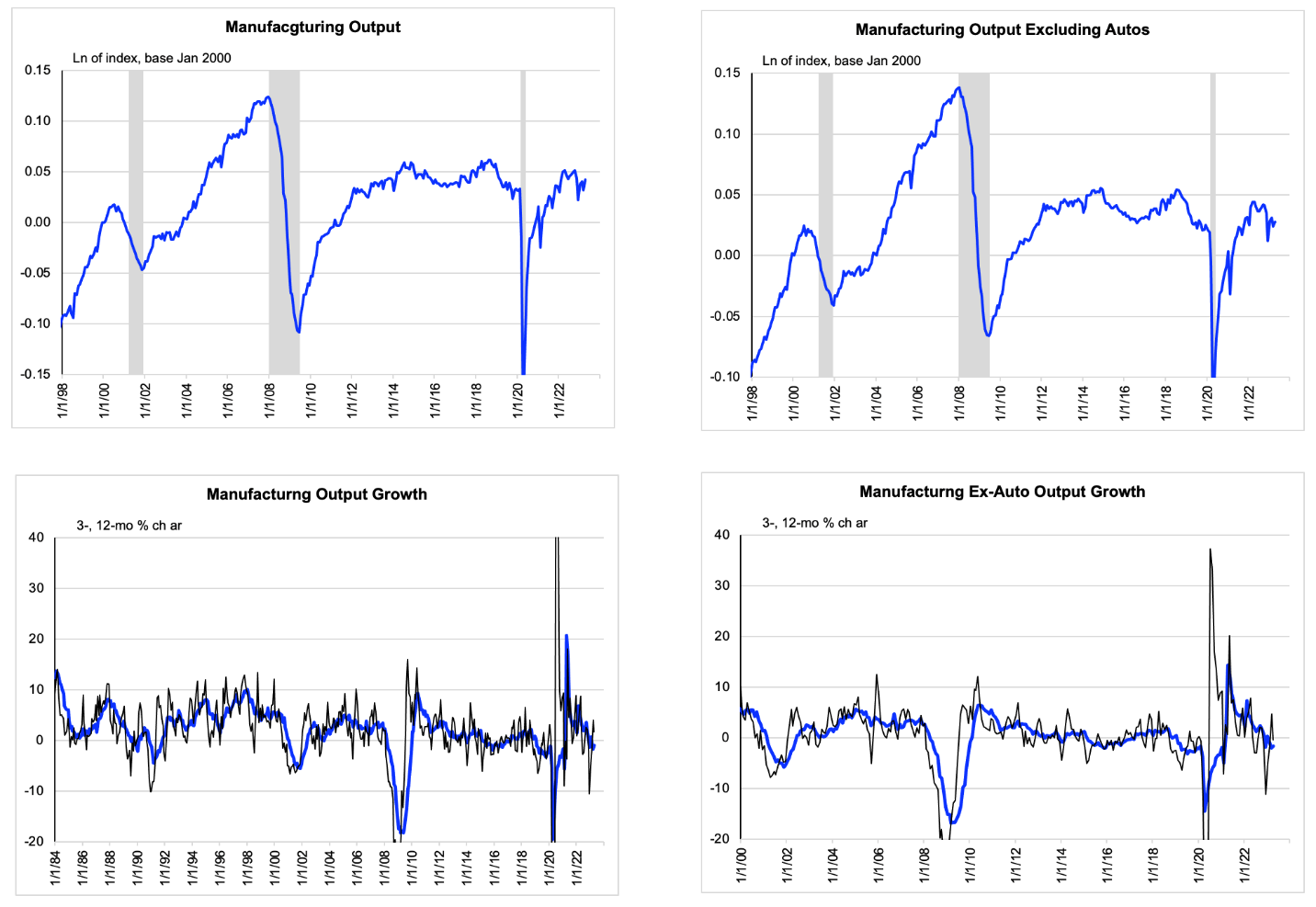
Data are actual to April.
Retail sales beat expectations. From Gerard, “The more relevant point is that underlying real PCE growth appears — just eyeballing the historical data, with no overlay of priors — to be growing at about 1 1/2%… The Fed would probably be content with a growth rate near there, assuming a slight collective drag from other components of GDP.” How consumer spending evolves will remain critical for setting soft vs. hard landing odds, but trends so far suggest a slow decline in consumption and inflation. To be clear, policy will remain tight as the Fed believes it needs to maintain below-trend growth, but the cumulative impact of rate hikes, bank failures, etc., so far, is not leading to the kind of collapse in activity that investors feared.
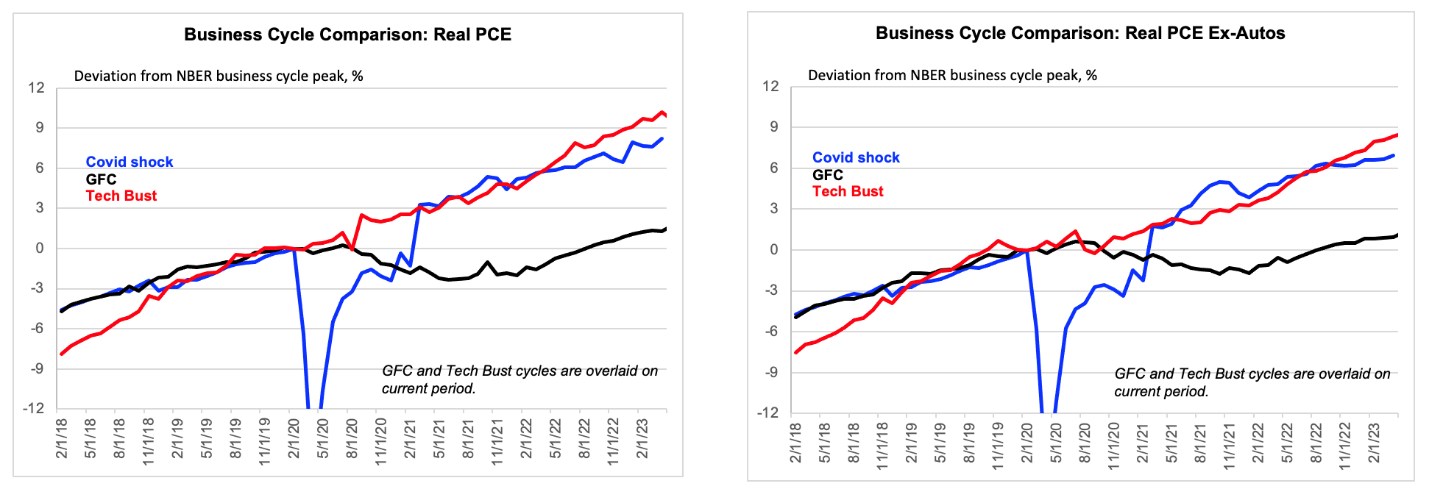
Data are actual to March and estimated to April.
Goods demand is under pressure. Service demand too, but it has been stronger. Within retail sales, the month-over-month contribution from food services and drinking places was strong. There were large drags from retail, home furnishing, and sporting goods/hobby stores. It’s important to separate the macro from the micro here; service strength is helping the economy avoid a collapse in activity, but XRT is underweight services (sub-industry weighting is mapped out below). We’ve highlighted over the past few days we expect XRT to continue underperforming (-2.5% yesterday), but that shouldn’t be extrapolated to a macro call.
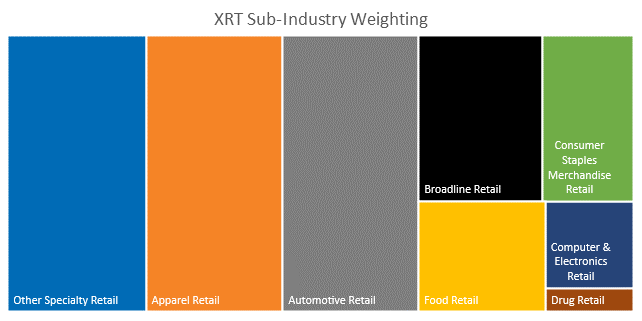
Source: Bloomberg, 22V Research
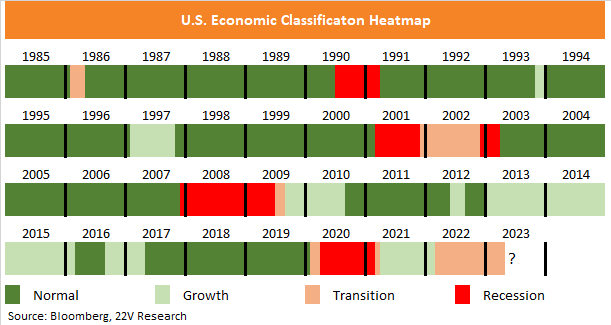
All the above is consistent with the results of our macro regime model, which puts the U.S. economy in a Transition period, with increasing odds of moving back to Normal growth (HERE). This is a state model, not a forecasting tool. It is meant to put the complete economic backdrop into an objective, probabilistic reading that can be mapped to different factor and market trends. The big takeaways are 1) macro data is not consistent with a recession, so current trends need to change for recession odds to increase (easiest is a rapid increase in the urate), and 2) risk-off factors, which have posted extreme gains since the bank failures, generally struggle outside of Transition/Recession periods. The bottom line is lower hard landing odds make the medium-term outlook for Low Vol stocks less attractive, while stocks with strong fundamental momentum are more attractive (Value too, but that is a harder call today, HERE).
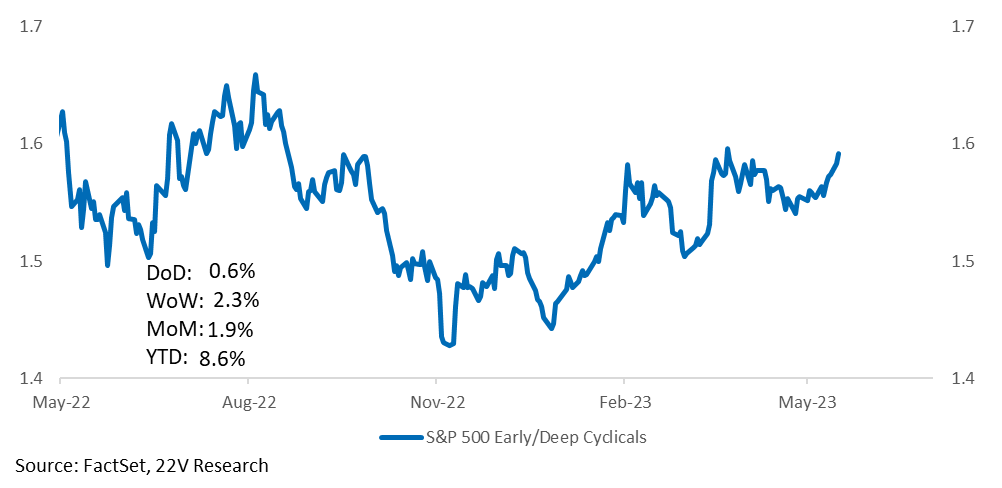
Transition is also a tailwind for Early vs Deep Cyclicals, a theme we continue to like and one that’s worked for much of the year. Of note, on a day the XRT fell over -2.5%, Early Cyclicals still outperformed Deep Cyclicals (all equal weight, so not just mega cap performance). S&P Discretionary, eq wgt, only fell -25bps yesterday, emphasizing the difference between it and the XRT.
Factor performance during different macro regimes are highlighted below.