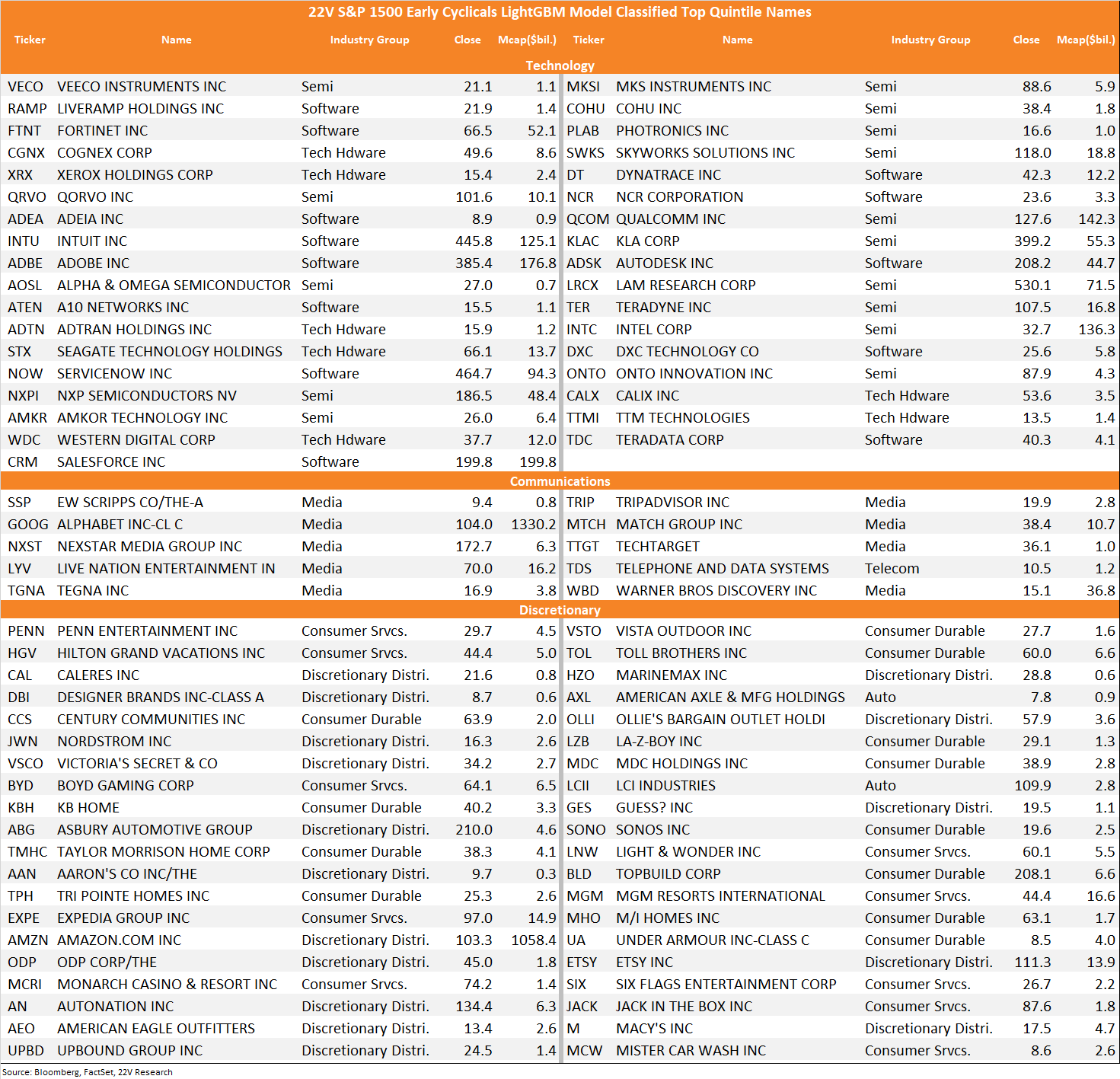
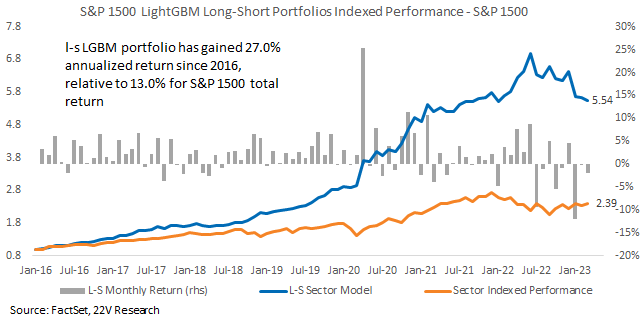
Last month, we introduced a gradient boosting machine learning technique for stock selection (HERE). To expand the model and improve the results, we have tweaked the model training, refining its feature selection at the sector level. In aggregate, this tweak has led to improved return and performance ratios. Model back tests now show a 27.7% annualized return, 1.35 sharp ratio and 0.71 information ratio on the S&P 1500. Economic volatility remains high, but correlations are in a declining trend. That backdrop increases the importance of understanding what forces are driving stock returns and that is where our LGBM approach can help.
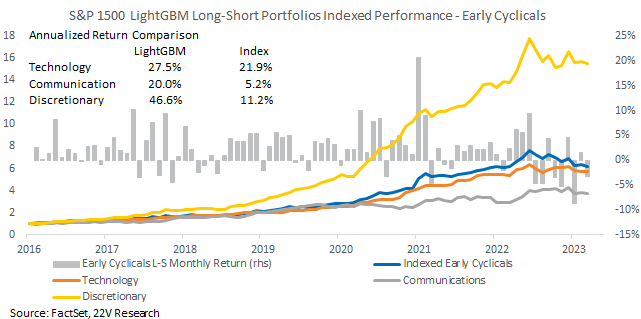
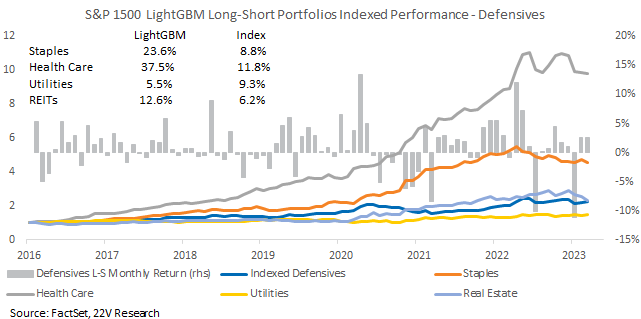
Our model approach works well across all early-Cyclical sectors (Tech, Comms, Disc), creating focused long-short portfolios. Selection within Discretionary has been strongest, taking advantage of the relatively high dispersion within the sector. The LGBM model also works on most Defensives, with returns to Health Care the most attractive.
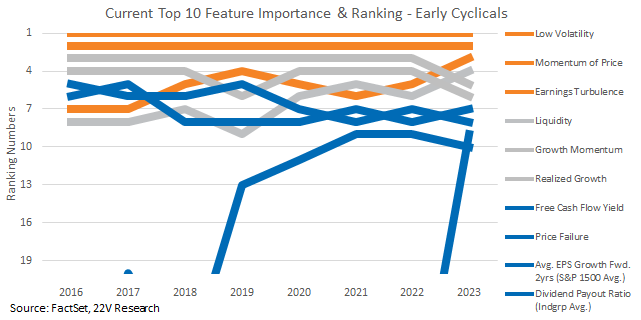
At the index level, macro forces tend to be among the most important stock selection features. At the sector level, fundamental factors tend to be more important. The leading features explaining Early Cyclical performance were Low Volatility and Momentum of Price. Risk-on factors including Liquidity and Earnings Turbulence we also important. The ranking is in line with recent backdrop as the market has been rotating between risk-on and off, weighting on Early Cyclicals.

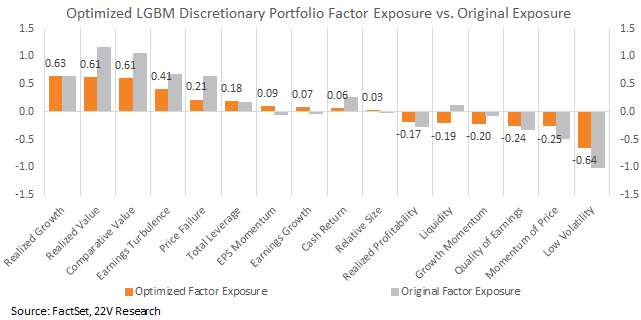
As macro uncertainty remains high, the best way to minimize portfolio volatility is to lower the overall factor exposure. We have optimized the weights for our long-short LGBM portfolio to achieve lower volatility. This leaves the portfolio less impacted by factor rotations and lower in volatility (more on that concept HERE).
At the end of the report, we list the top quintile (best) stocks from each Early Cyclical sector. These names are expected to perform better based on the model. A full list of S&P 1500 stock ranking within each sector is available as well. Just let us know if you are interested.
Apply LightGBM to Sector Level Stock Selection: Last month, we introduced our LightGBM based model, a gradient boosting ML technique for stock selection (HERE). To expand that model, we add a few improvements including a 3mo look-back on fundamental data and further training to incorporate the current year monthly returns. Absolute and risk-adjusted returns have improved at indexed level, where the model now posts a 27.7% annualized return, 1.35 sharp ratio and 0.71 information ratio. In addition, we better tailoring the model for sector focused stock selection.
Early Cyclicals are particularly well suited to today’s macro backdrop, so today we focus on applying the LGBM model to Early Cyclical sectors. The LGBM model approach works across all three sectors Early Cyclicals at constructing long-short portfolios. The best performer by a large margin is Discretionary, but the l-s LGBM portfolios outperformance across all three sectors.
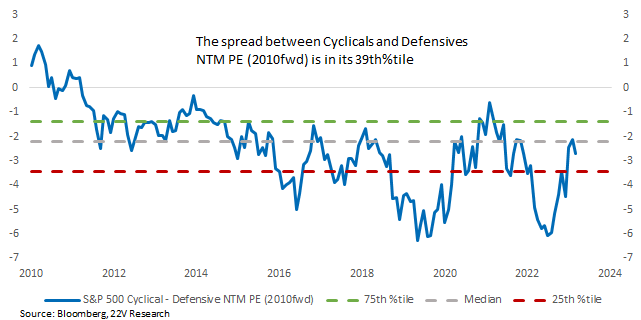
We focused on Early Cyclicals because the groups valuations remains lower than Defensives. In addition, Early Cyclical cash return yields remain higher than for Defensives and the US 10yr yield. As we discussed a few weeks ago, cash return remains an important component of fair value (HERE). That combination, along with the slowing but not collapsing growth backdrop leaves us favoring Cyclicals, especially Early Cyclicals.
Surfacing Important Sector Influences: At the sector level, fundamental factors play a more important role in stock ranking than macro factors, which are more important at the index level. Macro sets the board. Fundamental factors move the pieces. Current leading features explaining the models prediction for Early Cyclical are Low Volatility followed by Momentum of Price. Risk-on factors including Earnings Turbulence and Liquidity are also important in forward return prediction. That ranking is in line with recent backdrop as investors have been rotating between risk-on and off factors, and that has weighed on Early Cyclicals performance.
Adjusting for High Volatility & Mean Reversion: Macro uncertainty remains high and factor mean reversal continues. Under that backdrop, a good way to minimize portfolio volatility is to reduce overall net-factor exposures. We optimize the factor exposures of our portfolio based on the return volatility of each facto, constrained by keeping the long and short portfolio roughly equally weighted. That leaves the portfolio less impacted by factor swings and lowers total return vol.
Though we expect Cyclicals, especially Early Cyclicals to outperform Defensives. We also ran our LGBM stock selection on Defensive sectors. The model worked well within Staples, Health Care and REITs, performing best for Health Care. Higher dispersion, lower macro influenced sectors benefit most from sector specific training, but it is very encouraging that the model still works well within higher correlation Defensive groups. That suggest ML techniques are a useful way for fundamental investors to broadly group stocks within sectors, helping create focus groups.
Below we list the S&P 1500 Early Cyclical names that rank in the top quintile in each sector based on our current LGBM model results. We expect these names will outperform their sectors and stocks with lower rankings. A full list of S&P 1500 stock rankings within each sector is available as well. Just let us know if you are interested.