Macro volatility has spiked higher over the past few weeks as bank failures have delivered another shock to investors already wrestling with policy/inflation uncertainty. Headline/core inflation trends remain too strong and forward rate hikes are potentially more constrained by the recent bank failures. The forward outlook will remain cloudy until the bank crisis has passed and the impact of recent failures on lending/growth is clearer.
To help navigate the current backdrop, today we look at ways to screen the market, in this case using ETFs, for pair trades that have diverged significantly from macro trends. We focus on Gold prices and Treasury Vol. 22V’s Commodity analyst Colin Fenton’s expects gold will move higher under MOST inflation scenarios (details HERE). Treasury volatility measured by MOVE Index has climbed sharply since the wave of bank failures, far exceeding its COVID peak, and is currently n its 98th %tile. Treasury and broad bond vol should ease unless the banking crisis spreads.
To position for lower bond vol, we ran pairwise long-short ETF pairs correlations with the MOVE Index and Gold prices separately. We also tested whether the ETF pairs are stationary. The pairs that passed the stationary test and had strong correlations with macro forces make up our list of potential pair trades.
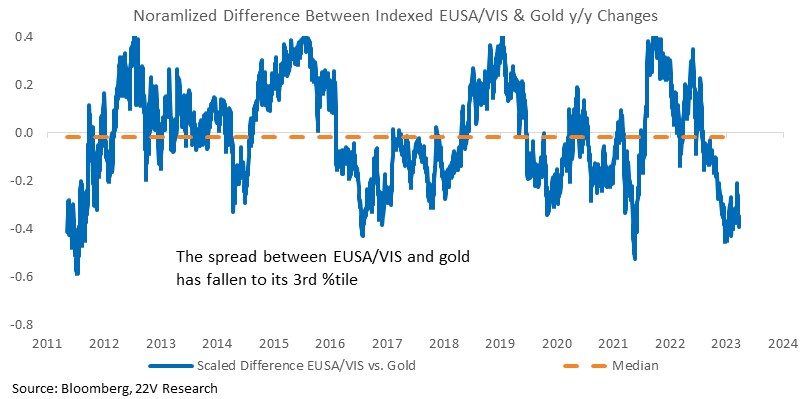
These pairs are based on the assumption that either Gold prices will trend higher or the MOVE index will decline. One example we highlight is EUSA/VIS and Gold. The relative performance of EUSA (equally weigher broad market index) vs. VIS (Vanguard Industrials) is positively correlated with gold prices. VIS has performed MUCH better than is suggested by the gains and forward trajectory of Gold. If Gold continues to move higher, EUSA is likely to outperform VIS.

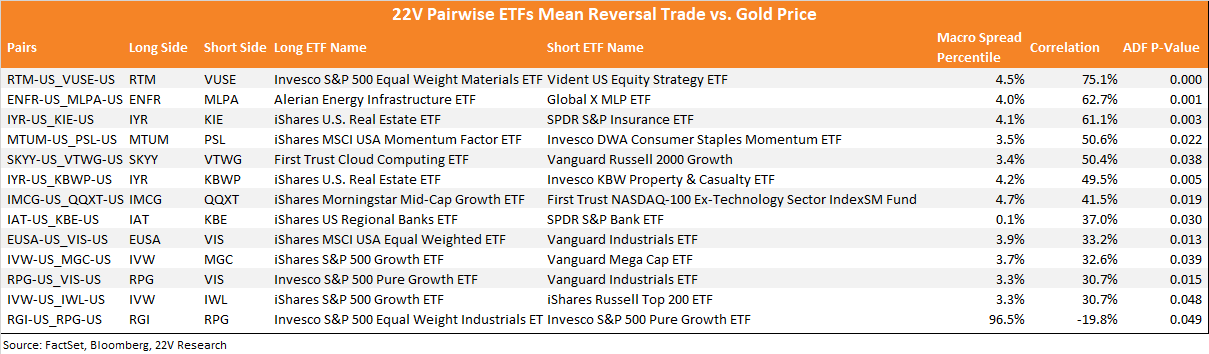
At the end of the report, we list all the stationary ETF pairs with extreme spreads and high correlations relative to MOVE Index and Gold. These pairwise ETFs are more likely to reverse as volatility eases and gold gains.
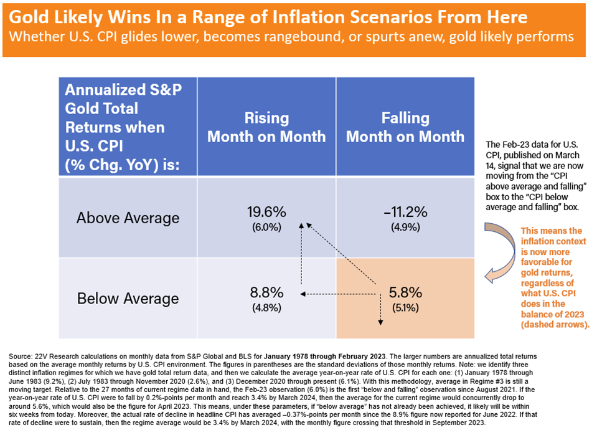
Gold Likely to Win in Most Inflation Scenarios: Headline/core inflation trends remain too strong and the forward of rate hikes potentially more constrained by the recent bank failures. 22V’s Commodity analyst Colin Fenton’s expects gold will move higher under MOST inflation scenarios (details HERE).
Talking Gold as a starting point, we looked for ETF pairs that are stationary and highly correlated with Gold. The relative performance of EUSA (equally weigher broad market index) vs. VIS (Vanguard Industrials) is positively correlated with gold prices. VIS has performed MUCH better than is suggested by the gains and forward trajectory of Gold. If Gold continues to move higher, EUSA is likely to outperform VIS.
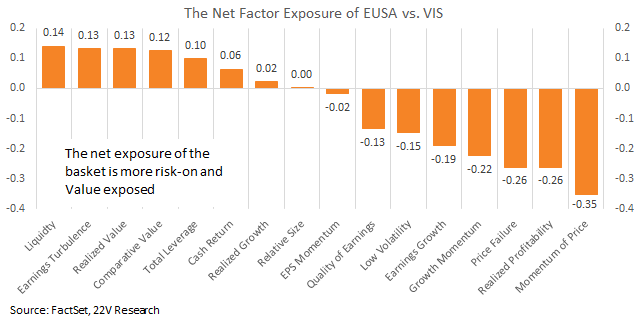
Looking at the internals, EUSA is more exposed to Value and risk-on factors than VIS. VIS is industrials specific while the EUSA is most exposed to Technology. A surge in inflation would benefit Gold but would be a risk to EUSA’s risk-on factor profile. At the same time, a more Tech focused orientation would benefit EUSA under the inflation spike scenario. There are few reasons to expect an inflation surge, but a general upward trend in Gold is likely, which would support EUSA.
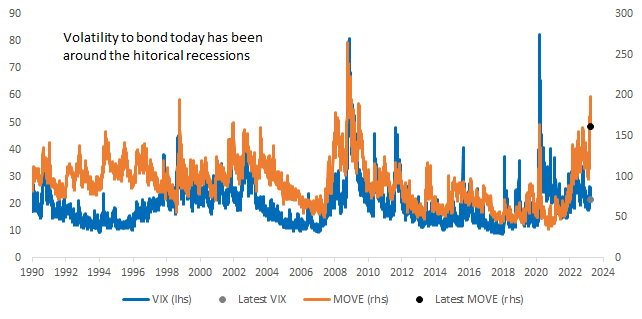
Extreme Bond Volatility: Treasury volatility measured by MOVE Index has climbed sharply since the wave of bank failures, far exceeding its COVID peak, reaching a level last seen after Lehman’s failure in 2008. The MOVE index has eased some but remains in its 98th %tile, a level consistent with recessions. Implied equity vol, which is typically highly correlated with the MOVE has NOT increased anywhere near as much. Unless the bank failure led to a sharp decline in lending and a rapid deterioration of economic activity, bond volatility should trend lower from here.
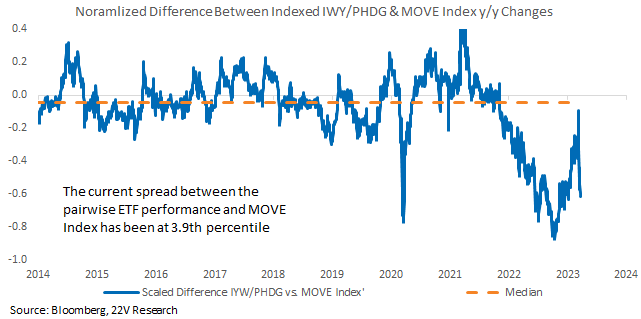
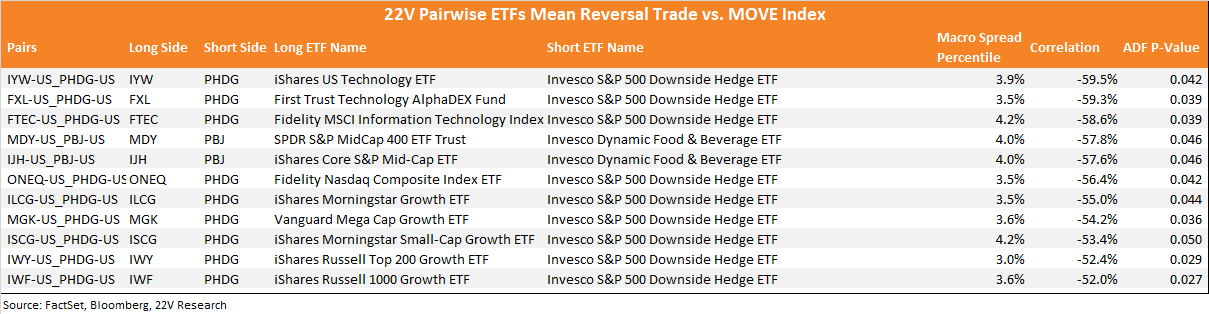
To position for lower bond vol, we ran pairwise long-short ETF correlation with MOVE Index using the y/y change in the spread between indexed ETF pairs and the MOVE Index. We also ran a stationary test on the spread. The pairs that passed the stationary test with a strong correlation with the MOVE Index historically and have seen an extreme spread between the indexed return and MOVE recently are listed at the end of this report. Currently, the relative performance of IYW (U.S. Tech) vs. PHDG (Dynamic Downside Hedge) is posting a wide divergence with MOVE Index.
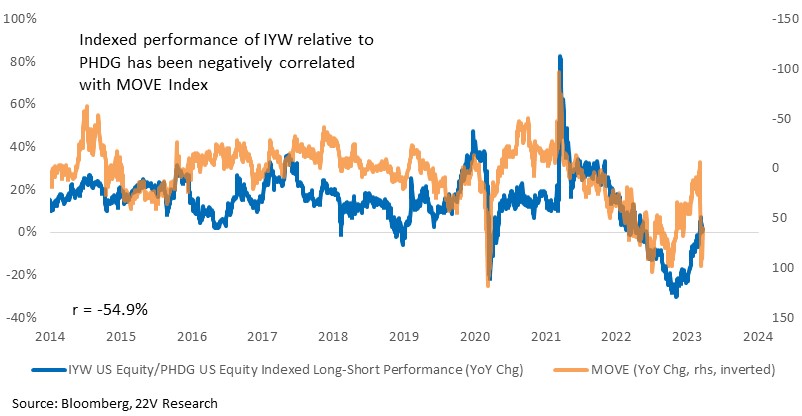
Historically, there is a negative correlation between ITW/PHDG returns and the MOVE. As the move has collapsed, PHDG has failed to outperform IYW, leaving the spread between the indexed ETFs and the MOVE exceptionally wide. Given their negative correlation and the extremely low spread, reversion of the MOVE index would be an ongoing support for Tech. The risk is a persistent widening of the MOVE index (not our base case outcome but a risk), which would benefit the PDHG.
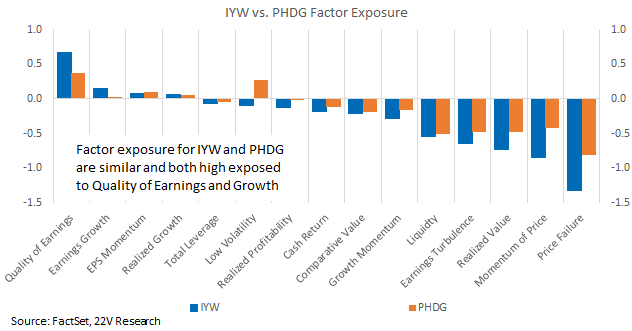
Fundamentally, both ETFs are heavily exposed to Technology, with IYW more exposed to Early Cyclicals (66.5% vs. 29.9% for IYW vs. PHDG). Net factor exposure of IYW is tilted more toward Quality of Earnings and Growth. Early Cyclicals and high Quality names continue to benefit from the current macro backdrop (details HERE), which helps explain the relative strength of the IYW and supports the ETF medium term.
Other ETF Pairs: Below we list all the stationary ETF pairs with extreme spreads and high correlations relative to MOVE Index.
Below are more pairwise ETFs to play further gains in Gold.