

SUMMARY
- We expect Beijing to announce a relatively conservative GDP growth target (“above 5%”) and modest additional stimulus for 2023; risks to the growth outlook are tilted to the upside, with potential for Xi and his new leadership team to aim for a stronger recovery than we expect.
- While Xi and incoming premier Li Qiang are seeking to reassure the private sector, it is unlikely that Beijing will announce major changes to the business climate that impress investors; economic security will remain a key policy priority amid stiff geopolitical competition with the United States.
- Recent signs point to major restructuring of the financial regulatory apparatus, with potential to improve internal coordination on major risks but also to worsen communication and the authority of financial technocrats; financial policy will stay disciplined but may be less dynamic and transparent under a new set of senior officials.
The annual NPC meeting kicks off on Sunday, March 5, bringing together officials throughout China’s system to unveil the major economic and social policies for the year. This NPC will have added importance as the first such meeting after the 20th Party Congress; it will appoint a new lineup of government positions as well as announce significant reforms to China’s regulatory and policymaking apparatus.
Xi Jinping and his new leadership team are eager to use the meeting to boost confidence in China’s recovery and longer-term outlook. However, there are trade-offs between Xi’s broad priorities and what markets and the private sector would most like to hear, including guarding against financial risks vs. increasing stimulus, and consolidating Party control and “economic security” vs. pursuing liberalizing reforms. There is more room for the NPC to surprise to the upside on growth and stimulus than when it comes to reforms and governance.
This preview note outlines the key watchpoints for the NPC, focusing on three main questions for investors:
- Growth: How much and what type of stimulus will Beijing use to support economic recovery this year?
- Regulation and reform: How strong are the pro-market policies coming from Xi and his new leadership team?
- Governance: What are the key changes to the personnel and structure of economic policymaking?
Key Items on the NPC Agenda:
The NPC opens this Sunday; the closing date has not yet been announced but is likely to fall between March 15-20. The key events with market implications are as follows:
- On Sunday, March 5, the NPC will open with the departing premier, Li Keqiang, delivering the government work report. The report sets out key economic tasks, including targets for the GDP growth and the fiscal deficit.
- Midway through the NPC, Beijing will announce institutional reforms, likely to include a new structure for coordinating financial regulation.
- On its second-to-last day in session, the NPC will approve appointments for the vice premiers who oversee key areas of policy and ministerial posts such as central bank governor and finance minister.
- On the last day of the NPC, new premier Li Qiang will hold a press conference and Xi Jinping may give a speech. These events will send useful signals for Beijing’s political priorities and the environment for domestic and foreign firms.
(1) Growth outlook: How much stimulus will Beijing devote to boosting domestic demand?
We have been on the cautious side of the growth outlook this year, particularly in terms of what it means for the global economy (please see: What could go wrong in 2023, 29 January 2023). That assessment is based on the following factors:
- Signals since the Central Economic Work Conference in December have implied Beijing is banking largely on reopening, rather than major new stimulus measures, to do most of the work for the rebound this year. The reticence for aggressive loosening comes from Beijing’s concern over longer-term financial risks and a desire to return policy to a more sustainable footing.
- Three years of pandemic controls and a severe property market downturn have hurt the balance sheets of households, local governments, and corporates. This may limit the strength of the rebound in spending and investment over the course of the year given only modest support from stimulus.
- Those factors imply growth in 2023 that is largely driven by a rebound in services, with much of this demand staying within China and relatively smaller positive spillovers to global growth than a cycle driven by credit-fueled investment stimulus (please see: Avoid excess optimism over “excess saving”, 19 January 2023).
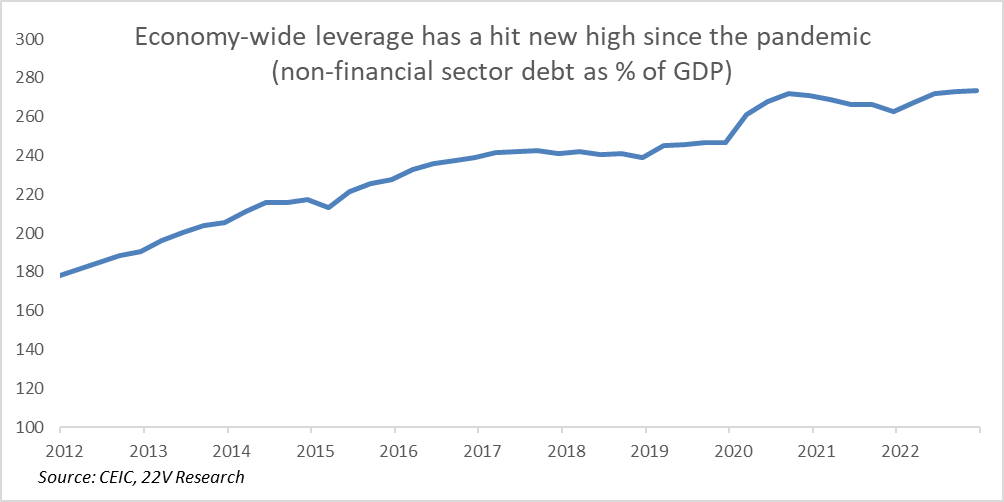
While this remains our view heading into the NPC, risks are tilted to the upside. We continue to think that Xi’s attention to financial risks will limit the aggressiveness of stimulus, and that he is as much focused on broader political and geopolitical goals – such as economic security – as the growth target per se. But he could surprise us with stronger policy support.
It may also turn out that China’s organic recovery from Covid is strong enough to not need much supporting stimulus. Recent data show the post-Covid recovery gaining momentum, with a strong jump in February in both the manufacturing PMI (52.6) and non-manufacturing PMI (56.3). But it is still very early days and we have stressed that the risk of disappointment is tilted towards H2, with potential for growth momentum to fade after an initial reopening rebound.
The key targets and stimulus policies to watch at the NPC are as follows (see Table I for a summary):
- GDP growth: Our expectation is a growth target of “above 5%” but there are a range of possibilities laid out below. GDP growth targets set by provincial governments for 2023 have a weighted average that is about 0.5 ppts lower than in 2022, when the national target was “around 5.5%,” so it stands to reason that 5% is the approximate range for the national target this year. Still, 5% is a quite conservative floor for growth this year given a low base effect from 2022 GDP growth of 3%; we thus also wouldn’t be surprised by a target of “around 5.5%.”

- Fiscal deficit: We expect a fiscal deficit target of 3% of GDP or slightly above; the upside case would be 3.5%. The deficit target for 2022 was 2.8%, but larger when including unused funds carried over from the previous year. The composition of fiscal spending is also important: we do not expect the central government to provide significant direct support to households to promote consumption, which would be an upside surprise. Beijing will instead leave this up to local governments, whose finances are heavily strained. It will thus also be important to see how much funding Beijing transfers to local governments in support of both social spending and infrastructure.
- Quota for local government bonds: We expect a quota of 3.8 trillion RMB, slightly above the original 2022 target of RMB 3.65 trillion. Note that despite the larger quota, infrastructure spending still faces headwinds from local governments’ depressed land sales revenues; their government funds budgets, a key source of infrastructure finance, hit a record deficit of 3% of GDP in 2022 (see chart below). Land sales are unlikely to rebound strongly or quickly, as once property sales rebound, developers will need to use the proceeds to pay back debt and complete stalled projects.

- Monetary and credit stimulus will stay accommodative but is unlikely to be significantly looser than 2022. The PBOC’s Q4 monetary policy report, released on Feb. 24, took a fairly optimistic view of the outlook this year and pledged to provide “sustainable support for the real economy,” implying a focus not only on short-term growth but also long-term risks.
- Property policies: We expect Beijing to signal that it will incrementally scale up measures to boost property sales (further flexibility for local governments) and to stabilize financing for the healthiest private property developers. However, this support will still be framed within the context of containing speculative pressures, not using housing as a form of stimulus, and avoiding moral hazard by bailing out developers. That is to say, Beijing seeks to stabilize housing prices and activity this year but not to try to engineer a U-shaped rebound. The upside case would be signals that the central government is moving beyond incremental support to become more directly involved in restructuring the property sector, such as through: stepped up central financing for developers to complete stalled housing projects; a stronger push from Beijing for local governments to restructure stalled projects and promote M&A; and steps towards institutional reforms such as a guarantee mechanism for households that pre-buy apartments, which would help revive confidence and boost property sales.
- The unemployment rate has also become an increasingly important target for China’s policymakers. A target of 5.5% for 2023, the same as for 2022, is likely; while this was the rate as of December, the return of migrant workers from the countryside (with the end of Covid) will increase the labor participation rate and could make this goal challenging. A less aggressive goal such as 6% would imply reduced urgency for stimulus and potentially a weaker outlook for consumption growth.

(2) Regulation and reform: How strong are the pro-reform signals coming from Xi and his new team?
Xi and incoming premier Li Qiang have sent messages of reassurance to the private sector in recent months, including statements signaling that the tech rectification campaign is over (for now). But there is big difference between reducing the political pressure on the private sector and pushing through measures that improve its fundamental confidence and standing, such as by leveling the playing field against SOEs and improving the predictability of regulation.
More broadly, it is increasingly important that Beijing push through reforms that boost productivity, given mounting to challenges to growth from demographics and an investment-driven model that is running out of gas (see our 2023 outlook for more).
While we don’t expect major shifts in policy, we will be looking for signals at the NPC on issues such as:
- How Xi balances his drive for “economic security” – including tech reliance but also food, energy and supply chain security – with growth and economic efficiency objectives
- The environment for foreign firms in China, with Beijing eager to retain foreign investment but potentially also warning (indirectly) of retaliation for US “long-arm enforcement measures” such as export controls
- Policies towards the digital economy, including the balance between data security and industry development
- The prominence of the “common prosperity” agenda, which has potential positives (increased social spending) and negatives (dampening private sentiment)
- The relationship between private firms and SOEs. In a speech earlier this week on institutional reforms (see next session), Xi mentioned the need to promote Party building in “mixed ownership firms” that have both state and private shareholders. The line between private and state firms has become increasingly blurry (but is not meaningless), with implications for corporate governance and how Chinese firms are perceived overseas.
(3) Governance: What are the key changes to the personnel and structure of economic policymaking?
A regulatory shake up is on the way
Xi used the 2018 NPC, which kicked off his second term, to push through major changes to China’s governance apparatus: wrestling control of economic policymaking from the cabinet (State Council) to Party commissions under his direct control; establishing a new anti-corruption body for public sector employees (not just Party members); and strengthening environment protection by creating a new agency.
In the last few days, it has become increasingly clear that significant institutional reforms are coming at this NPC as well. Xi gave a speech on Tuesday (Feb. 28) that pointed to reforms to Party and state institutions that, among other things, will “deepen the reform of the financial system and improve the system of unified leadership of the Party Central Committee over science and technology work.” Xi noted that the changes are “targeted and intense” and touch on “deep interests” and issues of “great concern to society” – in other words, these are changes meant to overcome institutional interests that Xi believes stand in the way of his agenda.
His comments would seem to confirm recent speculation and media reporting that Xi will shake up the regulatory structure for financial agencies, perhaps by reviving a Central Financial Work Commission. If carried out skillfully, such a body could break down regulatory silos that have contributed to growing financial risks, particularly on center-local issues such as local government debt risks and weak regional banks. But there are potential downsides, including a cumbersome new structure that delays decision-making and worsens communication problems: the new PBOC governor may lack credibility or flexibility in communicating to investors if all decisions are made at the very top, which could amplify shocks from China to global markets during periods of financial stress and policy uncertainty in China. The other danger is that a new structure reduces the technocratic orientation of the financial regulators and elevates more political goals, such as funding Xi’s industrial policy initiatives. But even after details come out at the NPC it may be too early to judge the practical impact.
Purely from a growth perspective, Xi’s continued attention to financial risk issues suggests that investors should not expect a return to loose financial and property policies (as existed prior to 2016/2017) just to support short-term growth. Financial discipline is baked in to policy, even if officials hawkish on risks (vice premier Liu He and banking regulator Guo Shuqing) are retiring.
On the innovation side, Xi seems palpably frustrated with the slow progress of China’s efforts to promote technological self-reliance in the face of increasingly broad and aggressive US export controls. Some observers speculate that this means a new, more centralized effort to spearhead China’s semiconductor sector, where many years of effort and billions in state funds have failed to reduce vulnerability to critical “chokepoints” exploited by Washington.
A new, more powerful body to steer semiconductors and other innovation/industrial policy initiatives is worth watching not only for what it means for China’s tech sector, but also the potential blowback from the US and other trading partners. There is a vicious cycle already underway: Xi ramps up industrial policies to address China’s perceived tech vulnerabilities, leading to greater concerns from rivals about China’s state-backed approach and calls for increased restrictions on Chinese firms’ access to tech and capital. This seems set to continue.
A new team to manage economic policy
In terms of key personnel, the NPC will shed light on the specific portfolios of the vice premiers who oversee economic policy and will appoint a wholesale change of the heads of key economic agencies. We discussed potential changes to the financial team in a note last week (please see: Speculating on Xi’s new financial team, 24 February 2023). A plausible line up reflected in recent media reporting is as follows:
- HE Lifeng (current head of the National Development and Reform Commission) takes over from LIU He as the vice premier in charge of financial policy. That said, a revamped financial regulatory structure could also sit directly under premier Li Qiang or executive vice premier Ding Xuexiang.
- ZHU Hexin (chairman of CITIC) takes over from YI Gang as PBOC governor. Whether Zhu or someone else is also the party secretary (political head) of PBOC is unclear.
- YI Huiman (head of the securities regulator) takes over from GUO Shuqing as the head of the banking and insurance regulator.
As we concluded in our previous note, this is a generational change rather than cleaning of the house; the line-up above implies financial sector policies that remain disciplined but are potentially less dynamic, transparent and market-oriented than under the outgoing team.
Looking beyond the financial agencies, Ding Xuedong (previously head of sovereign wealth fund CIC) is the most likely candidate for finance minister, an important role given pressing issues such addressing local government debt risks and fiscal reforms to support greater household consumption. We will also be watching for posts such as the head of the National Development and Reform Commission and the Commerce Ministry.
With thanks to Houze Song for his contributions to the analysis.

