With China’s Covid situation evolving quickly, I wanted to provide a short note following up on our piece from yesterday (please see: Days ahead are critical test of China’s Covid policies). This is more about how to think about these dynamics in the days ahead rather than a specific update.
The key point to make is that it increasingly looks like China’s pivot from zero-Covid has already started and in a hastier manner than we (and many others) anticipated. Investors have cheered momentum behind an eventual reopening but are possibly overlooking the financial and economic tail risks on the path to getting there.
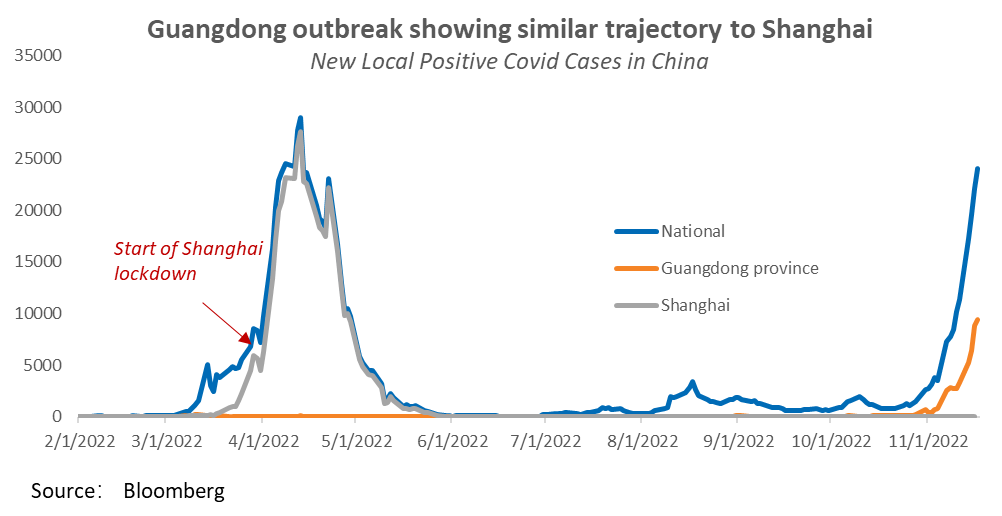
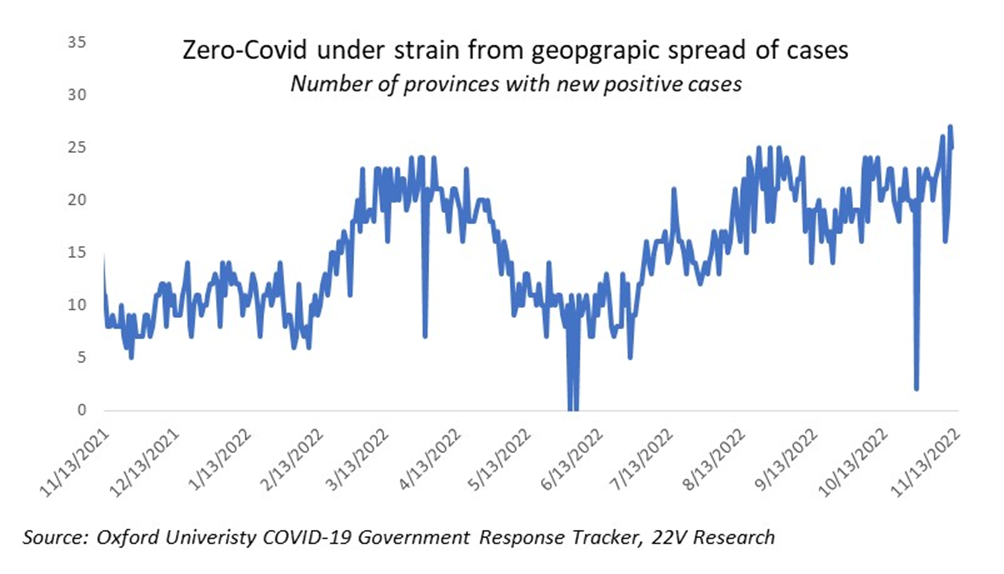
China faces its most challenging containment task to date. New daily cases are rapidly approaching the peak from April. The outbreak in Guangdong province (centered in the provincial capital of Guangzhou) looks very similar to Shanghai in April, but it is has not yet locked down to the same extent that Shanghai did. Beyond Guangdong, most provinces are experiencing at least small outbreaks, straining government capacity.
All this is happening with Covid policies in flux. China’s 11 November measures removed onerous and inefficient testing and containment measures (such as mandatory quarantines for secondary contacts). The central government has framed this move as “optimizing” and not relaxing zero-Covid. But some local governments, under heavy fiscal stress and wary of growing social discontent, have effectively started to loosen. The central government’s tolerance for these experiments is not yet fully clear, and Xi Jinping’s absence from the country (he returns from G-20/APEC meetings this weekend) may be contributing to the confusion.
Pushback and concern are building. Public health officials are warning (quietly for now) that China is not ready yet to handle a surge in cases, from relatively low elderly vaccination rates to limited ICU capacity. While many people in large cities are bristling under zero-Covid, the population has lived under protection from Covid for more than two years; there is anxiety over the disease, the possibility of a run on the medical system, and how government policies will evolve. This overall lack of preparation is indeed the key reason why we had consistently expected a gradual and very hesitant pivot beginning in March 2023. That outcome is still possible but becomes less likely with every day.
I see three main scenarios for Covid over the winter:
- Zero-Covid stays in place. This would require the leadership to roll back messages of fine-tuning and likely impose strict lockdowns in Guangzhou, Chongqing and elsewhere. Given growth in cases and exhaustion at the local level, this would take an extreme effort and impose heavy economic costs. The start of the pivot would only come in the spring.
- Transition to a mostly controlled pivot. This is the most optimistic scenario for the economy, with China taking a somewhat less draconian approach but still using testing and quarantine to flatten the curve of outbreaks and achieve relatively low rates of serious illness and death (akin to Taiwan or Japan). It would still mean a rocky winter – especially as households restrict activity as cases surge – but would put major momentum behind reopening in spring 2023.
- A chaotic pivot. This scenario would see cases surge beyond control, overwhelming quarantine and medical facilities in some parts of the country. Local policies would be a confusing patchwork, with some cities (particularly wealthy areas along the cost) coping well but others needing to impose tight restrictions. Many residents would restrict their movement, potentially leading to disruptions to supply chains as workers stay home. If the social and political pressures become intense, it could delay the timing for a more robust reopening in 2023. In all, this could be a very turbulent environment for confidence and activity, coming at a time when growth is already weak and local government finances are under pressure. Financial risks could rise significantly.
Conversations with investors lead me to think that the markets may be underpricing the probability and/or potential economic downsides of this chaotic pivot scenario. I hesitate at this point to put percentages on the scenarios, and the most likely outcome is a blend of the three:
- Some localities stay very tight this winter (especially Beijing, given its position as the capital)
- Some localities are able to successfully execute the start of a controlled pivot (Shanghai and other wealthy coastal cities); and
- Poorer provinces, and/or those with cases already beyond practical control, face a potentially chaotic situation.
At the very least I think China is headed for a difficult and uncertain winter. The next several weeks are likely to provide more visibility as to which path we are headed down, with the situation at the local level – particularly Guangzhou – as a key signpost, along with messaging from China’s leadership. We will of course be carefully tracking the dynamics and updating views in the days ahead.