SUMMARY
- News that Beijing will approve use of the BioNTech mRNA vaccine for foreigners in China is positive. It suggests eventual approval for the domestic population as early as Q1 and that Xi Jinping feels an urgency to bolster confidence in the outlook.
- However, China will likely only modestly reduce containment measures through H1 2023. H2 will see more room for loosening but containment will remain Beijing’s key line of defense until a more robust reopening in 2024.
- The result is that demand in China, including for oil, will increase in mid-2023 but remain below the pre-pandemic trend next year. An inflationary shock from China in coming quarters is unlikely.
Markets continue to whip-sawed by both signals and noise over potential shifts in China’s policies. The major development on Friday was the announcement by German Chancellor Olaf Scholz, following his meeting with General Secretary Xi Jinping in Beijing, that China will approve the use of the BioNTech vaccine for foreigners in China. Beijing has not signaled approval for the broader population, but today’s news does suggest a strong probability that it will happen in coming months. We had flagged the possibility of an announcement around Scholz’s visit in our note earlier this week (link here).
To be clear, this is a very positive development. It suggests that Xi Jinping has come around to the use of mRNA vaccines and feels an urgency to begin moving away from zero-Covid and perhaps to bolster confidence more broadly. But markets are also reacting to a flood of less solid information about China’s Covid policies, including reports that Beijing will soon announce a timeline to significantly relax containment measures after the March 2023 National People’s Congress. We remain skeptical that a major pivot will start this spring.
Our basecase (70% probability) is a modest loosening of Covid restrictions in mid-2023 but a strategy that continues to rely heavily on containment measures next year given the need to prepare the public health system and the population for a surge in cases. This will bring moderate relief to the economy in Q2 and Q3 but tightening and loosening will ebb and flow throughout next year. China will likely not be ready for a robust reopening until 2024.
BEIJING WON’T PIVOT UNTIL CHINA IS READY
Our view on China’s Covid policies rests on a few central assumptions.
(1) Xi Jinping will remain determined to avoid a major surge in serious illness and death from Covid. While he appears to be increasingly sensitive to the economic costs of Covid, public health considerations will remain the primary driver in Beijing’s decision-making.
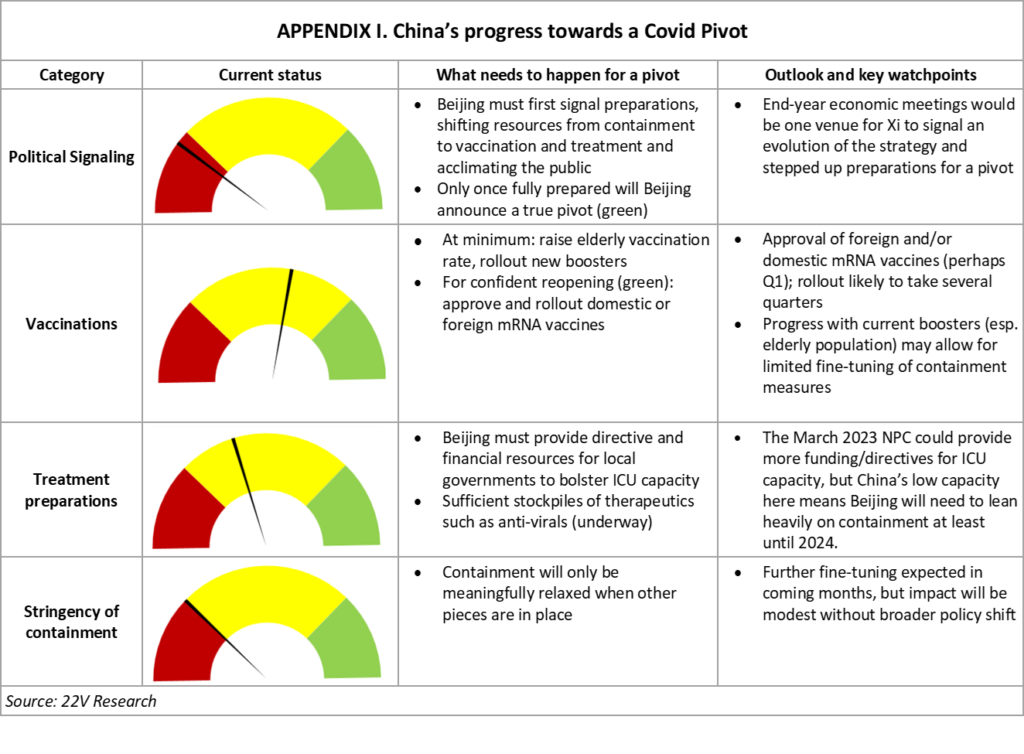
(2) China will only significantly relax containment measures when it has addressed major vulnerabilities in the two other elements of its Covid defenses – vaccination and treatment.
- Vaccines: It is likely now that China will approve the use of foreign and/or domestic mRNA vaccines in 2023 but the rollout will be gradual. Even vaccinating the population with existing inactivated vaccines has been slow; less than 70% of the elderly population has received boosters, a dangerous vulnerability for China. A key reason is vaccine hesitancy, which will almost certainly be an issue with mRNA vaccines given rumors early in the pandemic – spread in part by state media – about the risks of side effects from foreign vaccines. If we assume that China approves use of BioNTech vaccine in Q1 – still speculative – a broad swath of the population is unlikely to be covered until Q3. Beijing will likely also approve use of a domestic mRNA vaccine made by Walvax, perhaps also in Q1, though its effectiveness, particularly for the elderly, is unclear.
- Treatment: Even with mRNA vaccines, China’s thorniest challenge will be the ability of the public health system to cope with a surge in cases. The authorities are extremely worried about not only deaths from Covid but also “excess mortality” if hospitals are flooded. Taiwan, with deployment of the Moderna vaccine and a very sophisticated public health infrastructure, experienced a surge in deaths during its pivot from zero-Covid that, for China’s population, would translate to 700K deaths. This is almost certainly very conservative given China’s much larger population and weak public health infrastructure: China’s number of ICU beds per capita is one tenth the level of the US and there are vast disparities between rich provinces such as Shanghai and poorer and rural areas. Bolstering ICU capacity and the public health system will require a major increase in spending by local governments, who face tight financial constraints from China’s property downturn and whose resources are tied up in containment and testing. Preparations will likely ramp up only after the March 2023 National People’s Congress. Even then, there is no quick solution for the lack of trained personnel. Progress in preparing anti-virals and other therapeutics is more positive, with China having approved Pfizer’s Paxlovid and other treatments and local governments already building stockpiles. Overall, however, China is unlikely to feel confident in the public health system until 2024, requiring a continued reliance on containment as the first line of defense.
(3) A phased shift in signaling from Beijing will be necessary to make the preparations above and to gradually acclimate the population to rising Covid cases. Well before any pivot, China’s leadership needs to prepare the bureaucracy to shift attention from containment and testing to bolstering public health capacity and completing the vaccination campaign. China’s population has not yet experienced a major Covid wave at the national level. Without preparation from the government, citizens are likely to flood hospitals or take highly precautionary steps that damage the economy, such as staying inside for fear of getting sick or being sent to a quarantine center. There are some early indications this week that China’s state media is starting to emphasize that Covid does not present a high risk to most people, which would be a positive turn after more than two years playing up the risks of Covid and justifying intensive precautions.
One can visualize these factors as a series of gauges, where a needle moving to green indicates China is ready to pivot (see Appendix I). What matters most for the economy is when China is ready to relax containment measures. But this gauge will only get to green (full reopening) when there is more progress in the other key areas. Short of that, containment measures will be stuck in yellow.
THE OUTLOOK FOR 2023:
With this backdrop, our basecase for 2023 (70% probability) is one of mostly fine-tuning of containment policies and preparations for a more robust reopening in 2024.
Covid policies:
- China begins gradual rollout of mRNA boosters in Q1, reaching critical mass in Q3/Q4.
- Local governments shift more resources to preparing the public health system after the March 2023 NPC but progress remains slow given financial constraints and a priority on containment and testing.
- While some localities experiment with significant loosening in Q1 2023, most provinces are not ready until Q2/Q3 when vaccines and other preparations gain momentum. However, the authorities must maintain a fairly tight containment stance heading into the more infectious season in Q3/Q4 in order to avoid overwhelming the public health system.
Economic conditions:
- Overall demand in China remains depressed in Q4 2022 and Q1 2023 given no major relaxation of containment measures. Demand picks up in Q2 and Q3 due to fine-tuning but is still subdued relative to pre-pandemic levels given a continued reliance on containment policies and households starting to restrict their behavior to avoid catching Covid. For the full year, the economic climate is an improvement over 2022 but a robust recovery must wait until 2024.
- China’s demand for oil increases somewhat as international travel becomes more frequent (but still well below pre-pandemic levels) by mid-2023. Domestic travel within China also remains below pre-pandemic levels as local governments maintain or impose their own restrictions on movement to and from localities experiencing outbreaks.
Other potential scenarios:
- Upside scenario: a decisive pivot by mid-2023 is unlikely (20% probability). This would require a rapid and concerted shift in strategy and aggressive ramp up of mRNA vaccinations and preparations for public health. Such a turn is unlikely given Xi’s caution and commitment to the containment strategy, local government financial constraints, and political and bureaucratic inertia.
- Downside scenario: a hasty and uncontrolled pivot in 2023, in which China loosens restrictions before vaccinations and the public health system are ready, is even more unlikely (10% probability). This would run a high risk of forcing China to reimpose draconian tightening measures as outbreaks get out of hand, shocking activity as well as confidence.
With thanks to Houze Song and D.F. Han for their contributions to the analysis.